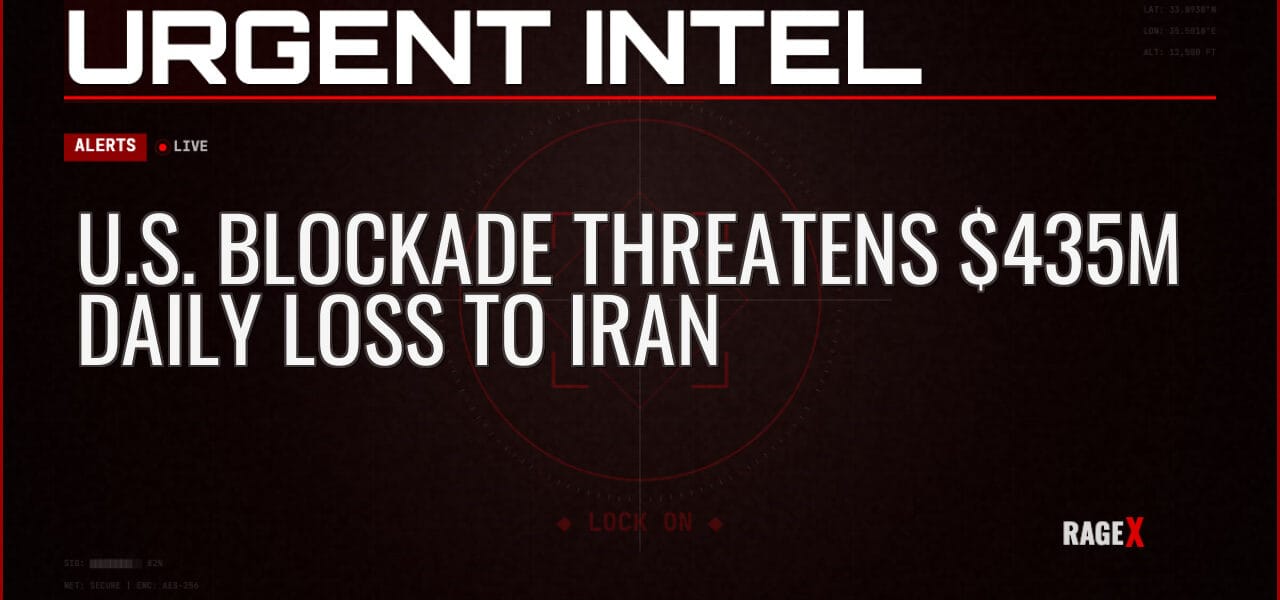
The United States naval blockade of Iranian ports is projected to inflict approximately $435 million in daily export losses, totaling roughly $13 billion monthly, as enforcement begins across the Gulf and Strait of Hormuz. The economic coercion targets Iran’s primary revenue stream even as wartime oil prices have boosted daily income to $139 million, a 37 percent increase since February.
The blockade terminates the Islamic Revolutionary Guard Corps’ lucrative “protection corridor,” which had charged vessels up to $2 million per transit in cryptocurrency for safe passage. With maritime trade severed, Iran faces cascading consequences: oil storage capacity exhaustion within thirteen days forcing production shutdowns, import disruption, food shortages, and accelerated rial collapse.
Washington’s strategy aims to achieve strategic objectives without ground invasion, leveraging economic pressure to force nuclear and regional policy concessions. However, the measure carries significant secondary risks. Global energy prices face sustained upward pressure as approximately 20 percent of world petroleum shipments remain constrained. The already fragile two-week ceasefire with Tehran appears functionally terminated.
China confronts particular vulnerability, depending on Hormuz for roughly 45 percent of Gulf oil imports. The timing—ahead of a planned Trump-Xi meeting—introduces bilateral friction into an already complex great power dynamic. Beijing’s response to Iranian economic strangulation may determine whether blockade achieves isolated pressure or triggers broader geopolitical realignment.
The daily loss calculation assumes complete enforcement success; actual impact depends on Iranian evasion attempts, third-party compliance, and blockade sustainability over extended duration.
U.S. Blockade Threatens $435M Daily Loss to Iran
U.S. naval blockade threatens Iran with $435M daily export losses and $13B monthly economic damage, halting IRGC's $2M-per-vessel crypto protection scheme. Oil storage capacity exhaustion looms within 13 days as China faces 45% Gulf import disruption ahead of Trump-Xi meeting.