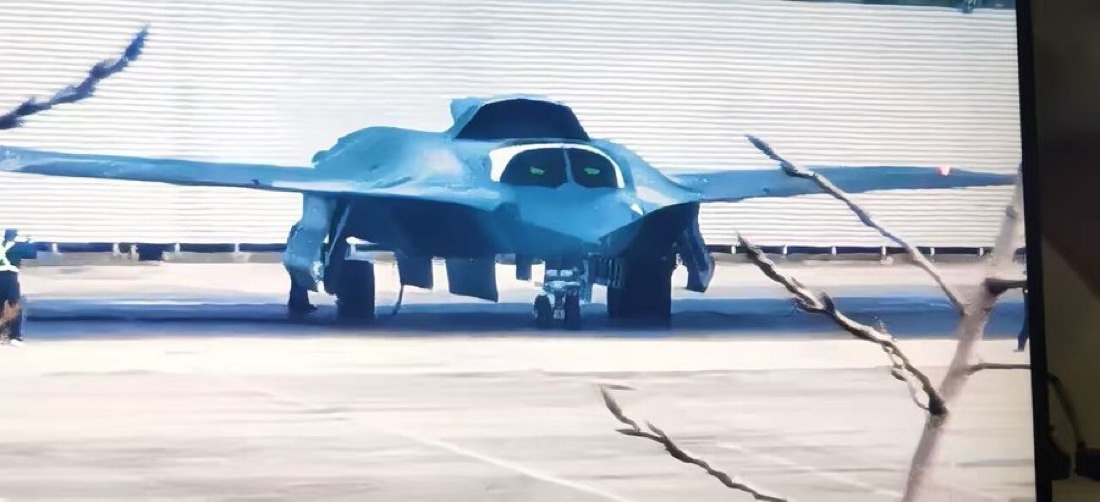

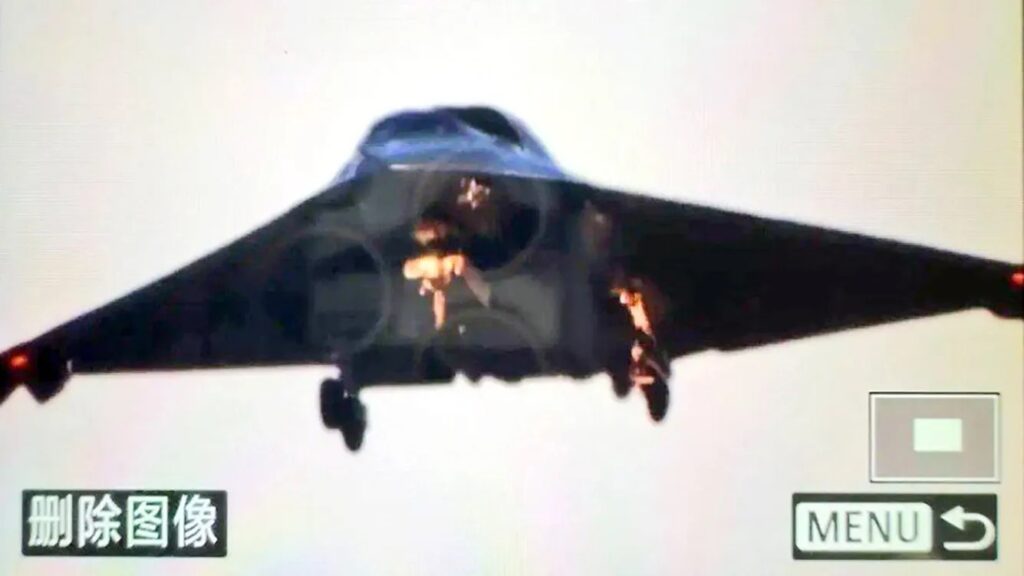
A newly leaked image of China’s elusive J-36 sixth-generation stealth jet may offer the clearest and most detailed look yet at one of the most secretive aircraft programs in the world. Captured on the ground at Chengdu Aircraft Corporation’s main plant, the image confirms long-speculated features and provides strong evidence of a powerful hybrid between a heavy fighter and tactical bomber.
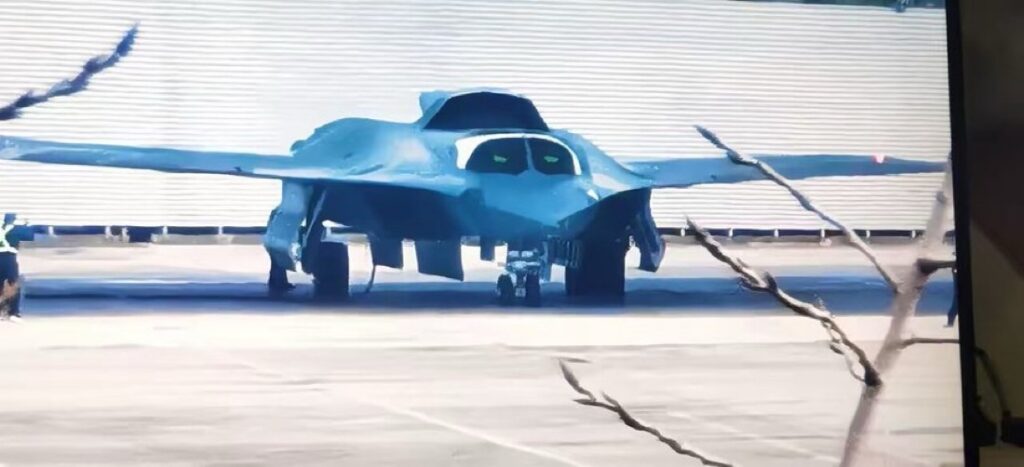
The image, reportedly taken with a long lens at low angle, shows the J-36 in a wide aircraft shelter with a distinctive white jet-blast barrier behind it—one first spotted at the Chengdu facility in December 2024. That structure, combined with visible personnel and scale, reinforces the jet’s impressive size, much larger than conventional fighters.

Side-by-Side Cockpit Confirmed
Most striking is the confirmation of a side-by-side cockpit configuration. Two distinct heads-up displays (HUDs) are visible through the canopy, aligning with previous speculation that the J-36 could serve as a crewed multi-role tactical strike platform. The configuration resembles the Su-34 or the F-111 Aardvark, with clear emphasis on long-range operation, coordination, and targeting.
Triple Internal Weapons Bays
Perhaps the most important technical revelation is the presence of three visible weapons bays:
A large central ventral bay for standoff weapons and deep strike munitions Two smaller auxiliary bays located to the sides, likely optimized for air-to-air missiles or precision-guided munitions
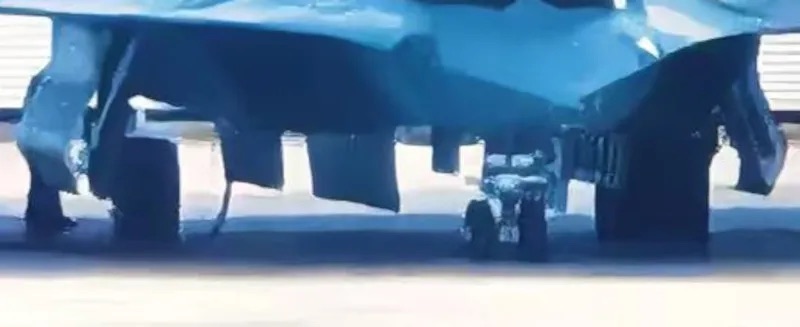
These outward-opening doors are completely separate from known landing gear bays, dispelling previous doubts and confirming the aircraft’s enormous internal volume. This layout supports previous analysis that the J-36 emphasizes range and internal loadout, possibly at the expense of magazine depth.
Electro-Optical & IR Sensor Windows
Another feature visible in this latest image includes large aperture windows near the nose, widely believed to house electro-optical or infrared targeting systems. These sensors are crucial for advanced situational awareness and passive tracking, suggesting the J-36 may also serve in a limited AWACS or ISR support role.
Air Inlet Configuration and Triple-Engine Design
The image also confirms lower trapezoidal inlets on either side of the cockpit, similar in shape to those on the F-22 Raptor, as well as a visible dorsal inlet, likely part of the aircraft’s triple-engine setup. This unusual configuration may allow for a combination of high-speed penetration, long-endurance flight, and improved redundancy.
Design Purpose: Heavy Fighter or Bomber?
The J-36 appears to blur conventional categories. With its large size, crew of two, deep internal bays, and stealth shaping, the aircraft may fill a multi-role niche akin to a “regional bomber” or long-range tactical strike fighter, possibly overlapping with past concepts like the JH-XX.
While comparisons to the U.S. B-21 or F-15EX are tempting, the J-36’s unique features and Chinese doctrinal priorities suggest a distinct role: high-endurance precision strike and air dominance, potentially extending China’s reach into the Pacific and beyond.
Strategic Analysis by RAGE X
This leak continues a trend of gradually increasing visibility into China’s advanced aerospace programs. Alongside the J-XDS/J-50, the J-36 points to a two-platform strategy for 6th-generation air combat.
If authentic, this latest image confirms China’s move into a new era of multi-role stealth platforms designed not only to evade detection but also to coordinate large-scale operations in contested airspace with minimal support.
At RAGEX.co, we decode global military advancements and bring them to light. From leaked stealth platforms like China’s J-36 to operational battlefield shifts, we cover the world’s most powerful developments in warfare, tech, and strategy. Whether it’s classified design elements or doctrine evolution, RAGE X leads the way in open-source military intelligence. Stay informed. Stay ahead. Visit www.ragex.co and follow our real-time defense updates: @rageintel