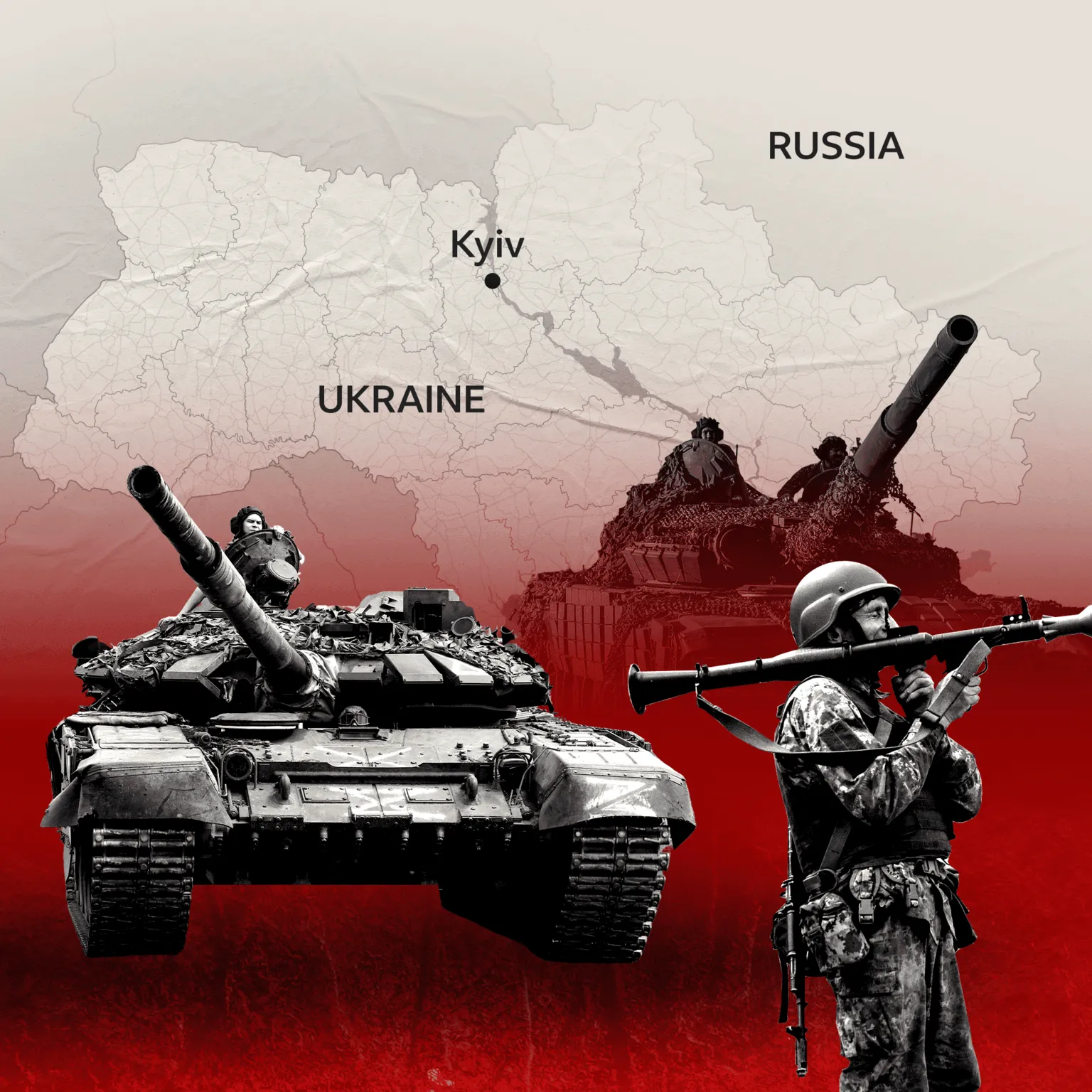

The Russia-Ukraine War: Europe’s Bloodiest Conflict Since 1945
The full-scale invasion of Ukraine by Russian forces on February 24, 2022, shattered the post-Cold War security order in Europe and triggered the continent’s largest armed conflict since World War II. What Russia’s President Vladimir Putin anticipated would be a swift military operation to topple the Ukrainian government and install a compliant regime has instead evolved into a protracted, grinding war of attrition that has claimed hundreds of thousands of lives, displaced millions, reshaped global geopolitics, and demonstrated the resilience of Ukrainian resistance against a numerically superior adversary. As the war continues into 2025, understanding its origins, evolution, and implications remains crucial for comprehending contemporary international relations and the future of European security.
Historical Roots: Ukraine Between East and West
To understand the Russia-Ukraine war, one must first grasp the complex historical relationship between these two nations. Ukraine’s identity has been shaped by centuries of contested sovereignty, foreign domination, and cultural intersection between Eastern and Western European traditions. For much of its history, Ukrainian territories were divided among various empires, including the Polish-Lithuanian Commonwealth, the Austro-Hungarian Empire, and most significantly, the Russian Empire.
The Soviet period fundamentally shaped modern Ukrainian-Russian relations. Ukraine became a founding republic of the Soviet Union in 1922, and its fate became intertwined with Moscow’s for seven decades. The Soviet era brought industrialization, forced collectivization that resulted in the devastating Holodomor famine of 1932-1933 that killed millions of Ukrainians, and significant Russian migration into Ukrainian cities, particularly in the eastern regions. This complex legacy created a Ukraine that was linguistically, culturally, and politically diverse, with western regions generally more oriented toward Europe and Ukrainian national identity, while eastern and southern regions maintained closer linguistic and cultural ties to Russia.
Ukraine’s independence in 1991 following the Soviet collapse was initially accepted by Russia, but tensions emerged over subsequent decades. Russia struggled to accept Ukraine as a truly independent nation with the sovereign right to choose its own geopolitical orientation. For many Russian leaders and citizens, Ukraine was viewed not as a separate nation but as an integral part of the “Russian world” – a civilizational concept that transcends state borders to encompass all Russian-speaking peoples and territories historically connected to Russia.
The Orange Revolution of 2004, when mass protests overturned a fraudulent election victory by the pro-Russian candidate Viktor Yanukovych, marked a critical turning point. For the first time, Ukrainians demonstrated their capacity for collective political action to defend democratic principles against Russian interference. This development alarmed Moscow, which saw Ukraine’s potential integration into Western institutions as a strategic threat.
The Euromaidan Revolution of 2013-2014 proved even more consequential. When President Yanukovych, under Russian pressure, abandoned plans to sign an association agreement with the European Union, massive protests erupted in Kyiv. The movement, which became known as the Revolution of Dignity, ultimately forced Yanukovych to flee to Russia. Moscow’s response was swift and aggressive: Russian forces seized and annexed Crimea in March 2014, while Russian-backed separatists launched rebellions in Ukraine’s Donetsk and Luhansk regions, beginning a conflict that would claim over 14,000 lives before the 2022 invasion.
Putin’s Calculations: Ideology, Security, and Imperial Ambition
Vladimir Putin’s decision to launch a full-scale invasion of Ukraine in February 2022 reflected a convergence of ideological beliefs, perceived security threats, and imperial ambitions. Putin’s worldview, articulated in numerous speeches and essays, fundamentally rejects Ukrainian national identity as distinct from Russian identity. In his infamous July 2021 essay “On the Historical Unity of Russians and Ukrainians,” Putin argued that Russians and Ukrainians are “one people” artificially divided by malevolent external forces.
From a security perspective, Putin has consistently portrayed NATO expansion as an existential threat to Russia. Ukraine’s growing cooperation with NATO and aspirations toward eventual membership represented, in Moscow’s view, an unacceptable Western encroachment on Russia’s sphere of influence. The Kremlin’s narrative framed the invasion as a defensive operation to prevent Ukraine from becoming a platform for Western aggression against Russia.
However, the invasion also reflected broader imperial ambitions. Putin has never reconciled himself to the Soviet Union’s dissolution, calling it “the greatest geopolitical catastrophe of the twentieth century.” Restoring Russian dominance over former Soviet territories, particularly Ukraine, appears central to his vision of making Russia a great power once again. The invasion represented an attempt to reverse what Putin viewed as the humiliating retreat of Russian power since 1991.
Putin’s calculations also reflected a catastrophic misreading of Ukrainian society and military capabilities. Russian planning assumed that Ukrainian resistance would be minimal, that President Volodymyr Zelenskyy’s government would quickly collapse, and that many Ukrainians, particularly in Russian-speaking regions, would welcome Russian forces as liberators. These assumptions proved disastrously wrong.
The Invasion: From Blitzkrieg to Stalemate
The Russian invasion began in the early morning hours of February 24, 2022, with missile strikes across Ukraine followed by ground incursions from multiple directions. Russian forces advanced from Belarus toward Kyiv, from Russia toward Kharkiv, and from Crimea toward southern Ukraine. The operation aimed for rapid seizure of Ukraine’s capital and decapitation of its government.
The initial phase of the invasion showcased stunning Russian military failures. Logistics proved catastrophic, with Russian columns running out of fuel and supplies. Ukrainian forces, bolstered by Western intelligence and anti-tank weapons, inflicted heavy casualties on exposed Russian units. The attempted seizure of Hostomel Airport, intended to enable airborne forces to capture Kyiv, failed. Rather than fleeing, President Zelenskyy remained in Kyiv, rallying Ukrainian resistance with the defiant declaration: “I need ammunition, not a ride.”
By early April 2022, the Battle of Kyiv had become a humiliating defeat for Russia. Unable to capture the capital and suffering unsustainable losses, Russian forces withdrew from northern Ukraine entirely, leaving behind evidence of atrocities in places like Bucha that shocked the world. The invasion that was supposed to last days had failed in its primary objective.
Russia then refocused on eastern and southern Ukraine, aiming to create a land bridge from Russia to Crimea and capture the entire Donbas region. This phase became a grinding artillery war, with Russian forces slowly advancing through massive firepower superiority despite continuing heavy losses. By summer 2022, Russia had captured Mariupol after a devastating siege and occupied significant additional territory in eastern Ukraine.
Ukrainian counteroffensives in autumn 2022 demonstrated Kyiv’s growing capabilities. Ukrainian forces recaptured the entire Kharkiv region in a stunning breakthrough operation, then liberated the strategic city of Kherson in the south. These successes showed that Ukraine could not only defend but also conduct complex offensive operations.
The much-anticipated Ukrainian counteroffensive of summer 2023, however, failed to achieve its objectives. Despite months of preparation and significant Western military aid, Ukrainian forces made only modest territorial gains against formidable Russian defensive fortifications, extensive minefields, and concentrated firepower. The failure of this offensive marked a transition to positional warfare reminiscent of World War I, with both sides unable to achieve decisive breakthroughs.
The War in 2025: Grinding Attrition and Uncertain Prospects
As of 2025, Russian troops occupy approximately 20% of Ukraine, and the conflict has settled into a brutal war of attrition with no clear end in sight. Recent reports indicate Russian forces continue making territorial gains, though at fluctuating rates and with enormous casualties. Russia is projected to reach the grim milestone of one million casualties by summer 2025, a staggering toll that reflects the war’s brutality and Russia’s willingness to accept catastrophic losses.
The battlefield dynamics in 2025 are characterized by several key features. Both sides have adapted to a technologically complex battlefield where drones, electronic warfare, precision artillery, and extensive fortifications define the fighting. Ukrainian forces continue to conduct deep strikes against Russian logistics, command centers, and military infrastructure using Western-supplied systems and increasingly sophisticated Ukrainian-developed weapons. Meanwhile, Russia maintains advantages in artillery ammunition, manpower, and its ability to sustain industrial production under wartime conditions.
The nature of the fighting has evolved significantly since the war’s opening phases. Static defensive positions, extensive trench networks, and massive minefields have created conditions resembling the Western Front of World War I, but with 21st-century weapons. Breaking through prepared defenses has proven extraordinarily difficult for both sides, resulting in incremental territorial changes achieved at enormous cost.
Ukrainian cities continue to endure regular bombardment. Russia has launched attacks with hundreds of kamikaze drones hitting residential buildings in Kyiv, demonstrating Moscow’s strategy of targeting civilian infrastructure and morale. These attacks on energy facilities, residential areas, and critical infrastructure represent attempts to break Ukrainian will to resist, though they have generally strengthened rather than weakened Ukrainian resolve.
International Dimensions: Western Support and Global Realignment
The war has fundamentally reshaped international relations, creating new divisions and alliances that will define geopolitics for years to come. Western response to the invasion has been multifaceted, combining unprecedented economic sanctions against Russia, massive military aid to Ukraine, and political support for Ukrainian sovereignty and territorial integrity.
Economic sanctions against Russia have been comprehensive, targeting its financial system, energy exports, technology imports, and individual oligarchs and officials. While these sanctions have damaged the Russian economy, they have not forced Moscow to alter its war objectives. Russia has adapted through import substitution, strengthened economic ties with China and India, and found alternative markets for its energy exports, albeit at discounted prices.
Western military aid to Ukraine has been transformative. What began with anti-tank missiles and body armor has evolved to include advanced air defense systems, long-range precision artillery, main battle tanks, and F-16 fighter aircraft. This aid has enabled Ukraine to defend itself against a much larger adversary, though debates continue about the pace and scope of weapons deliveries. Western nations have walked a careful line, providing enough support to prevent Ukrainian defeat while avoiding direct confrontation with nuclear-armed Russia.
In 2025, international support continues with various initiatives, including EU technological cooperation programs and continued aid discussions, though political dynamics in supporting countries have evolved as the war drags on. The sustainability of Western support faces challenges from war fatigue, competing priorities, and political changes in supporting nations.
China’s position has proven particularly significant. While Beijing has not provided direct military aid to Russia, it has strengthened economic ties that help Moscow withstand Western sanctions. China’s refusal to condemn the invasion and its rhetorical support for Russian security concerns have signaled a degree of solidarity that concerns Western capitals. The Russia-China partnership, described as having “no limits” shortly before the invasion, represents a major geopolitical realignment with implications extending far beyond Ukraine.
India has maintained a complex balancing act, significantly increasing its purchases of Russian oil while strengthening security partnerships with the United States and other democracies. This positioning reflects India’s desire to maintain strategic autonomy while benefiting economically from discounted Russian energy.
The Global South has generally avoided taking strong positions on the war, with many nations abstaining on UN votes condemning Russia. This reflects resentment of Western dominance, practical economic interests, and historical ties to Russia. The war has exposed divisions within the international system that transcend the immediate conflict.
Humanitarian Catastrophe: The Human Cost
The human toll of the war defies easy comprehension. About 8 million Ukrainians have been internally displaced and more than 8.2 million have fled the country, creating Europe’s largest refugee crisis since World War II. Casualties on both sides number in the hundreds of thousands, with precise figures difficult to determine given the fog of war and incentives for both sides to manipulate casualty reporting.
Civilian suffering has been immense. Russian bombardment has destroyed entire cities, with places like Mariupol reduced to rubble. Thousands of civilians have been killed, with many more wounded. Reports of war crimes, including torture, summary executions, sexual violence, and deportation of Ukrainian children to Russia, have emerged throughout the war. The International Criminal Court has issued arrest warrants for Putin and other Russian officials for war crimes, though enforcement remains impossible while they remain in Russia.
The psychological trauma affecting Ukrainian society will persist for generations. Children have grown up under air raid sirens, millions have been forced from their homes, and families have been torn apart. The experience of resistance and survival has forged a stronger Ukrainian national identity, but at an incalculable human cost.
Economic destruction has been equally severe. Ukraine’s economy contracted massively in 2022, though it has shown resilience in subsequent years. Infrastructure destruction will require hundreds of billions of dollars to repair. Agricultural production, critical to both Ukraine and global food security, has been disrupted by fighting and Russian blockades of grain exports, though international agreements have enabled some shipments to continue.
Nuclear Dimensions: The Shadow of Escalation
The Russia-Ukraine war represents the first major conflict between nuclear-armed powers since the Cold War’s end, adding a dangerous dimension of potential escalation. Russia has repeatedly engaged in nuclear saber-rattling, with Putin and other officials making veiled threats about nuclear weapons use if Russia faces existential threats.
The seizure of the Zaporizhzhia Nuclear Power Plant by Russian forces created unprecedented risks of nuclear accident in a war zone. Fighting around Europe’s largest nuclear facility raised fears of radiation release that could affect millions of people across multiple countries. International efforts to ensure safety at the plant have been partially successful, but the situation remains precarious.
Western nations have carefully calibrated their support for Ukraine to avoid triggering Russian nuclear escalation. This has led to debates about “escalation management” – providing enough support for Ukrainian defense while avoiding actions Moscow might view as justifying nuclear response. These calculations have sometimes resulted in delayed or restricted weapons deliveries, frustrating Ukrainian officials who argue that excessive caution enables Russian aggression.
The nuclear dimension also affects broader international security. The war has shattered assumptions about nuclear powers respecting the territorial integrity of states that surrendered nuclear weapons. Ukraine gave up the world’s third-largest nuclear arsenal in 1994 under the Budapest Memorandum, receiving security assurances from Russia, the United States, and United Kingdom. Russia’s violation of these assurances has profound implications for nuclear nonproliferation, potentially encouraging other nations to acquire or retain nuclear weapons rather than trusting international guarantees.
Information Warfare and Narratives
The Russia-Ukraine war has been fought not only on physical battlefields but also in the information space. Both sides have deployed sophisticated propaganda and information operations to shape domestic and international perceptions.
Russia has promoted narratives portraying the invasion as a defensive operation against NATO aggression, liberation of Russian speakers from Ukrainian oppression, and a fight against fascism and Western decadence. These narratives, amplified through state media and social media manipulation, aim to maintain domestic support and divide Western opinion.
Ukraine has demonstrated remarkable effectiveness in information warfare. President Zelenskyy’s video addresses, which combine emotional appeals with concrete information, have rallied international support and maintained Ukrainian morale. Ukraine has also been transparent about its challenges while highlighting Russian atrocities and Ukrainian resilience.
Social media has played an unprecedented role, with combat footage, civilian testimonies, and real-time battle updates shaping public understanding. This transparency has helped Ukraine maintain international support but has also created challenges in managing operational security.
Disinformation has proliferated on both sides, with false flag operations, fabricated atrocities, and misleading military claims complicating accurate understanding of events. Western nations have devoted significant resources to countering Russian disinformation while supporting Ukrainian information efforts.
Military Lessons and Tactical Evolution
The war has provided crucial lessons for military strategists worldwide. The failure of Russia’s initial invasion demonstrated the limits of conventional military superiority when facing determined resistance, difficult terrain, and modern anti-tank weapons. Small, well-trained Ukrainian units equipped with Javelin and NLAW missiles destroyed hundreds of Russian armored vehicles, showing that expensive tanks remain vulnerable to relatively cheap precision weapons operated by skilled soldiers.
Drones have emerged as transformative weapons. Small commercial drones modified to drop grenades, sophisticated attack drones like the Turkish TB2 Bayraktar, and long-range strike drones have changed battlefield dynamics. Both sides use drones extensively for reconnaissance, targeting, and direct attacks. The war has accelerated drone development and tactics that will influence future conflicts globally.
Artillery remains the dominant killer on the battlefield. Both sides have fired millions of shells, with artillery causing the majority of casualties. Control of ammunition supplies has proven critical, with Ukraine dependent on Western production while Russia leverages its larger industrial base despite quality limitations.
Air defense has proven more effective than many analysts expected. Neither side has achieved air superiority, with sophisticated air defense systems preventing the kind of air dominance that has characterized recent Western military operations. This has forced both sides to fight primarily as ground wars with limited air support.
Urban warfare has shown its defensive advantages and humanitarian costs. Cities like Mariupol, Bakhmut, and Avdiivka became sites of brutal fighting where defenders could inflict heavy casualties on attackers but only by accepting massive civilian suffering and infrastructure destruction.
Economic Warfare: Sanctions and Energy Geopolitics
The war has weaponized economic interdependence in unprecedented ways. Western sanctions against Russia represent the most comprehensive economic warfare campaign in modern history, targeting Russian banks, oil and gas exports, technology imports, and personal assets of Russian elites.
Energy has been a crucial battlefield. Russia attempted to leverage European dependence on its natural gas to divide Western support for Ukraine, cutting supplies to pressure nations to reduce aid. However, this strategy largely backfired. European nations successfully reduced Russian gas imports through emergency measures including increased liquefied natural gas imports, energy conservation, and accelerated renewable energy development. While expensive and disruptive, Europe proved its energy dependence on Russia was not an unbreakable constraint.
Russia has reoriented its energy exports toward Asia, particularly China and India, though at discounted prices that reduce revenue. The long-term impact on Russia’s energy sector remains uncertain, as redirecting infrastructure built for European markets to Asian customers requires massive investment and accepts Russia’s position as a junior partner to China.
Sanctions have forced Russia toward economic autarky and increased reliance on China. While Russia has shown more resilience than many expected, largely due to high energy prices in 2022 and adapting to sanctions, its long-term economic prospects have deteriorated significantly. Cut off from Western technology and investment, Russia faces declining living standards and reduced capacity for innovation.
Domestic Politics: War and Society
The war has transformed both Russian and Ukrainian societies in profound ways. In Ukraine, the conflict has accelerated national consolidation. Regional, linguistic, and political divisions that characterized pre-war Ukraine have been largely transcended by shared resistance to Russian aggression. Russian-speaking Ukrainians have proven among the fiercest defenders of Ukrainian independence, demolishing Putin’s assumption that language determined political loyalty.
Ukrainian civil society has demonstrated remarkable resilience and initiative. Volunteer networks provide humanitarian aid, support military units, and maintain civilian morale. The experience of collective resistance has created a stronger sense of national identity and civic solidarity that will shape Ukraine’s future.
In Russia, the war’s domestic impact has been complex. Putin has intensified authoritarian controls, crushing dissent and independent media. Laws criminalizing criticism of the military have silenced opposition voices. However, maintaining public support for the war has required avoiding full mobilization of Russian society. After partial mobilization in fall 2022 triggered social unrest and mass emigration, the Kremlin has relied on volunteers, convicts, and economic incentives to fill military ranks while avoiding another general mobilization that might threaten regime stability.
The Russian economy has shifted toward war production, with massive military spending crowding out civilian investment. This reorientation may be sustainable short-term but threatens long-term economic development and living standards.
Future Scenarios: Paths Forward
As the war continues into 2025, several potential scenarios for its conclusion or continuation can be envisioned, each with profound implications for regional and global security.
Continued stalemate appears most likely in the near term. Neither side currently possesses the capability to achieve decisive military victory, but neither is willing to accept terms the other finds acceptable. This could result in a frozen conflict lasting years or decades, with periodic escalations but no final resolution.
Ukrainian military victory – defined as restoration of 1991 borders including Crimea – remains theoretically possible but would require sustained massive Western military support, Russian internal collapse, or unexpected battlefield breakthroughs. Each of these seems unlikely in the immediate future, though longer-term Russian weakness could create opportunities.
Negotiated settlement would require both sides to compromise on fundamental positions. Russia would need to abandon territorial conquests or accept Ukraine’s NATO/EU integration, while Ukraine would need to accept territorial losses or neutrality guarantees. Neither side currently shows willingness for such compromises, though changing battlefield conditions or domestic politics could alter calculations.
Russian military victory through conquest of Ukraine appears extremely unlikely given Ukrainian resistance and Western support, but Russian could potentially consolidate control over currently occupied territories while maintaining pressure on remaining Ukrainian-controlled areas.
Escalation to broader war remains possible, though both sides and their supporters have incentives to avoid such an outcome. Accidental or intentional attacks on NATO territory, use of weapons of mass destruction, or Russian attacks on Western supply lines could trigger escalation with catastrophic consequences.
Internal political change in Russia, whether through Putin’s death, coup, or popular uprising, could dramatically alter the war’s trajectory. However, such changes are inherently unpredictable and might lead to either peace negotiations or more extreme nationalism.
Conclusion: A War That Changed Everything
The Russia-Ukraine war represents a watershed moment in post-Cold War history, shattering assumptions about European security, international order, and the obsolescence of large-scale conventional warfare. Putin’s invasion aimed to subordinate Ukraine and restore Russian imperial influence, but has instead strengthened Ukrainian national identity, revitalized NATO, and demonstrated the limits of authoritarian military power against determined democratic resistance.
The war’s costs have been staggering. Hundreds of thousands dead, millions displaced, cities destroyed, economies shattered, and security architecture collapsed. Yet Ukraine survives as an independent state, confounding predictions of its rapid defeat and demonstrating that national will and Western support can counter conventional military superiority.
For the international system, the war has ended illusions of post-Cold War convergence and renewed great power competition. It has fractured global governance, weaponized economic interdependence, and raised nuclear risks. The war has also exposed Western vulnerabilities in defense production, revealed the Global South’s desire for strategic autonomy, and demonstrated the resilience of authoritarian regimes facing international isolation.
As fighting continues, fundamental questions remain unanswered. Can Ukraine sustain its resistance and eventually prevail? Can Russia achieve any meaningful strategic objectives? Will the West maintain support for Ukraine despite mounting costs? Can nuclear escalation be avoided? How will the war ultimately end?
What seems clear is that the Russia-Ukraine war will define European and global security for years to come. Its outcome will determine whether the post-1945 prohibition on conquest by force retains meaning, whether democracy or authoritarianism appears ascendant, and whether international institutions can enforce peace or merely observe its violation. For Ukraine, Russia, Europe, and the world, the stakes could hardly be higher. The war that was supposed to last days has become a defining conflict of the twenty-first century, with consequences that will reverberate long after the guns fall silent.