
U.S. President Donald Trump accused Iran of spreading disinformation using artificial intelligence and media manipulation, claiming the country is attempting to exaggerate its military capabilities during the ongoing conflict.
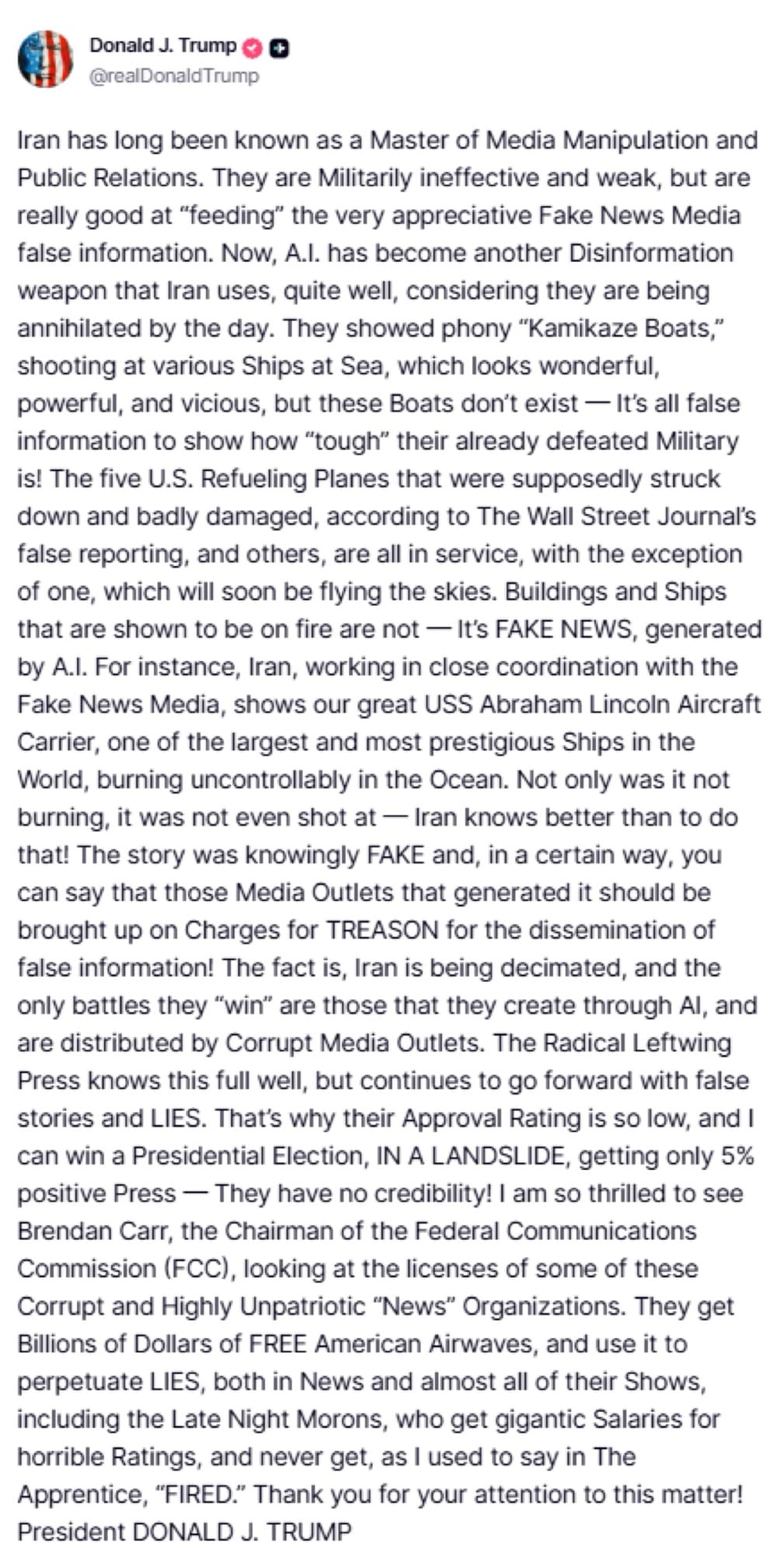
Trump said Iran has long relied on media manipulation and public relations tactics to shape global narratives, but argued that recent efforts have increasingly relied on AI-generated imagery and misinformation distributed online.
According to Trump, Iranian sources have circulated images and videos showing alleged attacks by “kamikaze boats” targeting ships at sea, which he claimed are fabricated.
“They showed phony ‘kamikaze boats’ shooting at ships, but those boats don’t exist,” Trump said, describing the images as false information designed to portray Iran’s military as stronger than it is.
Trump also criticized media reports suggesting that multiple U.S. refueling aircraft had been destroyed, saying the claims were inaccurate.
He said that five U.S. aerial refueling planes reportedly damaged in earlier reports are largely still operational, with only one aircraft temporarily out of service.
The president also dismissed online claims showing the USS Abraham Lincoln aircraft carrier on fire, calling the images fabricated and part of a broader disinformation campaign.
“Not only was it not burning, it was not even shot at,” Trump said, adding that the images were AI-generated and intended to mislead audiences about the conflict.
Trump argued that Iran is attempting to create the appearance of military success through manipulated media, even as the country faces heavy losses in the ongoing war.
“The only battles they win are the ones they create through AI,” he said.
The president also directed criticism toward several media outlets, accusing parts of the press of amplifying unverified or misleading information about the war.
He claimed that some reports about the conflict were based on manipulated content or inaccurate intelligence, which he said contributed to confusion about the actual situation on the battlefield.
Trump further suggested that federal regulators should review broadcast licenses for media organizations that repeatedly publish false information, referencing ongoing discussions about media accountability.
He praised Federal Communications Commission Chairman Brendan Carr for examining whether certain broadcasters are complying with regulations governing the use of public airwaves.
According to Trump, media organizations that operate using U.S. broadcast frequencies have a responsibility to provide accurate reporting, particularly during periods of international conflict.
The comments reflect the growing role of information warfare and digital propaganda in modern conflicts, where both governments and non-state actors use online platforms and advanced technology to influence public perception.
Analysts say the use of AI-generated imagery, manipulated videos, and coordinated online messaging has become a key feature of contemporary geopolitical disputes.
Trump’s remarks come as the conflict between the United States, Israel, and Iran continues to unfold, with both military operations and information campaigns playing a significant role in shaping the global narrative around the war.