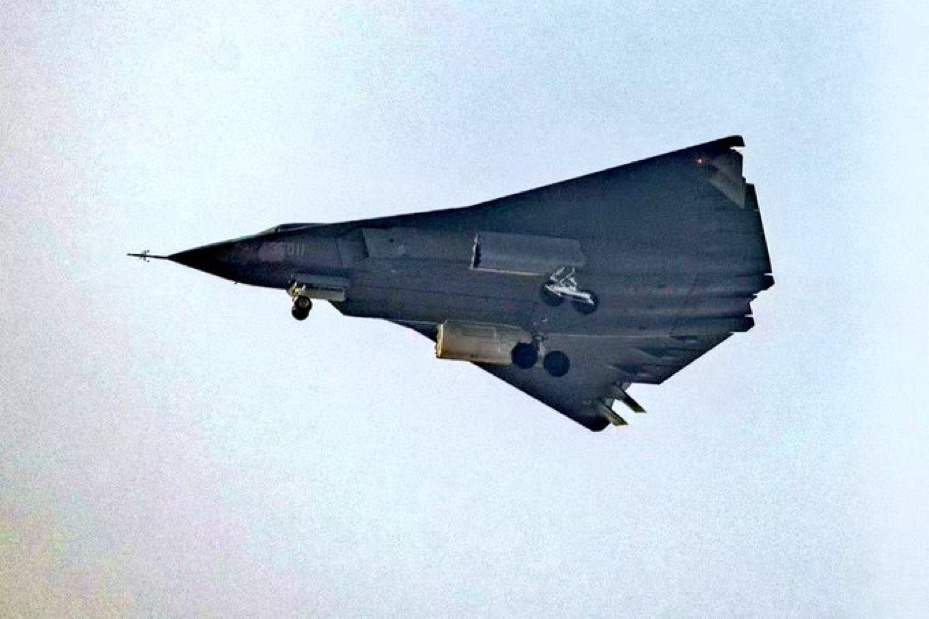
The aircraft designated by analysts as the Chengdu J-36 is the most visible evidence of China’s accelerated path toward a sixth-generation air combat capability. Spotted in prototype flight trials near the Chengdu Aircraft Corporation (CAC) facility since late 2024, the J-36—nicknamed the “Ginkgo Leaf”—is a heavy, long-range platform that deviates radically from current fifth-generation designs. Its mere existence signals a calculated challenge to Western air dominance and systems like the US Next Generation Air Dominance (NGAD) program.

***
Radical Tailless Design and Tri-Jet Configuration
The J-36 is defined by two revolutionary characteristics. First is its tailless flying-wing design, featuring a voluminous, double-delta airframe. The absence of traditional vertical and horizontal stabilizers is a move toward maximizing broadband stealth, minimizing its Radar Cross-Section (RCS) from all angles, a crucial feature for deep-penetration strike missions. Its low-speed control relies on advanced fly-by-wire systems manipulating split ruddervons on the wing trailing edges, compensating for the inherent instability of the tailless planform.
Second is the unique tri-jet engine arrangement. The aircraft features two side-mounted intakes and one dorsal intake, feeding three engines (speculated to be high-thrust WS-15 or WS-19 variants). This configuration suggests a primary emphasis on supercruise (sustained supersonic flight without afterburners) and generating tremendous electrical power. This power is essential not just for high speed and range (estimated at up to 3,000 km combat radius) but for next-generation systems like directed-energy weapons and sophisticated Electronic Warfare (EW) suites.
***
The Role of a Networked Strike Commander
The J-36 is not designed as a pure dogfighter but as a heavy strike and command platform. Evidence suggests a wide, possibly side-by-side, two-seat cockpit, which is typical for long-range fighter-bombers or “battle manager” roles. Its expected mission set is centered on Manned-Unmanned Teaming (MUM-T). The crewed J-36 would operate as a resilient, stealthy command node, coordinating swarms of uncrewed aerial vehicles (UAVs) to conduct ISR, jamming, and decoy missions in highly contested airspace.
Its armament capacity reinforces this strike role. Analysts have observed three internal weapons bays: a large central bay capable of carrying long-range munitions like the PL-17 Beyond-Visual-Range Air-to-Air Missile (BVRAAM), flanked by two smaller bays for other air-to-air or air-to-surface munitions. This substantial internal payload preserves its low-observable profile while offering versatile, multi-domain strike capability.
***
Accelerated Iteration and Global Signaling
The J-36 program is moving at a rapid, iterative pace. Following its initial flight in late 2024, images of a second prototype emerged in late 2025 showing significant modifications, including changes to the landing gear, air inlets, and three angular exhaust nozzles that suggest some form of thrust vectoring. These immediate refinements indicate China is using an aggressive, iterative design scheme common in digital engineering, aiming to accelerate the path to a production-ready platform. The continued public sightings of the J-36 are widely interpreted as strategic signaling, confirming China’s lead in developing next-generation operational platforms, potentially reaching Initial Operational Capability (IOC) earlier than its Western rivals.