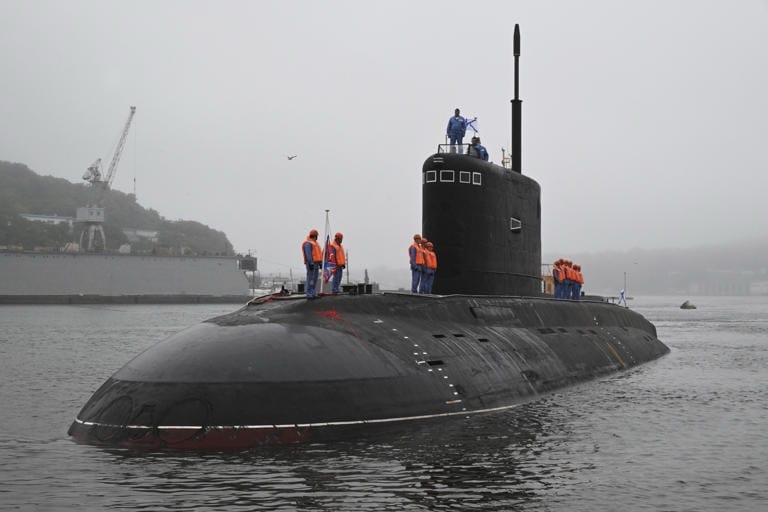

In a watershed moment for naval warfare, the Security Service of Ukraine (SBU) has released footage claiming the first successful combat use of an underwater drone against a submarine. The attack, which took place in the Russian Black Sea port of Novorossiysk, reportedly targeted a Kilo-class diesel-electric attack submarine, inflicting critical damage that has effectively removed the vessel from the Russian Navy’s operational fleet.
The operation, executed jointly by the SBU’s 13th Main Directorate of Military Counterintelligence and the Ukrainian Navy, utilized a new iteration of the “Sea Baby” maritime drone, now modified for subsurface capabilities. Dubbed the “Sub Sea Baby,” these unmanned surface vehicles (USVs) have evolved from surface skimmers to submersibles capable of bypassing traditional surface defenses.

According to SBU reports released on Monday, December 15, 2025, the target was a Project 636.3 Varshavyanka-class submarine. Known by its NATO reporting name as the “Improved Kilo,” this class is often referred to as the “Black Hole” due to its acoustic stealth capabilities. The specific vessel struck was a key asset in Russia’s Black Sea Fleet, equipped with four launch tubes capable of firing Kalibr cruise missiles—weapons frequently used to target Ukrainian civilian infrastructure.
SBU officials stated that the submarine was docked in Novorossiysk at the time of the strike. This location is significant; the Russian fleet had largely retreated to Novorossiysk from its traditional headquarters in Sevastopol, Crimea, specifically to escape the reach of Ukrainian surface drones. The success of this underwater strike suggests that even these rear-area sanctuaries are no longer safe. The footage released by the SBU shows a massive explosion rocking the port, followed by secondary detonations consistent with a hull breach.
The financial and strategic cost to Russia is substantial. The SBU estimates the value of the submarine at approximately $400 million. However, given the tightening grip of international sanctions on high-tech military components, the replacement cost could soar to over $500 million, with a construction timeline stretching over years. “The explosion caused critical damage… the boat was actually put out of action,” the SBU confirmed in a Telegram statement.
This incident marks a historic evolution in asymmetric naval warfare. While surface drones have claimed several Russian surface ships over the past two years, hitting a submarine—specifically one designed for stealth—demonstrates a leap in Ukrainian guidance and targeting technology. It forces the Russian command to reconsider the security of its entire maritime logistics chain, as the threat now emanates from below the waterline as well as above it.
As of Monday evening, the Russian Ministry of Defense has not officially commented on the loss, though local social media channels in Novorossiysk reported hearing loud explosions and seeing emergency services rushing to the naval piers.