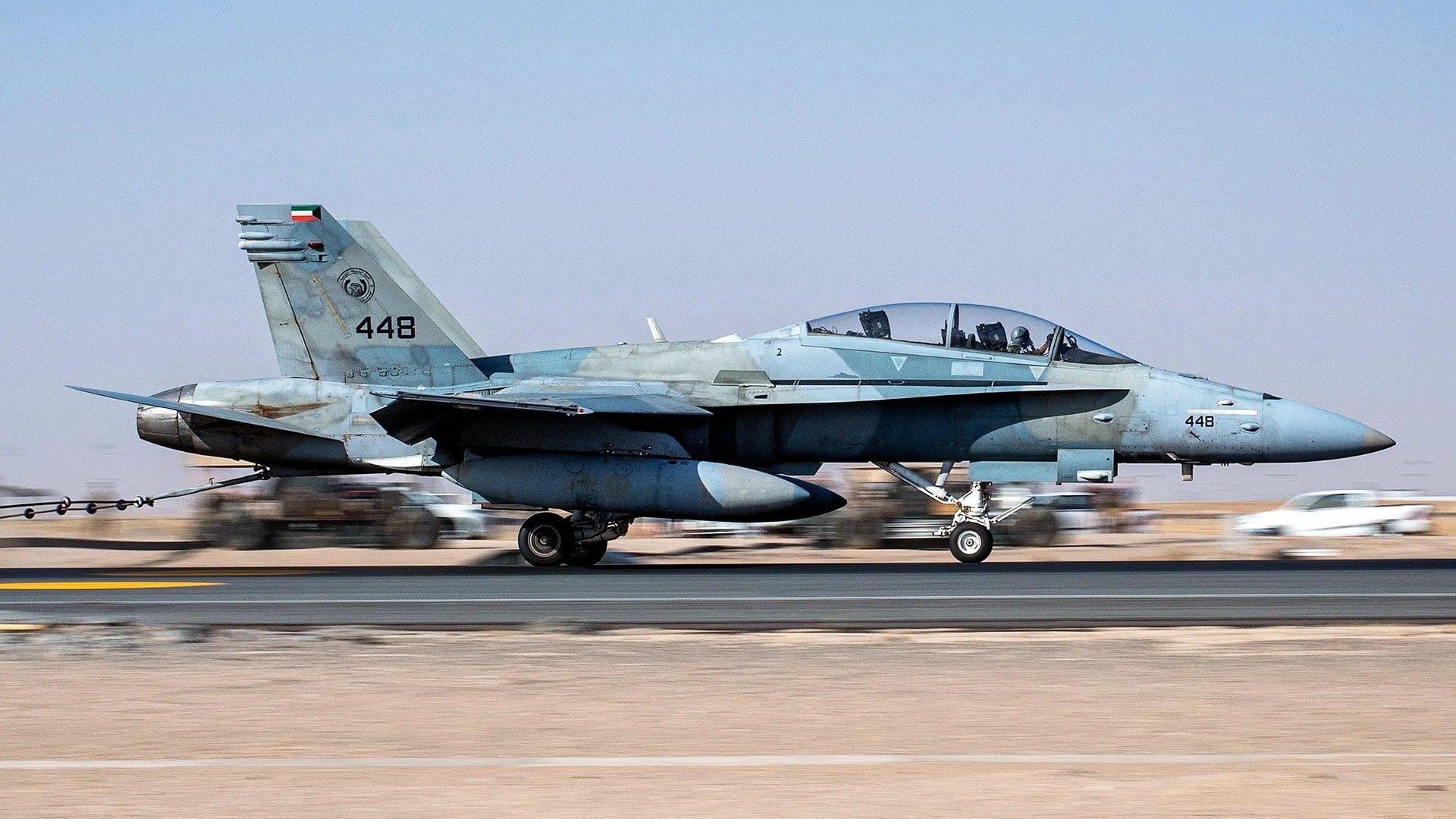

The “fog of war” hanging over the Middle East has resulted in one of the most astonishing friendly-fire incidents in modern aviation history. Following the initial confusion surrounding the loss of three American fighter jets over the Persian Gulf, preliminary investigations have revealed a staggering reality: a single Kuwaiti F/A-18 Hornet accidentally shot down three U.S. F-15E Strike Eagles during an intense aerial engagement.
A Chaotic Sky Over Kuwait
The catastrophic incident occurred as allied forces scrambled to intercept a massive saturation attack launched by the remnants of the Iranian military. The skies above Kuwait were heavily congested with a chaotic mix of incoming Iranian suicide drones, ballistic missiles, and dozens of overlapping allied interceptors trying desperately to protect the airspace.
Operating in this deeply saturated environment, a lone Kuwaiti Air Force F/A-18 Hornet was engaged in active air defense operations, actively hunting hostile unmanned aerial vehicles. However, amidst the overwhelming volume of radar tracks and heavy electronic warfare interference, a critical breakdown in Identification Friend or Foe (IFF) protocols seemingly occurred.
Three Missiles, Three Kills
Initial reports had incorrectly speculated that the American jets were brought down by a malfunctioning allied Patriot surface-to-air missile battery or an Iranian suicide drone. However, defense officials have now confirmed the unprecedented sequence of events. The single Kuwaiti Hornet pilot inadvertently locked onto the friendly American formation and fired three separate air-to-air missiles.
With deadly, unrelenting precision, each of the three missiles successfully struck a different U.S. F-15E Strike Eagle. The American jets, which were operating in support of the ongoing U.S.-led Operation Epic Fury, were caught completely by surprise and went down in separate incidents around 7:00 a.m. local time. Viral footage captured from the ground verified the horrific aftermath, showing at least one of the heavy American fighter jets completely ablaze, missing its vertical stabilizers, and falling in a helpless flat spin toward the desert floor.
A Miraculous Survival
Despite the total destruction of three highly advanced, multimillion-dollar combat aircraft, the human outcome was nothing short of miraculous. All six American aviators—comprising three pilots and three weapon systems officers—successfully initiated their ejection sequences just moments before their respective aircraft disintegrated upon impact.
Combat search and rescue operations were immediately launched across the area. All six crew members were safely recovered on the ground by Kuwaiti locals and emergency responders, and they are currently receiving care in stable condition.
The unprecedented loss heavily underscores the extreme, deadly complexity of multinational air operations during a saturation bombardment. While Kuwait remains a major non-NATO ally that heavily coordinates with U.S. Central Command, this tragic blue-on-green incident will force an immediate, theater-wide overhaul of airspace deconfliction protocols before allied forces can safely continue their massive aerial campaign against the surviving Iranian proxy forces.