
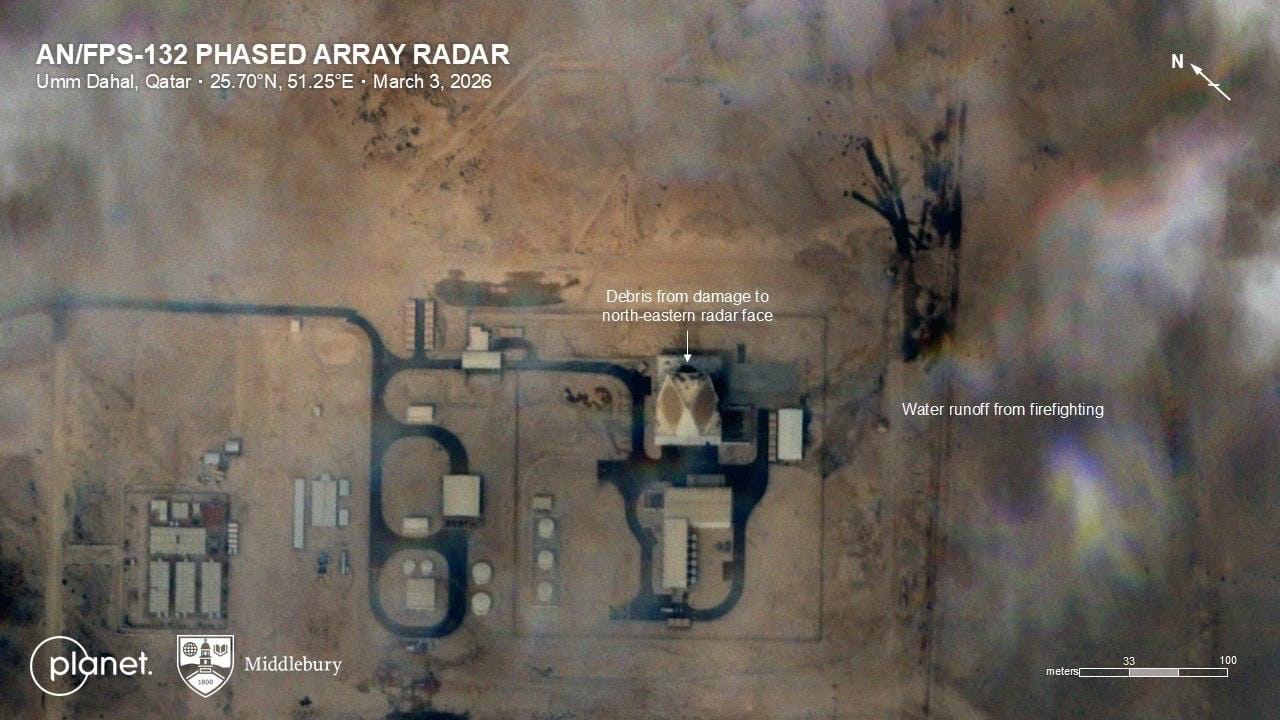

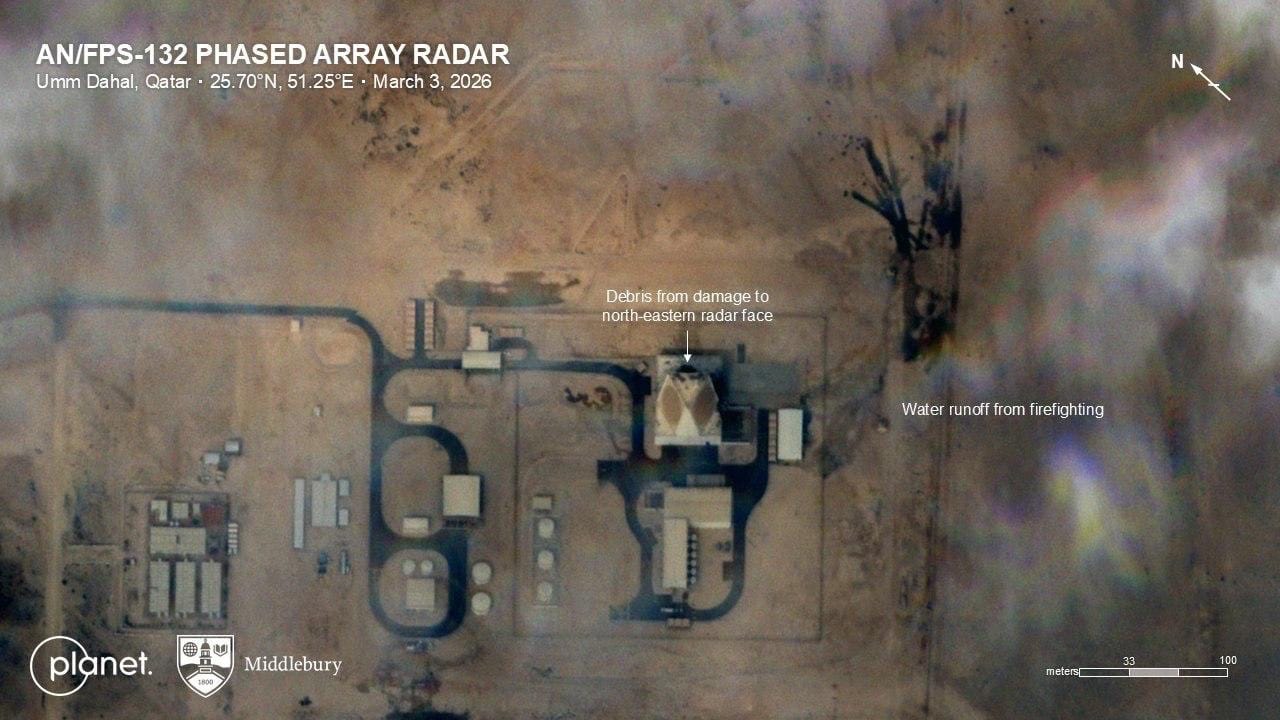
In a highly significant tactical victory for the remnants of the Iranian regime, recent satellite imagery has confirmed that a retaliatory ballistic missile strike successfully penetrated the airspace over Qatar and damaged a critical piece of U.S. defense infrastructure. The primary target was the massive AN/FPS-132 early warning radar system, strategically located at Al Udeid Air Base.
The Breach at Al Udeid Air Base
While Qatari defense officials previously reported intercepting the vast majority of incoming ballistic missiles across the region, this visual confirmation proves that Iran’s uncoordinated “saturation attack” strategy has managed to land at least one highly precise, high-value blow against the allied coalition.
* Visual Confirmation: Defense analysts have confirmed through recent satellite imagery that at least one face of the colossal, multi-directional radar structure sustained direct kinetic damage.
* A Staggering Investment: The AN/FPS-132 is not a standard, tactical battlefield radar. It is a massive, $1.1 billion installation that represents one of the most expensive pieces of fixed infrastructure in the region. It operates as a strategic-level system that forms the absolute backbone of the United States’ global missile warning network.
Degrading the Multi-Layered Defensive Shield
The successful strike on the radar facility threatens to temporarily complicate U.S. Central Command’s ability to seamlessly intercept the ongoing Iranian ballistic missile barrages across the Persian Gulf.
* Unmatched Detection Range: The compromised radar system boasts an incredible detection range of approximately 5,000 kilometers. This extreme reach allows allied forces to monitor deep into Iranian territory, detecting exoatmospheric ballistic launches moments after ignition and tracking them continuously.
* Advanced Technical Capabilities: Operating in the Ultra High Frequency (UHF) band, the radar achieves better penetration through the atmosphere than higher-frequency systems. The installation uses three distinct radar faces—each containing roughly 3,589 antenna elements—to provide comprehensive, 360-degree surveillance. Powered by nearly 2,500 solid-state transmission modules, it generates a powerful beam capable of differentiating between real kinetic threats and non-hazardous space debris.
* The Interception Kill Chain: Crucially, the AN/FPS-132 does not operate in total isolation. It acts as the primary “eyes” of the Gulf’s integrated air defense grid. It feeds its early-warning telemetry and calculated interception trajectories directly to regional interceptor batteries, including the advanced THAAD (Terminal High Altitude Area Defense) and Patriot missile systems.
A Temporary Vulnerability in the Gulf
By successfully damaging even one face of this billion-dollar radar, the surviving Islamic Revolutionary Guard Corps (IRGC) commanders have likely created a temporary, localized blind spot in the allied early-warning network. Because fixed strategic installations like this cannot be rapidly relocated or easily replaced, they are inherently more difficult to regenerate if physically degraded during an active conflict.
Consequently, the U.S. military will now be forced to rapidly rely on overlapping coverage from naval Aegis destroyers and airborne early warning aircraft to patch the hole in their radar umbrella while they assess the full extent of the structural damage at Al Udeid Air Base.