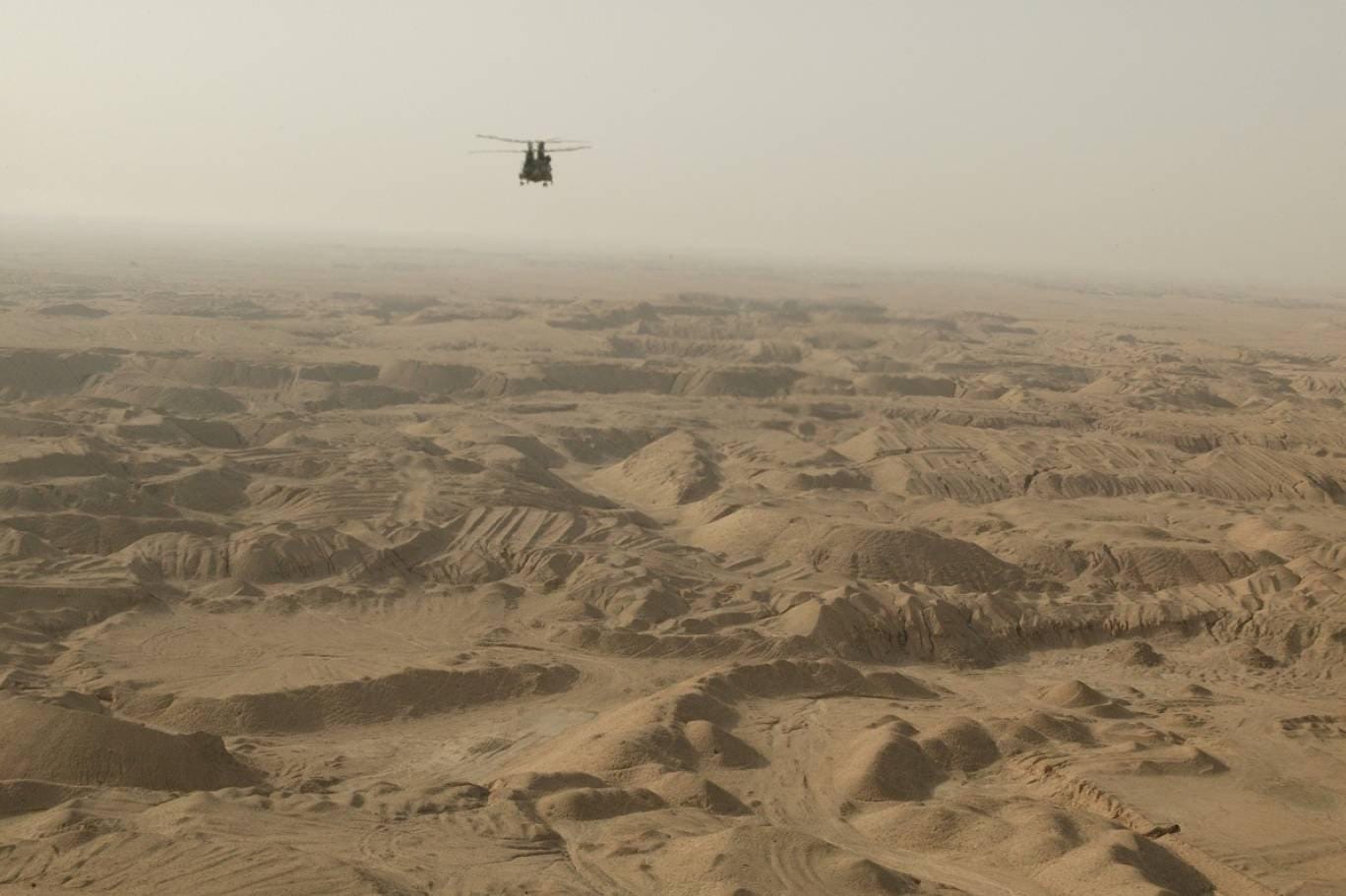
The shadow war spilling across the Middle East has now officially expanded deep into Iraqi territory. According to emerging reports from local security sources, foreign military forces, strongly believed to be United States and Israeli special operations units, have conducted a highly classified helicopter airdrop deep within the desolate Najaf desert. This brazen, unacknowledged incursion has already resulted in lethal consequences for Iraqi military personnel.
This unacknowledged operation highlights the extreme lengths the allied coalition is currently going to in order to secure actionable intelligence against the Iranian regime and its sprawling proxy network across the region. Iraqi intelligence indicates that a formation of four to seven unidentified military helicopters executed the clandestine airdrop in the remote Najaf region. Military analysts suggest the insertion was likely designed to deploy highly advanced, localized surveillance equipment or to facilitate direct logistical support and tactical coordination with anti-Iran militant factions currently operating in the borderlands. Conducting ground operations inside Iraq represents a significant, highly volatile escalation, indicating that the U.S.-Israeli coalition is actively establishing forward-operating intelligence nodes to meticulously map Iranian supply lines and disrupt their early warning networks before they can be fully utilized.
The highly secretive nature of the Najaf desert airdrop was violently enforced when local authorities attempted to investigate the incursion. Following scattered reports of the unauthorized helicopter landings, the Iraqi military immediately dispatched a localized reconnaissance convoy to physically inspect the desert landing zone. However, before the convoy could fully secure the area, it was deliberately targeted and heavily hit by an unidentified airstrike. The precision bombing left one Iraqi soldier dead and severely wounded two others. While Iraqi national authorities have immediately launched a formal investigation into the fatal incident, Baghdad has conspicuously refrained from officially naming the foreign forces responsible for the strike, likely to avoid a severe diplomatic rupture.
The timing of the Najaf desert operation closely aligns with highly suggestive comments made by the Israeli military command recently. Speaking on the ongoing regional campaign, Israeli Air Force commander Major General Tomer Bar stated that IAF special forces are currently executing “extraordinary missions that could ignite the imagination.” The IAF commands several top-tier special mission units uniquely suited for this exact type of deep-penetration operation. This includes the elite Shaldag, also known as Unit 5101, and the combat search-and-rescue specialists of Unit 669. These specialized, highly trained units regularly conduct deep ground reconnaissance, actively designate targets for heavy airstrikes, and operate autonomously far behind enemy lines alongside standard IAF strike packages.
This lethal encounter places the Iraqi government in an incredibly precarious diplomatic and security position. Caught between its strategic agreements with Washington and the immense political pressure exerted by Iranian-backed Shia militias operating within its borders, Baghdad is struggling to maintain its sovereignty. If allied special forces were indeed compromised on the ground, the sudden airstrike on the Iraqi convoy was likely a designated close air support measure designed to protect the operators and completely sanitize the extraction zone from any remaining local threats.
Foreign Forces Strike Iraqi Convoy Following Secret Airdrop
Foreign forces, likely US and Israeli, executed a secret helicopter airdrop in the Najaf desert. When an Iraqi reconnaissance convoy investigated, an airstrike hit them, killing one, and wounding two.