
🇯🇵🔬 — In a breakthrough that sounds like science fiction, researchers at Japan’s RIKEN Center for Theoretical Physics have unveiled a model for a “topological quantum battery” — a system that can transfer and store energy without losing power, even under physical stress or environmental interference.
Unlike conventional batteries, which lose energy through heat, friction, and imperfect conductivity, this new design relies on topological physics — a branch of quantum mechanics that deals with properties immune to disturbance. Think of it as energy storage that doesn’t care if the world around it bends, twists, or vibrates; it keeps performing as if nothing happened.

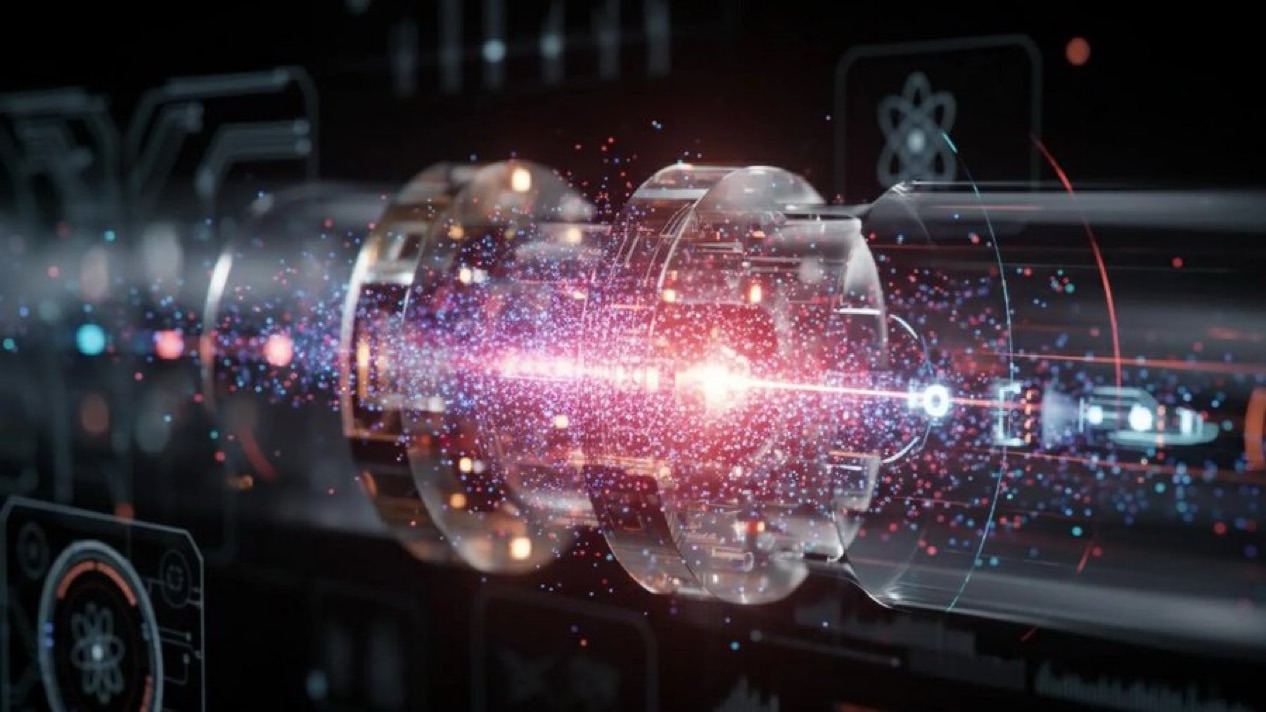
The RIKEN team’s theoretical model uses photonic waveguides — structures that guide light at the quantum level — to create a scenario where energy dissipation disappears. Even more remarkably, under specific conditions, the system doesn’t just avoid losing power; it actually enhances its own charging efficiency.
In other words, instead of losing energy over distance, it can gain performance from disorder. Imagine your phone charging faster after being dropped, or your electric car’s battery improving with wear — that’s the kind of reversal this concept implies.
The Science Behind the Magic
The principle lies in topology — a mathematical concept describing properties that remain unchanged even when deformed. The RIKEN scientists applied these ideas to quantum energy states, creating a system where power transmission stays robust regardless of imperfections in the material.
Traditional nanoscale batteries suffer from inefficiencies caused by quantum decoherence — the gradual loss of order in particle states that leads to energy drain. But by leveraging topological protection, these new quantum systems keep coherence intact, allowing seamless energy transfer across long distances.
This could mean the end of many current technological bottlenecks:
• Quantum computers could maintain stable power levels without thermal noise.
• Nanomachines could store energy for extended periods without degradation.
• Wearable and flexible electronics could remain fully efficient even when twisted or stretched.
The implications go far beyond consumer tech. If scalable, topological quantum batteries could revolutionize energy infrastructure, enabling lossless power grids, ultra-efficient satellites, and long-duration deep-space systems that never waste a single joule.
Why This Matters
Energy loss is one of physics’ most stubborn problems — from transmission lines that bleed electricity to microchips that heat up and waste power. The RIKEN discovery could, in principle, eliminate these inefficiencies altogether.
However, the model remains theoretical for now. Building a working prototype will require overcoming immense engineering challenges, particularly in stabilizing topological quantum states in real-world environments. But researchers are optimistic that photonics — manipulating light instead of electrons — could offer a more stable pathway to practical realization.
If proven in experiments, Japan’s breakthrough could redefine how humanity stores and uses energy. From smartphones to supercomputers, from EVs to fusion reactors, a lossless, self-stabilizing energy system could usher in an era of unmatched efficiency.
It might even be the missing piece in making quantum devices truly scalable — transforming quantum technology from fragile lab setups into everyday powerhouses.