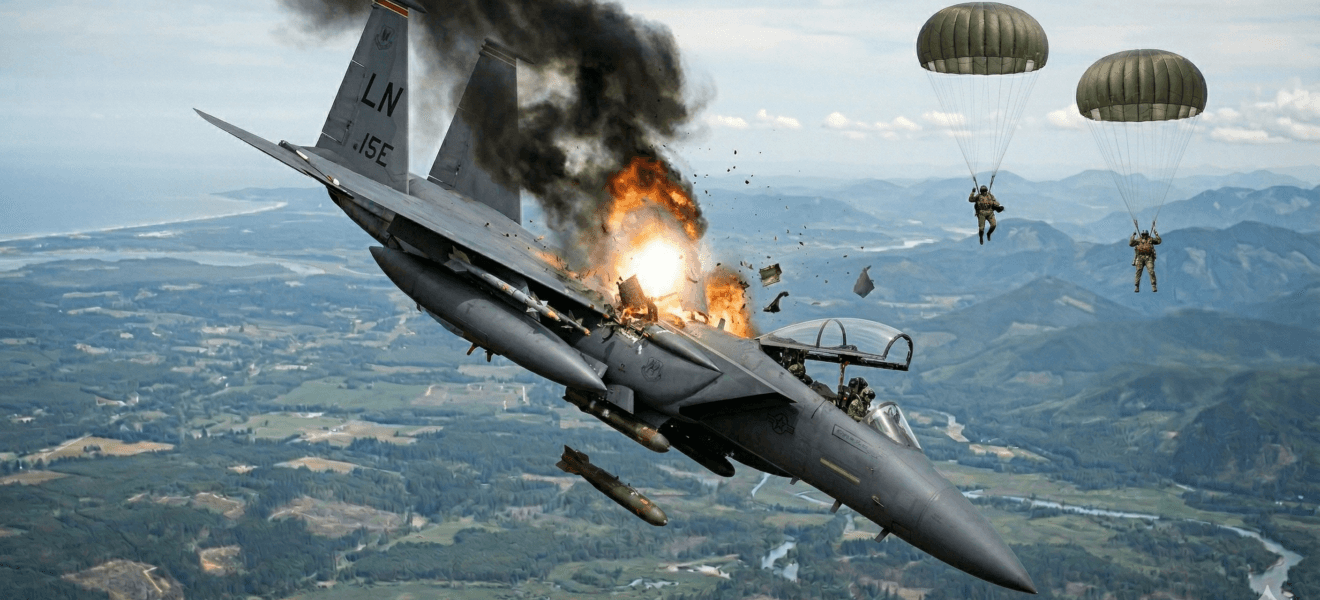

This wasn’t air supremacy failing. It was one good Iranian shot triggering a cascading ground game that the United States is now racing to control — in hostile mountains, against the clock, with a second crew member whose location is still unknown.
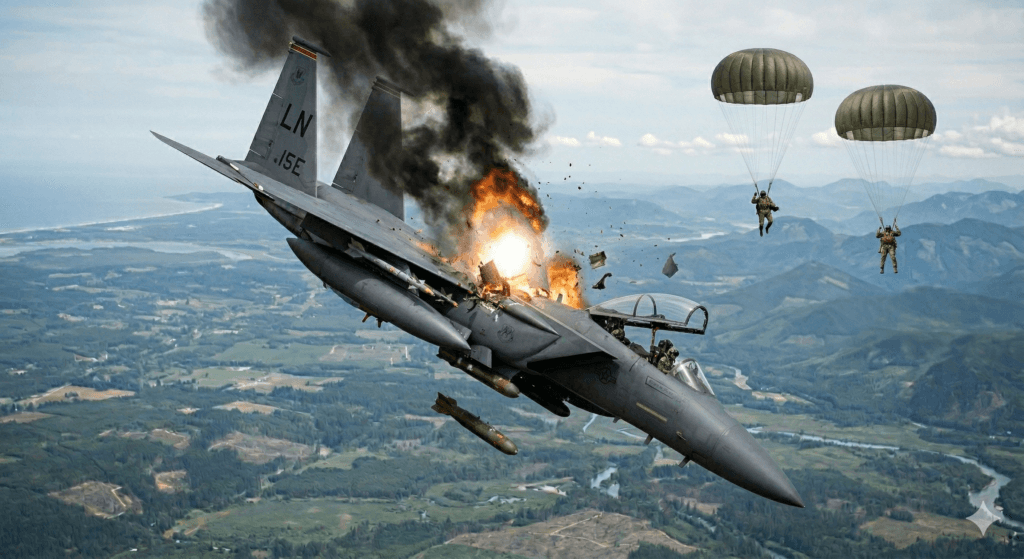
Let’s reconstruct what actually happened — and what it means.
The Strike
The F-15E that went down on April 3 was not on a routine patrol. It was on a deep penetration strike mission into southwestern Iran — Kohgiluyeh and Boyer-Ahmad province, mountainous terrain, well inside hostile territory. This is not airspace where you send a jet to circle. You send it there because there is a high-value target worth the risk.
That risk materialized. Iran’s air defenses — likely a repositioned Bavar-373 battery, mobile SAM launchers kept off radar until the moment of engagement, or a surviving S-300 node that U.S. strikes hadn’t yet located — finally scored a confirmed kill on a manned American aircraft. The first of Operation Epic Fury.
Confirmed Facts
| Aircraft | F-15E Strike Eagle, 494th Fighter Squadron, RAF Lakenheath |
| Crew | 2 — Pilot + Weapons Systems Officer. Both ejected successfully. |
| Crash Area | Kohgiluyeh & Boyer-Ahmad province, southwestern Iran. Mountainous, IRGC-patrolled. |
| Status | Pilot recovered. WSO location NOT confirmed as of April 4. |
| Wreckage | Photos verified by aviation analysts. Ejection seat recovered by Iranian civilians. |
| Iranian Response | IRGC mobilized locals with bounties. Governor denied capture reports. |
Both crew ejected successfully. And that is where one problem became three.
The Separation
An F-15E flying at combat speed over broken mountain terrain, engaged by a surface-to-air missile, does not give its crew a controlled exit. The ejection sequence is automated and sequential — pilot first, then the weapons systems officer, fractions of a second apart. At high altitude and airspeed over complex topography, those fractions of a second translate to significant distance on the ground.
The pilot came down somewhere accessible. U.S. Pararescue — PJs, the Air Force’s elite combat rescue operators — flying HC-130s and HH-60 Pave Hawks moved in fast, extremely low, confirmed in video footage over the two provinces. They got him. The rescue helicopter was hit by small arms fire during recovery, wounding crew members aboard — but it landed safely.
The weapons systems officer came down somewhere else. Valleys. Vegetation. Possibly within range of IRGC ground forces already flooding the area. As of this writing, his location remains unknown.
“They are probably waiting for night to do any extraction if they are in contact with one or both crew.” — Retired USAF Pilot, sourced by Military.com
The CSAR Battle
Combat Search and Rescue — CSAR — is among the most dangerous operations the U.S. military conducts. It requires flying into the same airspace that just killed one aircraft, slower and lower, to recover people on the ground before an adversary reaches them. Iran understands this perfectly.
Sequence of Events — April 3
Phase 1: F-15E Downed Over Kohgiluyeh Province Both crew eject successfully. Wreckage confirmed on the ground in southwestern Iran. IRGC and local authorities alerted immediately. Iranians call on civilians to locate the crew — but not to harm them.
Phase 2: CSAR Launched — HC-130 + HH-60 Pave Hawks Move In Special Operations Pararescue units penetrate hostile airspace at extremely low altitude. Iranian TASNIM reports U.S. helicopters operating over Kohgiluyeh. One helicopter attacked “near the border by air defense” — likely MANPADS or AAA.
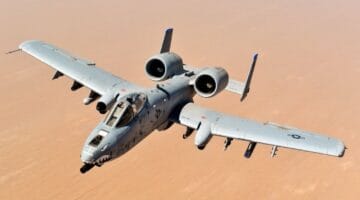
Phase 3 — Escalation: A-10 Scrambled to Cover the Rescue An A-10 Thunderbolt II is tasked with close air support for the CSAR — doing exactly what Warthogs do: fly low, fly slow, put fire on threats near the rescue zone. IRGC forces and militias rush the area. The A-10 takes fire — MANPADS, AAA, or both. It nurses itself to the Persian Gulf. The pilot ejects safely and is recovered.
Phase 4: Pilot Recovered — WSO Still Missing The F-15E pilot is extracted by Pave Hawks. His helicopter is hit by small arms fire, wounding crew aboard — but lands safely. The WSO’s location remains unconfirmed. Pentagon notifies Congress: status “NOT known.”
Now — Ongoing: The Search Continues One rescue mission produced one F-15E pilot recovered, one A-10 lost, two rescue helicopters damaged, multiple crew wounded — and one airman still unaccounted for. Iran has mobilized the entire IRGC apparatus in the region. Spec ops are almost certainly on the ground.
The Missing Airman
The weapons systems officer is almost certainly evading right now. SERE training — Survival, Evasion, Resistance, Escape — is among the most rigorous preparation any aircrew undergoes precisely for this scenario: downed in hostile territory, surrounded, with recovery assets trying to reach you. He has the training. He has the equipment. He has a beacon.
But the terrain and the clock are working against him. Kohgiluyeh is mountainous, heavily forested in places, and now saturated with IRGC ground forces and mobilized civilians responding to state calls to locate American crew. Iran has sealed the area. The governor of the province publicly denied reports of capture — which itself confirms the intensity of the search.
Three Scenarios
🟢 Best Case: Active Evasion The WSO is moving, maintaining beacon discipline, and U.S. spec ops have a fix or near-fix on his position. Extraction is being planned for a low-signature night window. High operational tempo of CSAR assets suggests active contact or strong signal.
🟡 Middle Case: Evading Without Contact He came down in difficult terrain — valley, dense cover, or injured. Beacon intermittent. U.S. assets have a search zone but not a confirmed position. IRGC is tightening the cordon. Time is compressing.
🔴 Worst Case: Captured The IRGC finds him first. Iran gains the single largest propaganda win of the war — a living American POW, paraded before cameras, used as leverage in negotiations Tehran officially claims aren’t happening. The strategic consequences would dwarf any military loss to date.
What This Actually Was
The narrative forming in some quarters is that this shootdown represents a failure of U.S. air supremacy over Iran. That framing misses the point entirely.
Air supremacy has never meant zero losses. It means the ability to operate at will, deny the enemy freedom of movement in the air, and sustain operations across a theater. The U.S. has struck over 12,300 targets. It has conducted more than 12,000 combat sorties. It has destroyed most of Iran’s fixed air defense network, its navy, its missile infrastructure. None of that changed on April 3.
What happened on April 3 was different. Iran didn’t win a battle. It fired one missile — almost certainly from a mobile system that survived by staying off the grid, repositioned, waited for a moment of exposure — and that single shot set off a chain reaction that U.S. planners now have to manage.
“High-end combat against a capable, integrated air defense system is never risk-free. What distinguishes modern Western airpower is not invulnerability, but the ability to survive, penetrate, and sustain operations while keeping losses exceptionally low.” — Lt. Gen. (Ret.) David Deptula, Mitchell Institute for Aerospace Studies
He is right — and the corollary is also true. Iran’s doctrine here is not to win in the air. It cannot. Its doctrine is to impose cost through asymmetry: keep mobile SAM batteries alive, fire at moments of maximum exposure, then let the rescue cascade do the rest. One downed jet becomes two aircraft lost, multiple helicopters damaged, crew wounded, and one airman missing — with the full weight of U.S. special operations now committed to a single recovery operation in hostile mountain terrain.
That is the game Iran is playing. And on April 3, it played it well.
RAGE X Assessment
Iran didn’t break American airpower yesterday. It fired one missile, then let the terrain, the clock, and the calculus of getting a man home do the rest. The CSAR became the battle. That was the plan.
Carlos Kfoury is the Founder of RAGE X and CEO of CORP X Strategic Solutions. Security entrepreneur and military intelligence analyst with 20+ years of technical expertise in counter-terrorism, counter-drone systems, and integrated security architecture.