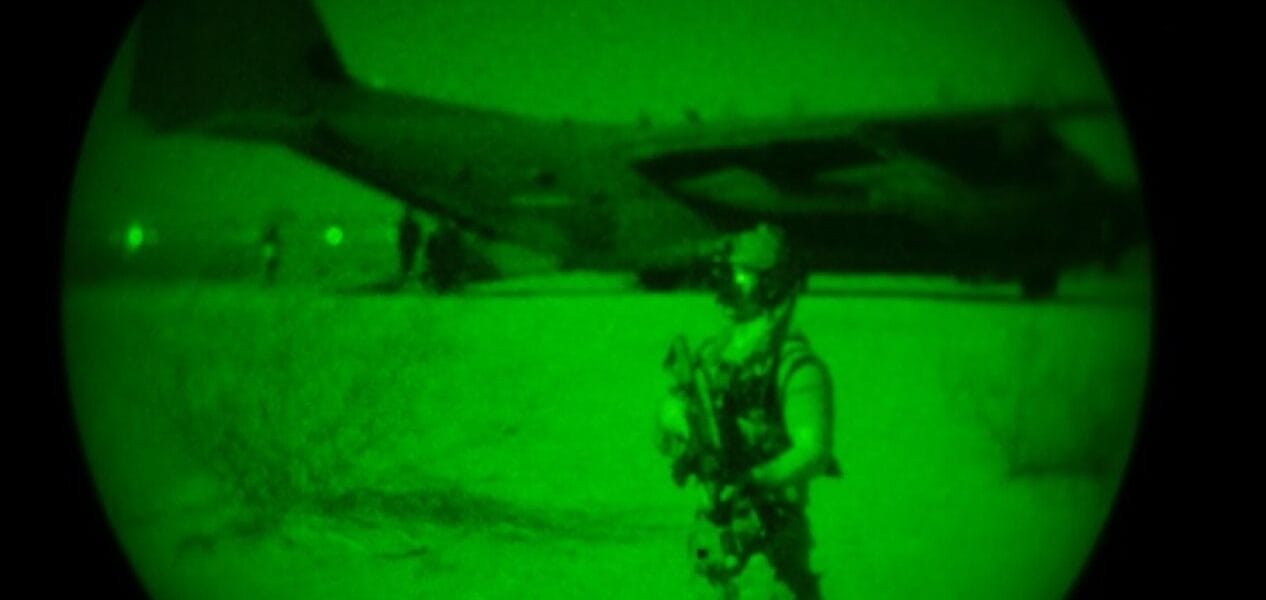

“One of the most challenging and complex in the history of U.S. Special Operations.” — Senior U.S. Military Officials, sourced by The New York Times
He is out.
After more than 24 hours behind enemy lines in the mountains of southern Iran — wounded, hunted, alone — the F-15E weapons systems officer from the 494th Fighter Wing at RAF Lakenheath is alive, in American hands, and clear of Iranian territory.
The operation that brought him home has now been confirmed by senior U.S. military officials as one of the most complex special operations missions in American history. It involved hundreds of special forces personnel, including members of SEAL Team Six. Dozens of fighter and strike aircraft. Multiple helicopters. Cyber, space, and intelligence capabilities deployed simultaneously. A CIA deception campaign run inside Iranian territory. Bombs dropped on Iranian convoys to clear a path. And — in the mission’s final, defining complication — two transport aircraft destroyed on Iranian soil rather than left for the IRGC.
This is the complete account, sourced from the New York Times, Fox News, Air & Space Forces Magazine, ABC News, Axios, and official statements.
Phase 1: The Shootdown
April 3, 2026 — Kohgiluyeh Province
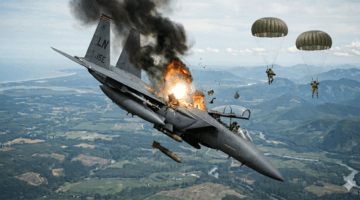
The F-15E Strike Eagle assigned to the 494th Expeditionary Fighter Squadron — a deep penetration strike aircraft flying out of RAF Lakenheath — was on a combat mission over southwestern Iran when Iranian air defenses acquired and engaged it. Both crew ejected successfully.
The aircraft was largely destroyed on impact. Iranian civilians and IRGC forces began converging on the crash site within minutes. Tehran announced a bounty of 10 billion tomans — approximately $60,000 — for the capture of American aircrew.
The two crew members came down in different places.
The pilot was located and extracted within hours — the rescue itself complicated by Iranian fire that struck two HH-60W Jolly Green II helicopters, wounding crew members aboard, and by an A-10 Thunderbolt II that took hits while providing close air support and was forced to egress to the Persian Gulf before its pilot ejected safely.
The weapons systems officer — confirmed as a colonel, a senior and experienced aviator — did not come down somewhere accessible. He was in the mountains. And the mountains of Kohgiluyeh are not forgiving terrain.
Phase 2: 24 Hours of Evasion
April 3–4, 2026 — Southern Iranian Mountains
What happened over the following 24 hours, before U.S. forces reached him, was an act of individual survival that will define this man’s story for the rest of his life.
The WSO activated his emergency beacon and began moving. Away from the crash site. Away from the sound of vehicles. Into terrain that offered concealment — valleys, vegetation, ridgeline. He was injured. He was alone. And every IRGC unit and Basij militia group in southwestern Iran was hunting him.
According to a senior U.S. military official briefed on the operation and sourced by the New York Times, the WSO at one point hiked up a 7,000-foot ridgeline. Injured. In darkness. Under pursuit.
He maintained beacon discipline. He found a hide site — a mountain crevice that, according to a senior administration official, rendered him “invisible but for CIA’s capabilities.” He stayed alive.
Meanwhile, the entire force structure of what would become one of the largest special operations missions in history was being assembled.
Phase 3: The CIA Runs the Deception
April 3–4, 2026 — Intelligence War Inside Iran
Before U.S. forces could move to rescue the WSO, they had to do two things simultaneously: find him, and prevent Iran from finding him first.
The CIA handled both.
On the deception side, confirmed by a senior Trump administration official to ABC News, Fox News, and Axios:
“The CIA first launched a deception campaign spreading word inside Iran that U.S. forces had already found him and were moving him on the ground for exfiltration out of the country.”
While IRGC forces redirected their search to intercept a convoy that did not exist — uncertain, confused about what was actually happening — the CIA deployed what the official described as “unique, exquisite capabilities” to conduct the actual search.
The terrain made it extraordinarily difficult. A wounded man in a mountain crevice in Kohgiluyeh province, maintaining radio discipline, in rough terrain covered in vegetation. The official’s description is not rhetorical:
“This was the ultimate ‘needle in a haystack,’ but in this case it was a brave American soul inside a mountain crevice, invisible but for CIA’s capabilities.”
The CIA found him. His exact coordinates were immediately transmitted to the Pentagon and the White House. President Trump ordered the rescue mission to launch.
Phase 4: The Force Package
The Most Complex CSAR Assembly in a Generation
What the United States deployed for this operation has now been confirmed in extraordinary detail by the New York Times, citing senior military officials directly.
The force included:
SEAL Team Six. The Naval Special Warfare Development Group — America’s Tier 1 maritime special operations unit, the same force that executed the Abbottabad raid. Their presence confirms the mission was classified at the highest operational level from the moment it was ordered. SEAL Team Six does not deploy to routine extractions. They deploy when the mission cannot fail and the enemy is capable.
Hundreds of additional special forces personnel. The NYT sourcing describes a force of hundreds — a number consistent with a complex joint forcible entry operation requiring layered security, multiple assault elements, reserves, and combat search and rescue specialists. U.S. Air Force Pararescuemen (PJs), Combat Controllers, and joint special operations personnel all contributed.
Dozens of fighter and strike aircraft. Not support aircraft. Strike aircraft — F-15Es, F-16s, and naval aviation assets from the carrier strike group — providing top cover, suppression of enemy air defenses, and most critically, direct attack on Iranian forces attempting to reach the WSO.
Helicopters. HH-60W Jolly Green IIs for personnel recovery. Support rotary-wing assets for the CSAR package.
Cyber, space, and intelligence capabilities. The NYT specifically names these as components of the operation — signals intelligence, satellite coverage, cyber operations targeting Iranian communications and coordination networks during the mission window. The full scope of what U.S. electronic warfare and cyber operations did to Iran’s ability to coordinate its response during those hours is classified. But it is named. It happened.
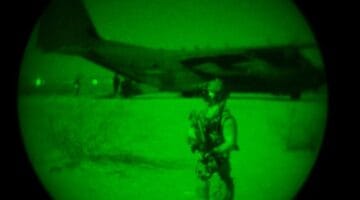
MC-130J Commando II aircraft. The primary special operations transport — capable of low-level, night operations into denied airspace, and of landing at austere or improvised airstrips with minimal ground preparation.
Phase 5: The Strike Mission That Cleared the Path
This is the detail that separates this operation from any conventional rescue scenario.
U.S. attack aircraft did not simply escort the rescue package. They actively engaged Iranian forces on the ground.
According to the New York Times, sourcing senior military officials: U.S. attack aircraft dropped bombs and opened fire on Iranian convoys to keep them away from the area where the airman was hiding.
This is an offensive air interdiction mission run simultaneously with a personnel recovery operation, inside Iranian territory, against Iranian ground forces. It requires real-time coordination between the intelligence picture (where are the Iranian forces), the ground rescue elements (where is the WSO, where is the rescue team), and the strike aircraft (which Iranian forces to engage, which approach vectors to clear).
The MQ-9 Reapers confirmed in earlier reporting were striking Iranian military-aged males who got within three kilometers of the WSO’s position. Strike aircraft were hitting convoys on approach routes. The effect: a moving protective bubble around the WSO’s position, maintained by continuous air attack on anything Iranian that moved toward him.
Phase 6: The Rescue — No Firefight
Here is the important clarification that the New York Times sourcing provides, and that distinguishes the official account from some earlier reports.
As U.S. Special Forces converged on the downed airman, they fired their weapons to keep Iranian forces away from the rescue site. But they did not engage in a firefight with the Iranians. The earlier reports of a “massive firefight” at the extraction point were overstated. Iranian forces were suppressed — by air and by the presence of the ground element — but a direct, sustained ground engagement with IRGC did not occur at the rescue site itself.
The distinction matters tactically. A firefight at the extraction point means U.S. forces are in contact while trying to load casualties and personnel onto aircraft — the most dangerous possible scenario. What actually happened: air dominance and the ground security perimeter kept Iranian forces from closing to engagement range. The WSO was reached, recovered, and the force began moving to extraction.
Phase 7: The C-130s Go Down
The Final Complication
In the mission’s last act, the operation encountered its most acute mechanical failure — and responded with the only tactically sound decision available.
Two MC-130J transport aircraft — the primary extraction platforms — landed at the forward operating base inside Iran and became stuck. Soft ground. Sand. The weight of fully loaded special operations transports on an improvised airstrip that was never designed for repeated use.
They could not take off.
The decision required no deliberation. The commanding officer ordered both aircraft destroyed in place. U.S. forces blew up both MC-130Js — their avionics, their mission systems, their communications equipment, everything — rather than allow the IRGC to recover them.
Three replacement aircraft were dispatched. They landed at the FARP. All U.S. military personnel, the rescue force, and the WSO loaded aboard. They departed Iranian airspace.
Images published on OSINT channels confirmed the burned wreckage of the two aircraft on Iranian soil. The IRGC now has evidence that U.S. forces established and operated a ground base inside Iran. They do not have the aircraft.
The Complete Ledger
| Element | Detail |
|---|---|
| Force commander | Senior special operations — exact identity classified |
| Tier 1 unit | SEAL Team Six confirmed |
| Ground force size | Hundreds of special operations personnel |
| Strike aircraft | Dozens — fighter and attack aviation |
| Intelligence dimensions | CIA deception · Cyber operations · Space assets · SIGINT |
| Duration of WSO evasion | 24+ hours |
| Maximum elevation reached by WSO | 7,000-foot ridgeline |
| Iranian convoys engaged | Multiple — bombed and strafed by U.S. attack aircraft |
| Ground firefight | No direct firefight at rescue site — Iranian forces suppressed by air and ground security |
| Aircraft destroyed at FARP | 2× MC-130J — blown up by U.S. forces on Iranian soil |
| Replacement extraction aircraft | 3× flown in for final extraction |
| WSO condition | Injured — expected full recovery |
| U.S. fatalities | Zero |
| Iranian IRGC/Basij casualties | Significant — confirmed by Iranian media and hospital reports |
What This Operation Actually Was
Senior military officials told the New York Times this was “one of the most challenging and complex in the history of U.S. Special Operations.” That is not a statement officials make publicly about operations that do not earn it. The comparison class includes Abbottabad, Operation Eagle Claw, Operation Urgent Fury, Gothic Serpent.
What made it extraordinary was not any single element. It was the convergence: mountainous terrain deep inside a country the United States is actively at war with, under maximum enemy awareness and pressure, with an injured airman evading for more than 24 hours, a CIA deception campaign running in parallel with the physical search, Tier 1 forces inserted under a strike umbrella, Iranian convoys bombed to clear the exfiltration corridor, and a FARP established, used, and destroyed on Iranian sovereign territory — all within a single operational cycle, with zero American fatalities.
The WSO survived because his training worked. He survived because the CIA found him before Iran did. He survived because U.S. strike aviation kept Iranian forces off him for 24 hours. He survived because SEAL Team Six and Pararescuemen flew into a mountain range in southern Iran and brought him out.
He survived because the United States, when it decides a man is coming home, has built a machine for exactly that purpose — and that machine, on the night of April 4–5, 2026, worked.
RAGE X Assessment
The New York Times sourcing — senior military officials, SEAL Team Six confirmed, cyber and space capabilities named — establishes this as the definitive official account. Strip the politics and the presidential messaging away and what remains is the operational fact: the United States conducted a multi-domain forcible entry mission inside a nation it is at war with, defeated Iranian interdiction attempts through air dominance and intelligence operations, recovered its man, and left with all personnel alive.
Two burned MC-130Js in the mountains of Kohgiluyeh are the cost. One colonel is home.
The math works.
CIS SECURITY
Because Your Safety Isn’t Optional
🎯 LEBANON SECURITY INDEX™
Powered by Advanced Intelligence Partnership
Daily Security Intelligence Dashboard LIVE RAGEX Intelligence Partner FEATURED