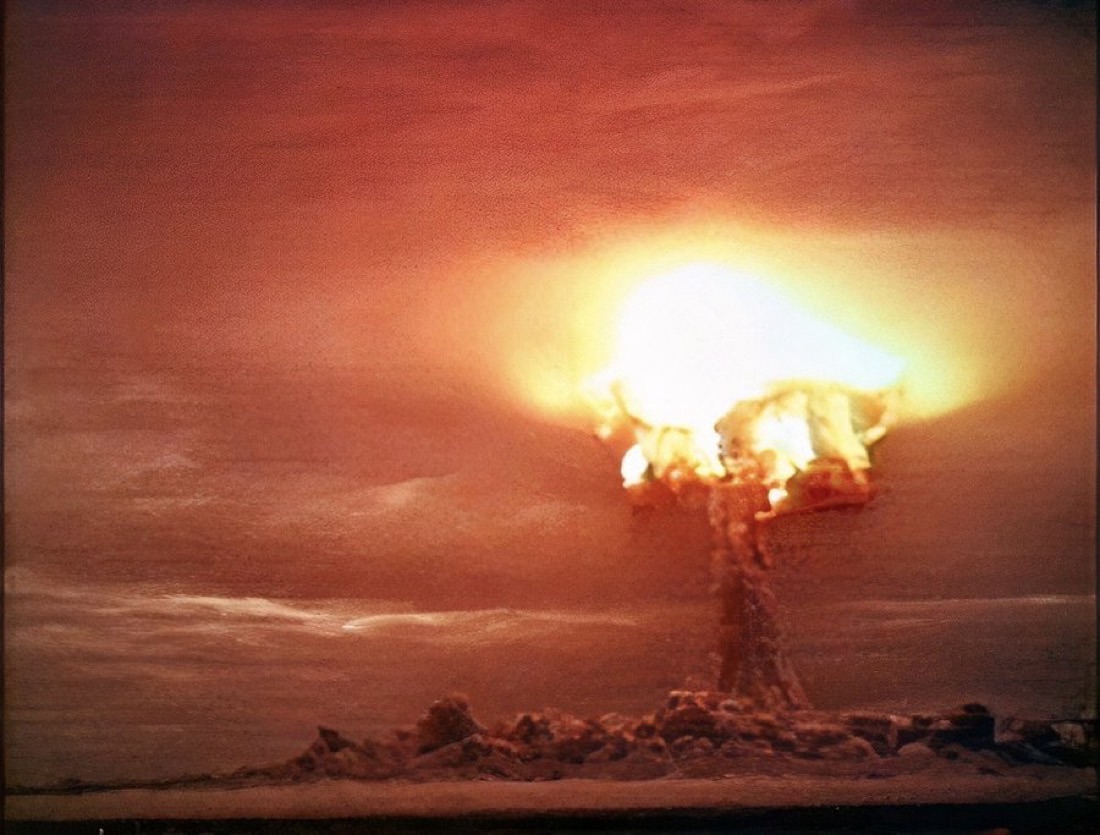


On March 29, 1955, the United States made nuclear weapons history by conducting two separate detonations within a single day. Just five hours and five minutes after the Apple-1 test, a second device—codenamed “Wasp Prime”—was detonated at 10:00 a.m. at the Nevada Test Site. This marked the first time two nuclear explosions were executed on the same day, reflecting the increasing pace and intensity of atomic weapons development during the Cold War.

Wasp Prime was an airburst detonation, exploding approximately 220 meters above ground level. It yielded 3.2 kilotons—modest by thermonuclear standards, but significant in its role and timing. The test formed part of Operation Teapot, a larger U.S. testing campaign carried out in 1955 aimed at advancing both the design and tactical use of nuclear weapons.
While the earlier Apple-1 test sought to evaluate the viability of a thermonuclear primary and radiation implosion system—albeit unsuccessfully—Wasp Prime had more focused objectives. Primarily, it served as a precision test for evaluating the effects of low-yield nuclear airbursts, particularly in terms of their blast dynamics, fireball characteristics, and potential military applications. The low-altitude detonation offered valuable data on how such weapons might be deployed tactically, such as against troop formations or in battlefield conditions where minimizing fallout and maximizing area effects would be essential.
The 3.2 kiloton yield, while relatively low, was precisely calculated to meet specific experimental goals. Airburst detonations at such altitudes are known to enhance horizontal blast effects while reducing local fallout—key advantages in tactical nuclear planning. Data from Wasp Prime contributed to evolving doctrines on nuclear battlefield utility, bridging the gap between strategic megaton-class weapons and more flexible, deployable atomic arms suited for combat use.
Wasp Prime’s detonation, coming just hours after Apple-1’s suboptimal 14 kiloton ground test, highlighted the sheer pace at which nuclear science was advancing. The compressed schedule demonstrated the logistical and technological sophistication of the U.S. nuclear test infrastructure at the time, as well as the urgency underpinning Cold War military strategy. The dual-detonation day was as much a display of capability as it was a scientific exercise.
Moreover, the unprecedented scheduling of two nuclear tests within such a narrow window raised operational and safety questions that would shape future testing protocols. Conducting back-to-back detonations required precise coordination of monitoring teams, atmospheric data collection, instrumentation recovery, and radiological safety measures. The experience helped refine procedures for high-throughput nuclear experimentation that became standard in later test series.
Operation Teapot, under which both Apple-1 and Wasp Prime were conducted, was a cornerstone in U.S. efforts to develop deployable nuclear weapons systems. The operation included 14 tests in total, aimed at improving weapon designs, understanding blast impacts on structures and military equipment, and integrating nuclear strategy with tactical military planning.
In retrospect, Wasp Prime is often overshadowed by larger and more dramatic detonations in nuclear history, yet its significance lies in what it represented: a turning point in testing methodology, operational tempo, and the military’s drive for versatile nuclear solutions. The pairing of Apple-1 and Wasp Prime not only provided contrasting data points—one on a flawed thermonuclear prototype and the other on a controlled low-yield airburst—but also symbolized a new phase in nuclear experimentation defined by speed, adaptability, and precision.
This dual-test milestone laid the groundwork for a new era in atomic research, where simultaneous experiments and rapid iteration became essential tools in refining the American nuclear arsenal. As such, March 29, 1955, remains a historic date in the annals of nuclear science and military history.
Follow us on:
• YouTube
• Telegram
• TikTok