
China Unveils $10K Feilong-300D Loitering Drone to Rival Shahed-136
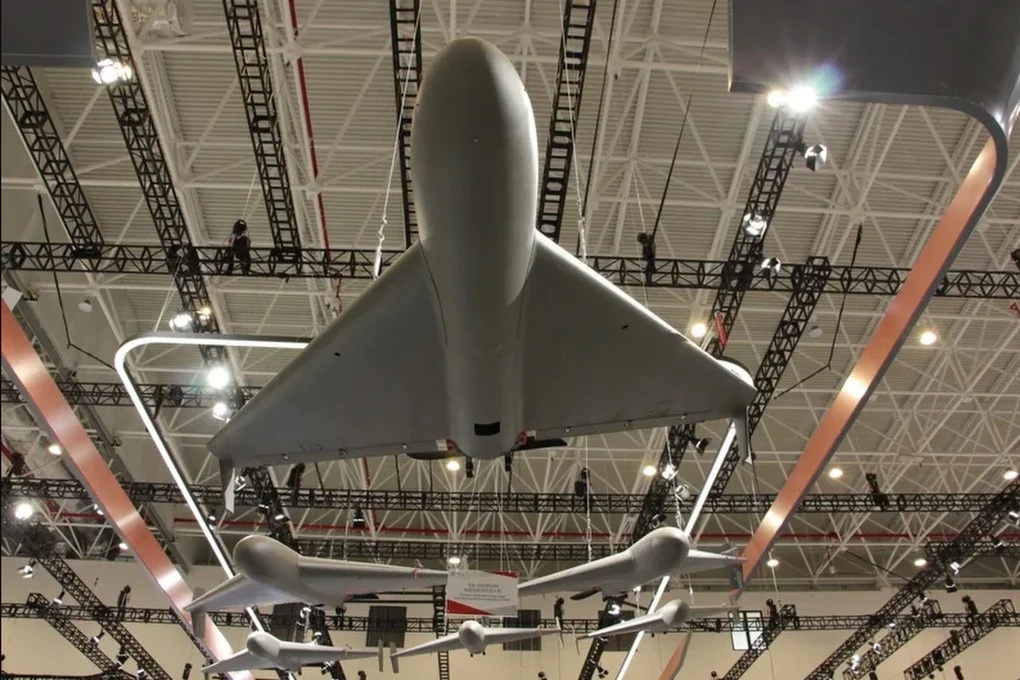
China has officially revealed the Feilong-300D, a next-generation loitering munition priced at just $10,000 per unit, designed to disrupt the global market for low-cost, long-range strike drones. Developed by a state-affiliated aerospace enterprise under the China Aerospace Science and Industry Corporation (CASIC) ecosystem, the Feilong-300D represents Beijing’s most aggressive foray yet into the attritional warfare segment currently dominated by Iran’s Shahed-136 and Russia’s Geran-2 derivatives.
Unlike China’s previous focus on high-end, multi-mission UAVs like the Wing Loong or CH-5 Rainbow series, the Feilong-300D is purpose-built for mass production, swarm deployment, and cost-effective attrition. At a time when drone swarms are redefining modern battlefields—from Ukraine’s frontlines to Red Sea maritime corridors—this new system signals China’s strategic pivot toward scalable, intelligent, and affordable unmanned strike capabilities.
Tactical Role and Strategic Vision
The Feilong-300D functions as a loitering munition, meaning it can patrol a designated area for hours, identify targets via onboard sensors, and then execute a precision dive onto high-value assets such as armored vehicles, radar sites, command posts, or energy infrastructure. It blends reconnaissance, electronic intelligence (ELINT), and kinetic strike in a single, disposable airframe—a doctrine China calls “intelligentized swarm warfare.”
This aligns with the People’s Liberation Army’s (PLA) 2027 modernization goals, which emphasize AI-enabled, networked, and low-cost systems to counter U.S. and allied technological superiority through saturation and complexity. The drone can operate autonomously or be integrated into a broader battlefield internet-of-things (IoT) architecture, receiving real-time targeting updates from satellites, ground units, or other UAVs.
Cost, Scale, and Export Implications
Priced at approximately $10,000, the Feilong-300D undercuts even the most economical competitors. By comparison:
- Iran’s Shahed-136: $20,000–$50,000
- U.S. Switchblade 600: $70,000+
- Ukrainian Lancet: $40,000–$60,000
This radical cost efficiency is achieved through modular design, commercial-grade components, and automated assembly lines. Chinese defense analysts estimate production could scale to 50,000–100,000 units annually, enabling both strategic stockpiling and aggressive export pricing.
Countries in Africa, the Middle East, Southeast Asia, and Latin America—many seeking affordable force multipliers amid budget constraints—are likely early adopters. Unlike Western exports, which often come with political or usage restrictions, Chinese drones typically include fewer end-user controls, making them attractive to authoritarian regimes or non-state proxies.
Technical Edge Over Shahed-136
While the Shahed-136 relies on inertial navigation with limited GPS backup and is vulnerable to electronic warfare (EW), the Feilong-300D integrates multi-source navigation:
- BeiDou-3 satellite positioning (China’s GPS alternative)
- Terrain contour matching (TERCOM) for GPS-denied environments
- Electro-optical/infrared (EO/IR) seekers with AI-assisted target recognition
- Optional anti-radiation homing for SEAD (Suppression of Enemy Air Defenses) missions
Its stealthy delta-wing design reduces radar cross-section, and it can fly at low altitudes (30–100 meters) to avoid detection. With a 2,000+ km range and 12-hour loiter time, it significantly outperforms the Shahed’s ~2,000 km (one-way) and lack of true loitering capability.
Production and Deployment Timeline
Initial flight tests concluded in Q4 2024, with serial production launched in early 2025. State media reports indicate the Feilong-300D is already being evaluated by the PLA Army and Rocket Force for integration into brigade-level fire support networks. Export variants are expected to debut at major arms expos like Zhuhai Airshow 2026.
Notably, the drone can be launched from truck-mounted rails, naval vessels, or even rail containers, enhancing strategic ambiguity and survivability. A single launch vehicle can carry 6–8 units, enabling rapid saturation strikes.
Geopolitical and Security Concerns
Western defense agencies warn that the Feilong-300D’s low cost, high range, and AI targeting could lower the threshold for drone warfare globally. Unlike traditional missiles, loitering munitions allow on-the-fly retargeting and battle damage assessment, making them ideal for dynamic conflicts.
The U.S. Department of Defense has flagged the system in its 2025 Unmanned Systems Strategic Review, citing risks of proliferation to Russia, Iran, or non-state actors via third-party intermediaries. Already, Chinese drone components have appeared in conflict zones from Myanmar to Sudan, raising red flags about supply chain transparency.
Moreover, the Feilong-300D’s data links and software could theoretically be backdoored for intelligence collection—though no public evidence exists yet. Still, its BeiDou dependency ties operational data flows to Chinese infrastructure, posing long-term strategic risks for importers.
Conclusion
The Feilong-300D is more than a weapon—it’s a geopolitical tool. By offering a high-performance, ultra-low-cost alternative to Western and Iranian drones, China is positioning itself as the default supplier of next-generation attritional warfare systems. In an era where quantity has a quality all its own, the Feilong-300D may well become the Kalashnikov of the drone age—ubiquitous, lethal, and transformative.
Feilong-300D Specifications
| Parameter | Specification |
|---|---|
| Type | Loitering Munition / Kamikaze Drone |
| Unit Cost | ~$10,000 |
| Range | 2,000+ km (one-way) |
| Loiter Time | Up to 12 hours |
| Warhead | 30–50 kg HE or shaped charge |
| Guidance | BeiDou-3 + INS + TERCOM + EO/IR seeker |
| Max Speed | 185 km/h (115 mph) |
| Cruise Altitude | 30–100 meters (nap-of-the-earth) |
| Launch Platform | Truck-mounted rail, naval vessel, containerized |
| Target Types | Armor, radar, C4ISR nodes, infrastructure |
| AI Features | Target recognition, swarm coordination, ECCM |
| Production Start | Early 2025 |
| Export Status | Expected 2026 |