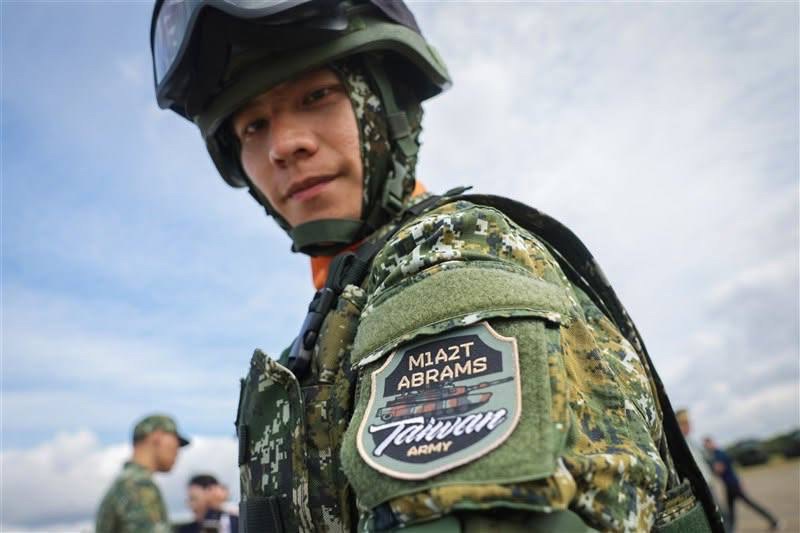

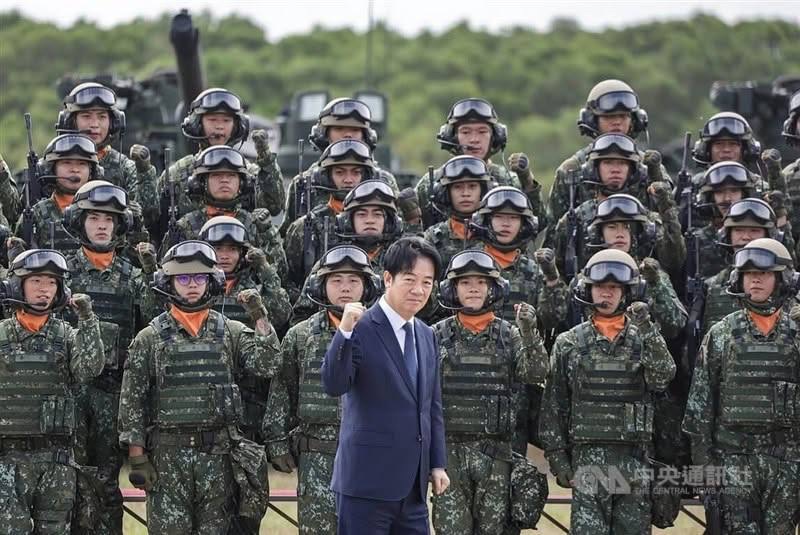
Taiwan has officially commissioned its first operational unit of M1A2T Abrams main battle tanks, marking a significant milestone in its military modernization and a powerful enhancement of its ground-based deterrent. In a formal ceremony at the Hukou military base in Hsinchu County, President Lai Ching-te oversaw the activation of the 3rd Combined Arms Battalion of the 584th Armored Brigade, the first unit to be fully equipped with the advanced American-made tanks.

The event, which saw the new M1A2Ts demonstrate their capabilities in live-fire exercises, represents the culmination of years of training and procurement. In his speech, President Lai emphasized that the new hardware was only part of the solution. He stressed that the armed forces must simultaneously adopt “new training, new thinking, and advanced technology” to fully realize the “spirit of asymmetric warfare.”

This dual focus on next-generation heavy armor and modern asymmetric doctrine highlights Taiwan’s evolving “resolute defense and multilayered deterrence” strategy. The commissioning signals that while Taiwan is investing heavily in mobile, cost-effective anti-invasion systems, it also retains a firm belief in the need for a powerful, conventional armored fist to deliver a decisive counter-punch against any potential beachhead.
The 108-Tank Deal: A Generational Leap in Firepower
The activation of the 584th Armored Brigade’s battalion is the first tangible result of a landmark $2.2 billion Foreign Military Sales (FMS) deal approved by the U.S. in 2019. The deal includes a total of 108 M1A2T Abrams tanks, 14 M88A2 Hercules armored recovery vehicles, and 16 M1070A1 heavy equipment transporters.
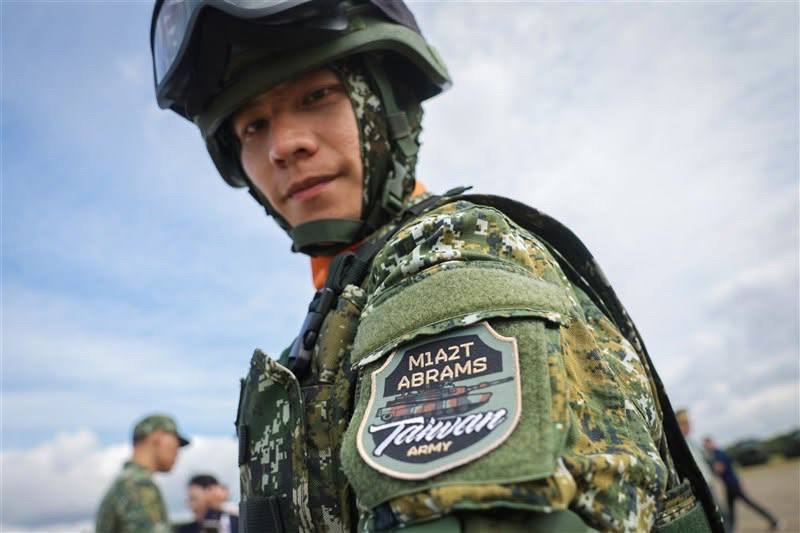
The M1A2T is not a standard-issue Abrams; it is a specialized variant customized for Taiwan’s unique operational requirements, based on the formidable M1A2 System Enhancement Package Version 2 (SEPv2) or Version 3 (SEPv3). This represents a generational leap over Taiwan’s aging fleet of M60A3 Patton tanks and locally-upgraded CM-11 “Brave Tiger” tanks, which are based on 1950s-era M48 chassis.
Key advantages of the M1A2T include:
• Superior Lethality: Its 120mm M256 smoothbore cannon provides overwhelming firepower, capable of defeating the most advanced armor. This is a significant upgrade from the 105mm rifled guns on Taiwan’s older tanks.
• Advanced Fire Control: The tank features a “hunter-killer” capability. The commander uses an independent thermal sight to scan for and designate new targets, while the gunner simultaneously engages a separate, previously designated target. This digitalized system allows the tank to rapidly engage multiple enemies.
• Network-Centric Warfare: The M1A2T is equipped with an Inter-Vehicular Information System (IVIS), a digital battle management system. This allows the tank battalion to share real-time targeting data and situational awareness with other tanks, infantry units, attack helicopters, and command centers.
• Unmatched Survivability: While the exact armor package is classified, the M1A2T features vastly superior composite armor protection compared to any other vehicle in Taiwan’s inventory, shielding its crew from a wide array of modern anti-tank threats.
The first batch of 38 tanks arrived in December 2024, with a second batch of 42 arriving in July 2025. The final 28 tanks are expected to be delivered by early 2026, which will allow the military to field additional Abrams-equipped battalions.
The Strategic Debate: Heavy Tanks in an Asymmetric Fight
The acquisition of a 70-ton main battle tank has been a subject of intense debate, as it seemingly conflicts with Taiwan’s widely publicized “porcupine strategy.” This asymmetric doctrine prioritizes large quantities of small, mobile, and lethal systems—such as Javelin anti-tank missiles, Stinger anti-aircraft missiles, and unmanned drones—designed to make an invasion unacceptably costly for Beijing.
Critics have argued that the M1A2T is too heavy for many of Taiwan’s bridges and soft, rural terrain, making it a potentially easy target for the People’s Liberation Army’s (PLA) air and naval superiority.
However, President Lai’s speech directly addressed this paradox. The M1A2T is not intended to be a replacement for asymmetric systems but a complement to them. Taiwanese military doctrine does not envision using these tanks as a static defense on the beaches, where they would be vulnerable.
Instead, the Abrams are a “decisive counter-attack” force. Their primary role is to be held in reserve, protected in hardened shelters, and then deployed as a powerful armored task force to annihilate any PLA forces that successfully establish a beachhead. While asymmetric systems are meant to “bleed” the invasion force during its sea transit and landing, the M1A2T is the “hammer” designed to crush whatever manages to get ashore.
By integrating the M1A2T’s advanced networking with drone reconnaissance and infantry-fired anti-tank missiles—as Lai’s speech called for—the Abrams becomes the survivable core of a modern, combined-arms force. Its mission is not to fight a war of attrition, but to win the decisive battle for Taiwan’s northern coast.
The strategic placement of the first battalion at Hukou in Hsinchu County confirms this. The 584th Armored Brigade is part of the 6th Army Corps, which is responsible for the defense of northern Taiwan, including the critical approaches to the capital, Taipei. By placing its most powerful new asset in this vital region, Taiwan is sending a clear message of its resolve to defend its political and economic center with overwhelming conventional force.
The commissioning of the first M1A2T battalion is therefore more than just a hardware upgrade. It is the beginning of a doctrinal evolution for Taiwan’s army, blending the resilience of a “porcupine” defense with the lethal, decisive power of an “Abrams” punch.