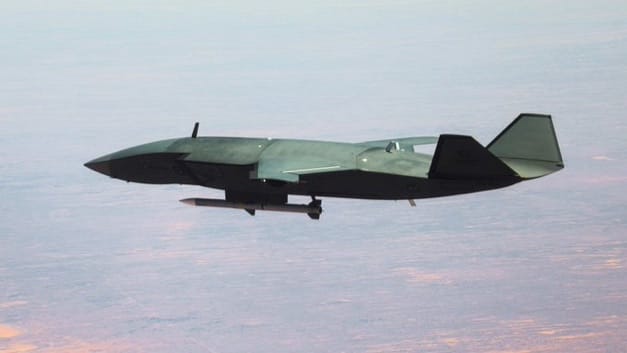

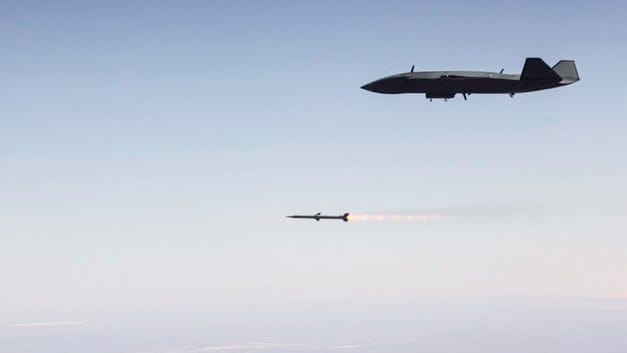
The Royal Australian Air Force (RAAF) and Boeing have achieved a major global military milestone in the future of air combat, successfully executing the world’s first autonomous air-to-air missile engagement using a front-line weapon. The Australian-designed and manufactured Boeing MQ-28A “Ghost Bat” Stealth, Multirole Combat Drone successfully launched an AIM-120 Advanced Medium-Range Air-to-Air Missile (AMRAAM) and destroyed a target drone.
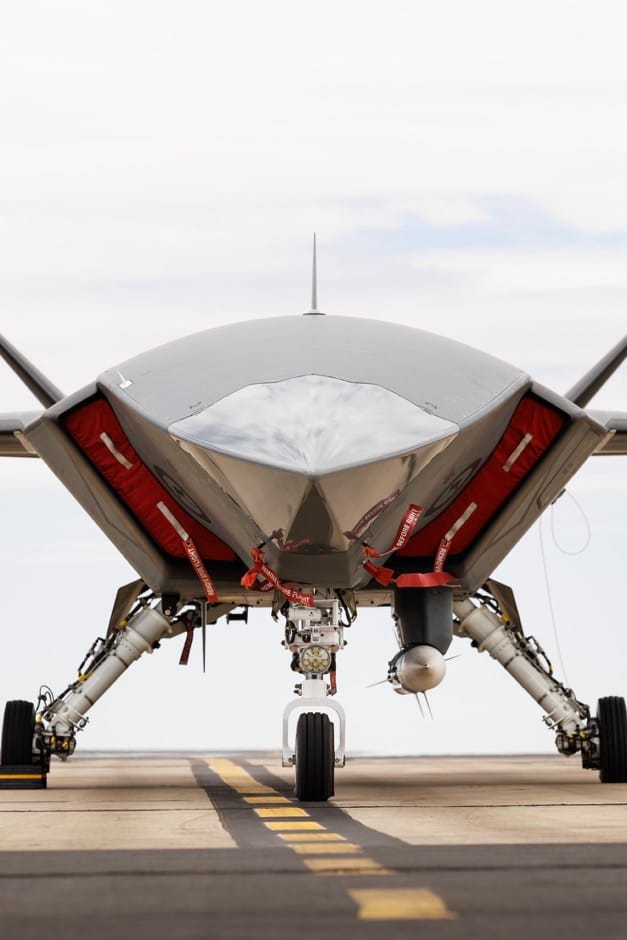
The landmark test, which took place at the RAAF Woomera Range Complex (WRC) on December 8, 2025, validated the MQ-28A’s transformation from a concept demonstrator to a mature, combat-capable Collaborative Combat Aircraft (CCA).
The Autonomous Engagement Scenario
The mission was executed as a collaborative, end-to-end combat scenario, demonstrating the seamless integration of crewed and uncrewed platforms, a key tenet of modern air power:
* Three-Part Team: The operation involved three distinct elements launching from separate locations: the MQ-28A Ghost Bat, a Boeing E-7A “Wedgetail” Airborne Early Warning and Control (AEW&C) Aircraft, and an F/A-18F Super Hornet fighter jet.
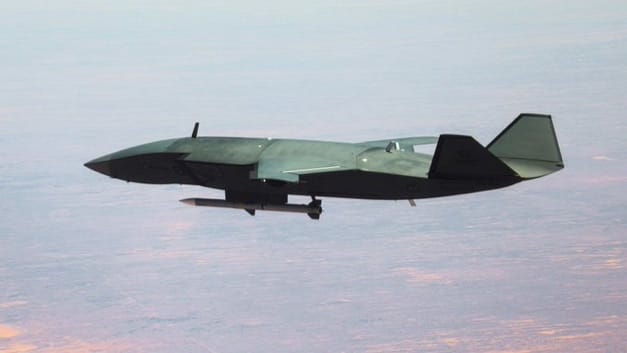
* Targeting and Command: The F/A-18F Super Hornet was responsible for initially tracking the target—an Australian-made Phoenix Jet Uncrewed Aerial-Target Drone (representative of a hostile fighter-class drone)—and sharing the targeting data across the network to all participating platforms.
* Custodianship: An operator aboard the E-7A Wedgetail assumed custodianship (supervisory control) of the MQ-28A once airborne to manage safety and provide the final engagement clearance.
* The Kill: The MQ-28A autonomously repositioned, received the authorization command, and successfully launched the AIM-120 AMRAAM, destroying the target drone.
This achievement establishes the MQ-28A as the most mature CCA platform globally capable of air-to-air engagement.
Strategic Importance and Force Multiplication
The successful missile firing is not merely a technological achievement; it fundamentally changes the operational calculus for the RAAF and allied forces. The MQ-28A is designed to act as a “loyal wingman,” providing affordable mass and reducing the risk to high-value crewed assets:
* Increased Lethality and Survivability: The Ghost Bat’s ability to use the AIM-120 allows the RAAF to employ the drone as a “missile truck” or an expendable forward sensor-shooter. This means crewed F/A-18s or F-35s can remain safely behind, commanding the MQ-28A to engage targets at range, increasing the overall lethality of the combat team while decreasing risk to human pilots.

* Support for Vulnerable Assets: The test specifically highlighted the Ghost Bat’s ability to team with the E-7A Wedgetail, a high-value, but physically vulnerable, support aircraft. The MQ-28A can provide an organic layer of protection and extended sensor capabilities for these critical command-and-control assets.
* Sovereign Capability: The Ghost Bat is the first military combat aircraft to be designed and built in Australia in over 50 years, bolstering the nation’s sovereign defense industry. This milestone immediately led the Australian government to announce a funding boost for the program, including an order for more operational Block 2 aircraft.
The successful weapons integration validates Boeing’s use of open architectures and advanced digital ecosystems, which allowed the team to integrate and test the weapon in an operationally relevant scenario in under eight months—a true example of speed-to-capability in military hardware development.