
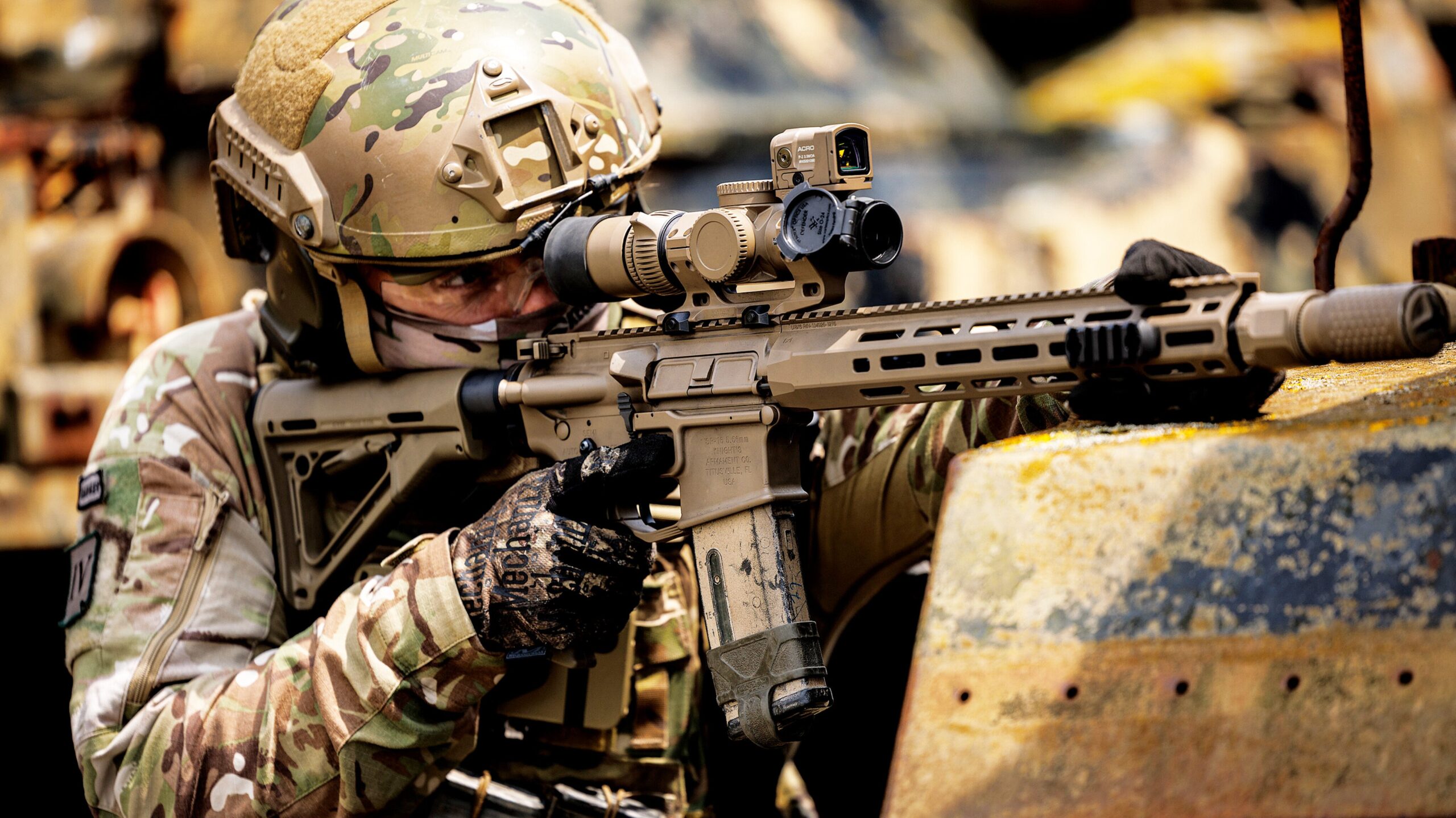

A New Era in British Small Arms – L403A1
The adoption of the L403A1 assault rifle marks a dramatic departure from British military small arms tradition and signals fundamental changes in how the United Kingdom approaches infantry weapons procurement. For decades, British forces relied on domestically designed and manufactured rifles—from the L1A1 Self-Loading Rifle through the troubled L85 family—despite persistent reliability concerns and performance limitations that compared unfavorably to weapons employed by allied forces. The decision to select an American-designed rifle manufactured under license represents acknowledgment that national pride cannot substitute for operational effectiveness when lives depend on weapon reliability.

The L403A1 designation conceals the weapon’s origins as the Knight’s Armament Company KS-1, a highly refined evolution of the AR-15/M16 platform incorporating decades of special operations experience and cutting-edge manufacturing techniques. Knight’s Armament Company, founded by legendary firearms designer C. Reed Knight Jr., has supplied specialized weapons and accessories to U.S. and allied special operations forces for decades, earning reputation for uncompromising quality, innovative design, and meticulous attention to operational requirements that separate exceptional weapons from merely adequate ones.
The rifle’s selection through Project Hunter—a comprehensive program evaluating submissions from leading international firearms manufacturers—followed rigorous testing under conditions simulating the most demanding operational environments British forces might encounter. Competitors including Heckler & Koch, SIG Sauer, and Glock submitted weapons representing their most advanced designs, yet the Knight’s Armament entry emerged victorious through superior reliability, accuracy, ergonomics, and maintainability. This competitive selection process ensures British forces receive genuinely world-class capabilities rather than weapons chosen through political considerations or institutional inertia.
Historical Context: The L85’s Troubled Legacy
Understanding the L403A1’s significance requires examining the problematic history of the weapon system it replaces. The L85A1, introduced in 1987 as the British military’s standard infantry rifle, quickly gained notoriety as one of the least reliable service rifles adopted by any major military force in the late twentieth century. The bullpup design, while offering theoretical advantages in overall length versus barrel length, introduced complexity and ergonomic challenges that plagued the weapon throughout its service life.
Initial L85A1 production rifles suffered catastrophic reliability problems. The weapons jammed frequently, particularly when exposed to sand, dirt, or moisture. Magazines failed to feed properly. Selector switches broke. Cocking handles snapped off. Sights lost zero. The litany of failures proved so severe that British forces lost confidence in their primary weapon system, creating morale problems and operational limitations during deployments to hostile environments. Soldiers reported preferring to carry sidearms or acquire alternative weapons rather than trust L85A1 rifles during combat operations.
Heckler & Koch’s extensive modification program, producing the L85A2 variant in the early 2000s, addressed many reliability concerns through comprehensive redesign of internal components, improved manufacturing quality control, and replacement of failure-prone parts. The L85A2 proved significantly more reliable than its predecessor, restoring some confidence in British small arms. However, the bullpup configuration’s inherent limitations—including poor ergonomics, difficult manipulation, awkward magazine changes, and inability to shoot from the non-dominant shoulder without modification—remained unresolved.
Special operations forces, for whom weapon reliability constitutes a life-or-death consideration rather than mere inconvenience, largely abandoned L85 family weapons in favor of alternatives. The Special Air Service, Special Boat Service, and other elite units adopted variants of the Canadian-designed Diemaco C8 (designated L119A1 in British service), a short-barreled carbine variant of the AR-15 platform offering reliability, ergonomics, and performance far superior to L85 rifles. This special operations adoption of alternative weapons highlighted the L85’s continued limitations despite improvements.
The decision to replace both the L85 family and the L119 series with a unified platform reflects modern procurement philosophy emphasizing standardization, interoperability, and logistical efficiency. Rather than maintaining multiple incompatible weapon systems across different force elements, the L403A1 adoption creates a common platform adaptable to various mission requirements through barrel length and accessory selection rather than fundamentally different weapons.
Technical Specifications and Design Features
The L403A1’s technical specifications reflect sophisticated engineering optimized for combat effectiveness, reliability, and operator confidence. Chambered in 5.56x45mm NATO—the standard small arms cartridge for NATO forces—the weapon maintains ammunition compatibility with allied militaries while delivering terminal ballistics proven adequate for most infantry engagement distances. The 5.56mm cartridge’s relatively light weight enables soldiers to carry more ammunition than larger calibers would allow, an important consideration for extended operations with limited resupply.
The rifle’s gas-operated, selective-fire mechanism allows individual shooters to select semi-automatic fire for precision engagements or fully automatic fire for suppression and close-quarters combat. The rate of fire, ranging from 700 to 900 rounds per minute in automatic mode, provides substantial suppressive capability when tactical situations demand overwhelming firepower. However, the weapon’s design and soldier training emphasize accurate, controlled fire rather than indiscriminate automatic fire that wastes ammunition and reduces accuracy.
The 16-inch barrel length in standard configuration represents careful compromise between competing requirements. Longer barrels increase muzzle velocity and extend effective range but add weight and length that complicate close-quarters maneuvering and vehicle operations. Shorter barrels enhance handling but sacrifice velocity and range. The 16-inch standard configuration proves optimal for general-purpose infantry use, though the modular design accommodates barrel swaps enabling units to configure weapons for specific mission requirements—shorter barrels for close protection or vehicle crews, longer barrels for designated marksmen requiring extended range.
Weight considerations significantly impact soldier effectiveness, as every ounce carried affects endurance during extended operations. The L403A1’s unloaded weight of 7.3 pounds positions it within acceptable parameters for modern assault rifles, though adding optics, suppressors, loaded magazines, and accessories increases practical carry weight substantially. The weapon’s relatively light weight for its capabilities reflects advanced manufacturing techniques and material selection that maintain structural integrity while minimizing unnecessary mass.
The effective firing range of 600 meters represents realistic engagement distances for 5.56mm ammunition from 16-inch barrels when employed by trained soldiers using appropriate optics. While the rifle remains capable of delivering fire at greater distances, accuracy, terminal ballistics, and hit probability degrade beyond 600 meters, making longer-range shots inefficient use of ammunition. Designated marksmen employing enhanced optics and ammunition selection can extend effective range somewhat, but truly long-range precision fire requires different weapons chambered in more powerful cartridges.
The 30-round detachable box magazine represents standard NATO small arms capacity, balancing ammunition availability against weight and bulk. The magazine’s design incorporates lessons learned from decades of combat experience, featuring enhanced feed lips, improved follower design, and corrosion-resistant coatings ensuring reliable feeding under adverse conditions. Compatibility with standard NATO magazines enables logistical flexibility and battlefield scavenging when operational circumstances demand.
Advanced Engineering: The Self-Indexing Gas System
The L403A1’s self-indexing gas system represents one of its most significant technological innovations, addressing persistent reliability challenges that have plagued gas-operated rifles since their invention. Traditional gas systems require precise timing and adjustment to function reliably across varying ammunition types, fouling conditions, and environmental factors. Improper gas system settings cause malfunctions ranging from failure to extract spent cases to violent over-cycling that accelerates wear and damages components.
Knight’s Armament Company’s self-indexing gas system automatically adjusts gas flow based on operating conditions, maintaining optimal cycling regardless of ammunition characteristics, fouling accumulation, or suppressor use. This adaptive capability eliminates manual gas system adjustments, simplifies operation, and ensures consistent reliability whether firing the first round from a clean weapon or the thousandth round from a fouled rifle in muddy conditions while employing a suppressor that increases back-pressure.
The gas-piston operating system employed in the L403A1 offers advantages over the direct impingement system used in standard M16/M4 rifles. Direct impingement channels propellant gases directly into the bolt carrier, driving the operating mechanism but also depositing combustion residue directly into the action where it accelerates fouling and increases maintenance requirements. Gas-piston systems separate propellant gas flow from the bolt carrier group, using gas pressure to drive a piston that mechanically cycles the action without introducing combustion residue into critical areas.
This separation reduces fouling accumulation in the bolt carrier group, extending intervals between required cleaning and maintenance. While gas-piston systems add slight weight and complexity compared to direct impingement designs, the reliability and reduced maintenance advantages prove worthwhile for military applications where weapons must function despite extended periods between maintenance opportunities and exposure to harsh environmental conditions.
The chrome-lined barrel extends service life by protecting the bore from erosion caused by hot propellant gases and combustion residue. Chrome lining also reduces friction and makes cleaning easier, as fouling adheres less tenaciously to chrome surfaces than bare steel. While chrome lining adds cost and complexity to manufacturing, the extended barrel life and enhanced reliability justify the investment for military weapons expected to fire tens of thousands of rounds during their service lives.
Ergonomics and Operator Interface
The fully ambidextrous lower receiver represents significant advancement over weapons designed primarily for right-handed shooters with left-handed operation as afterthought. All critical controls—including selector switches, magazine releases, bolt catches, and charging handles—can be manipulated equally effectively from either shoulder, enabling operators to transition seamlessly between shoulders based on cover, shooting positions, or injury to the primary shooting side. This ambidextrous design proves particularly valuable during urban operations where shooters must engage around both left-side and right-side cover.
The collapsible and adjustable stock accommodates operators of different statures and enables length-of-pull adjustment for shooters wearing body armor, cold weather clothing, or other equipment affecting weapon positioning. Six position adjustment provides precise fit rather than merely short and long settings, allowing individual operators to configure weapons optimally for their physique and preferences. Proper stock length dramatically affects shooting accuracy, particularly during rapid engagements where improper fit causes misalignment between eye, sights, and target.
The Picatinny rail system integrated into the upper receiver enables mounting of optical sights, laser designators, illumination devices, and other accessories essential for modern combat operations. The standardized rail interface ensures compatibility with accessories from multiple manufacturers rather than proprietary mounting systems requiring specific brand equipment. This modularity allows units to select optimal accessories for specific missions while maintaining commonality across the force.
The ability to mount under-barrel grenade launchers extends the rifle’s versatility, enabling individual soldiers to deliver explosive or illumination projectiles at ranges and precision exceeding hand-thrown grenades. This capability proves particularly valuable during urban operations or when engaging enemies in fortified positions where direct rifle fire proves ineffective. The rail system also accommodates bipods that stabilize weapons during long-range precision fire or sustained defensive positions.
Enhanced bolt carrier group design incorporating a proprietary bolt reflects decades of special operations experience identifying failure points and stress concentrations in standard AR-15 bolt designs. Knight’s Armament Company’s proprietary modifications strengthen critical areas, improve surface treatments, and optimize geometry to enhance reliability and extend component service life. These seemingly minor improvements accumulate into substantially more robust systems capable of sustained operation under conditions that would degrade lesser weapons.
Optical Systems and Fire Control
The L403A1 system includes sophisticated optical sights that dramatically enhance operator effectiveness compared to iron sights alone. The low-power variable optic provides magnification ranging from 1x to 6x or 8x depending on model selection, enabling both close-quarters rapid target acquisition and precision fire at extended ranges without switching optics. Variable magnification optics traditionally suffered from weight penalties, optical complexity, and durability concerns, but modern designs employing advanced lens coatings, robust housings, and precise adjustment mechanisms provide capabilities previously requiring multiple dedicated optics.
At 1x magnification with both eyes open, the low-power variable optic functions similarly to red dot sights, projecting the reticle onto the target plane and enabling rapid target acquisition without precise eye alignment or head positioning. This capability proves essential during close-quarters engagements where fractions of seconds determine survival. Increasing magnification enables precise shot placement at extended ranges where identifying and engaging targets with iron sights or non-magnified optics becomes extremely difficult.
The red dot sight mounted at 45-degree offset or on top of the low-power variable optic provides backup aiming capability and extremely rapid close-range engagement option. Operators can quickly cant the weapon to activate the offset red dot sight when entering close-quarters environments where the magnified optic’s field of view becomes too restricted for rapid target acquisition. This dual-optic configuration provides optimal capability across the entire engagement spectrum from room-clearing distances to precision fire beyond 500 meters.
Optical quality represents critical consideration for combat sights subjected to shock, vibration, temperature extremes, moisture, and rough handling that would destroy consumer-grade optics. Military-specification optics from manufacturers including Vortex Optics and Aimpoint undergo extensive testing validating their ability to maintain zero, resist fogging, and continue functioning despite abuse that would render lesser optics unusable. The investment in premium optics proves worthwhile when considering that weapons are only as effective as operators’ ability to accurately aim them under combat stress.
Signature Reduction and Suppressor Integration
The L403A1 system includes integrated suppressor capabilities reflecting modern military emphasis on signature reduction. Suppressors, often incorrectly called “silencers,” reduce but do not eliminate firearm discharge noise. However, the reduction proves tactically significant, lowering peak sound pressure levels from approximately 160 decibels to approximately 130-140 decibels depending on ammunition and suppressor design. This reduction moves gunfire from causing immediate permanent hearing damage to levels that, while still very loud, prove less destructive to operators’ hearing.
Beyond hearing protection, suppressors provide significant tactical advantages. Reduced sound signature makes determining shooter locations more difficult, particularly in urban environments where sound reflects and echoes, confusing auditory localization. Enemies have greater difficulty determining whether they’re under fire, from which direction fire originates, and how many shooters are present. This uncertainty degrades enemy response effectiveness and provides psychological advantage to suppressor-equipped forces.
Muzzle flash reduction represents another suppressor benefit. Unsuppressed rifles produce substantial muzzle flash visible to enemies, particularly during low-light conditions. This flash reveals shooter positions and provides aiming reference for return fire. Suppressors dramatically reduce visible flash signature, making shooters harder to detect and target. This advantage proves particularly valuable during dawn, dusk, or night operations when muzzle flash would otherwise compromise concealment.
Suppressors also reduce recoil and muzzle rise by capturing and redirecting propellant gases that would otherwise escape rapidly from the muzzle. This reduction improves shooter control during rapid fire, enabling faster follow-up shots and enhanced accuracy during automatic fire. The improved controllability proves particularly valuable for less experienced shooters or during high-stress engagements where recoil management becomes more challenging.
The self-indexing gas system’s ability to function reliably with suppressors attached addresses persistent challenges with suppressed weapons. Suppressors increase back-pressure in gas systems, potentially causing over-cycling that accelerates wear and can cause malfunctions. Traditional gas systems require adjustment when adding or removing suppressors, creating opportunities for operator error and complicating weapon manipulation. The L403A1’s adaptive gas system eliminates these concerns, functioning identically whether suppressed or unsuppressed.
Project Hunter: Competitive Selection Process
Project Hunter, the procurement program that selected the L403A1, exemplifies modern defense acquisition methodology emphasizing competitive evaluation against objective performance criteria rather than predetermined outcomes or political considerations. The program’s stated objectives included replacing aging L85 and L119 weapon systems with modern rifles offering enhanced reliability, accuracy, ergonomics, and maintainability while achieving interoperability with allied forces and reducing long-term support costs.
The competitive evaluation process subjected candidate weapons to comprehensive testing simulating operational conditions British forces might encounter. Reliability testing exposed weapons to sand, mud, water, temperature extremes, and extended firing schedules designed to reveal failure modes and maintenance requirements. Accuracy testing evaluated precision and consistency across various ranges, ammunition types, and environmental conditions. Ergonomic assessment examined control placement, manipulation speed, and operator comfort during extended use.
Knight’s Armament Company’s entry prevailed over submissions from firearms industry leaders including Heckler & Koch—ironically the company that rescued the L85A2 through extensive redesign—SIG Sauer, and Glock. This outcome validates the KS-1’s design excellence and Knight’s Armament Company’s reputation for uncompromising quality. The selection also demonstrates British military willingness to choose best available technology regardless of origin rather than prioritizing domestic industry or traditional supplier relationships.
The initial contract valued at £90 million includes 1,620 complete weapon systems comprising rifles, suppressors, optics, accessories, and training systems. This initial procurement equips priority special operations units with advanced capabilities while establishing production and support infrastructure. Options to procure up to 10,000 systems over the subsequent decade enable potential expansion to additional units based on operational experience and budget availability.
Manufacturing and Supply Chain
Edgar Brothers, a long-established UK firearms distributor and defense contractor, serves as prime contractor for L403A1 production and support. This arrangement leverages Edgar Brothers’ existing relationships with component suppliers and expertise in firearms logistics while establishing UK-based capability for weapon system assembly, quality control, and sustainment. The approach balances efficiency of utilizing established international component suppliers against desires for domestic industrial participation and supply chain security.
The weapon system comprises components from multiple specialized manufacturers, each contributing expertise in specific areas. Knight’s Armament Company provides core rifle components including receivers, barrel assemblies, bolt carrier groups, and gas systems—the fundamental elements defining weapon functionality and reliability. Vortex Optics and Aimpoint supply optical sights meeting military specifications for durability, optical performance, and environmental resistance. Magpul contributes accessories including magazines, stocks, and grips benefiting from their extensive experience in combat-proven component design.
This multi-supplier approach, while adding supply chain complexity, ensures each component represents best-in-class capability rather than compromising overall system performance to simplify logistics. The integration of components from proven suppliers also leverages existing qualification testing, reducing development risk and accelerating fielding timelines compared to designing entirely new systems.
The procurement includes comprehensive training systems enabling realistic practice without consuming service ammunition or accelerating weapon wear. Safe Blank Firing Systems use blank ammunition to simulate weapon operation during force-on-force training, providing realistic manipulation and immediate action practice without projectile hazards. Marker Round Training Systems fire paint-marking projectiles enabling realistic force-on-force exercises with hit indication while maintaining weapon handling characteristics closely approximating live ammunition.
Operational Deployment and Force Integration
Initial L403A1 deployment prioritizes special operations forces including the Special Air Service, Special Boat Service, Special Reconnaissance Regiment, and supporting elements. These elite units conduct the most demanding missions in the highest-threat environments, making weapon reliability and capability directly relevant to mission success and operator survival. Special operations forces also possess the training infrastructure and operational experience necessary to efficiently integrate new weapon systems and provide feedback informing broader force adoption.
The prioritization of special operations forces for initial equipment reflects both operational necessity and practical acquisition strategy. Special operations units require cutting-edge capabilities and can justify premium equipment costs through their strategic importance and small numerical strength. Equipping several thousand special operators proves more financially feasible than simultaneously rearming the entire British military. The phased approach also enables identifying and addressing any unforeseen issues before expanding procurement.
Royal Marines Commandos represent likely next recipients of L403A1 systems following special operations forces. The Marines conduct amphibious and expeditionary operations in austere environments where weapon reliability proves essential. Their operational profile—including beach assaults, ship boarding, and mountain warfare—demands versatile, dependable weapons functional despite exposure to saltwater, sand, and extreme temperature ranges. The L403A1’s proven reliability and modular design align well with Marine operational requirements.
Potential expansion to conventional Army units remains uncertain, depending on budget availability, operational experience with initial deployments, and political decisions regarding force-wide modernization versus maintaining legacy systems for standard infantry units. Complete rearming of British ground forces would require procuring tens of thousands of rifles at substantial cost, making budget implications significant. However, the operational advantages and long-term cost savings from reduced maintenance and enhanced effectiveness may justify investment.
The L403A1’s compatibility with weapon systems employed by American, Canadian, Australian, and other allied special operations forces enhances interoperability during coalition operations. Shared weapon platforms enable ammunition sharing, simplified logistics, and common training standards—valuable capabilities when forces from multiple nations operate together during complex missions. This interoperability consideration factored into Project Hunter evaluation criteria and represents significant strategic benefit beyond raw technical performance.
A New Standard for British Infantry Weapons
The L403A1’s adoption represents more than merely replacing worn-out rifles with modern equivalents. It signifies fundamental shift in British military small arms philosophy, acknowledging that weapon excellence requires ruthless prioritization of performance over politics, pride, or tradition. The willingness to select an American-designed rifle after decades of indigenous weapon development demonstrates maturity and pragmatism that ultimately serves soldiers better than institutionally convenient choices that perpetuate capability gaps.
For British soldiers, the L403A1 provides confidence that their primary weapon will function when needed, accurately engage threats at realistic combat distances, and prove comfortable during extended operations. This confidence cannot be overstated—soldiers cannot focus on mission accomplishment when worried about weapon reliability. The psychological benefit of carrying proven, reliable weapons enhances combat effectiveness beyond mere technical specifications.
The L403A1’s modular design and extensive accessory compatibility ensure relevance despite evolving threats and technological advancement. Rather than requiring complete weapon replacement as requirements change, the platform accommodates capability upgrades through improved optics, enhanced accessories, and optimized ammunition selection. This adaptability protects procurement investment while ensuring continued effectiveness.
As British forces continue confronting diverse threats from peer military competitors to terrorist organizations to hybrid warfare challenges, the L403A1 provides the individual weapon foundation enabling success across the entire operational spectrum. While rifles alone do not win wars, providing soldiers with reliable, effective weapons constitutes fundamental prerequisite for operational success. The L403A1 fulfills this requirement while establishing performance benchmarks that will influence British military small arms for decades to come.