

China’s naval ambitions have taken another significant leap forward with the revelation of a revolutionary new warship. Recent satellite imagery and analysis confirm the existence of a high-speed, unmanned, trimaran arsenal ship under construction at the Huangpu shipyard in Guangzhou. This “loyal wingman” vessel, which also appears to feature a semi-submersible design, is purpose-built to act as a floating missile magazine for the People’s Liberation Army Navy’s (PLAN) advanced destroyers.

The new platform represents a major tactical shift, designed to operate in tandem with manned warships like the Type 055 and Type 052D destroyers. By offloading a significant number of missiles onto this unmanned drone ship, the PLAN can massively increase the firepower and survivability of its Carrier Strike Groups (CSGs). This new vessel is not just a support craft; it is a networked, expendable, and highly lethal force multiplier that will fundamentally change the calculus of naval warfare in the Pacific.
A New Class of Warship: The Unmanned Arsenal Ship
The concept of an “arsenal ship” is not new; the U.S. Navy explored the idea in the 1990s. The core concept is a large, stealthy vessel with a minimal crew and a massive number of Vertical Launch System (VLS) cells, acting as an external magazine for a fleet. China, however, has taken this concept into the 21st century by making its version completely unmanned and incorporating a highly advanced hull design.
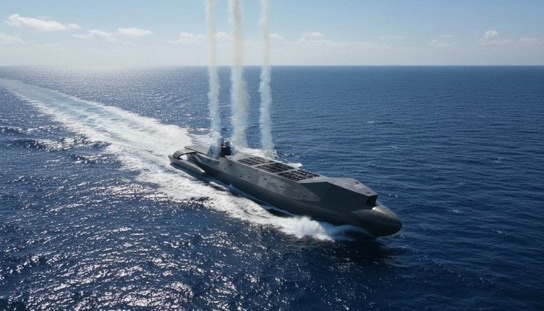
Analysis of the new 65-meter (213-foot) vessel reveals several key features that align with this mission:
• Trimaran Hull: The ship is built on a trimaran-hull design, which provides exceptional stability and high speeds, exceeding what a traditional monohull could achieve. This speed is critical for allowing the unmanned ship to keep pace with a carrier strike group’s main escorts.
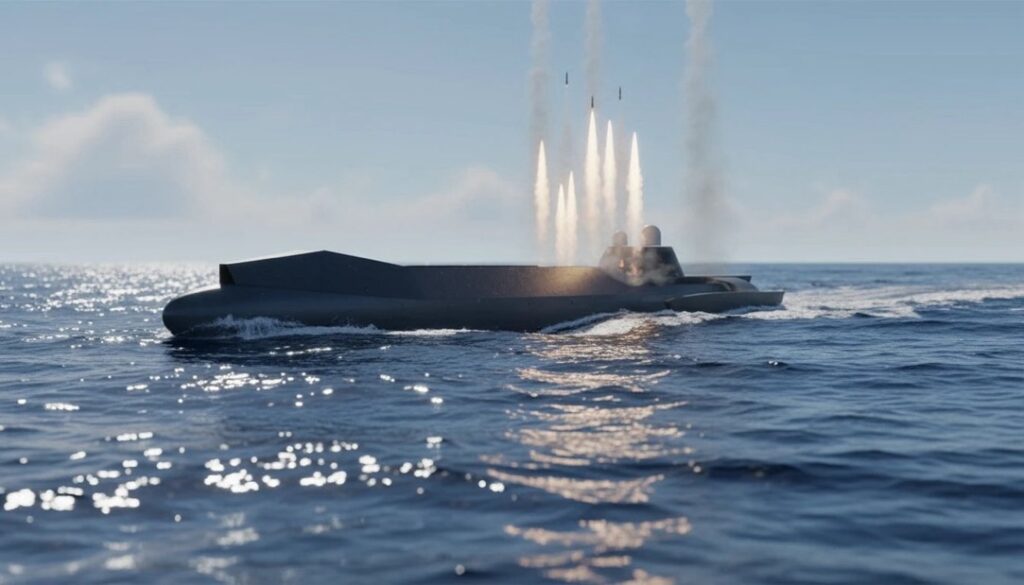
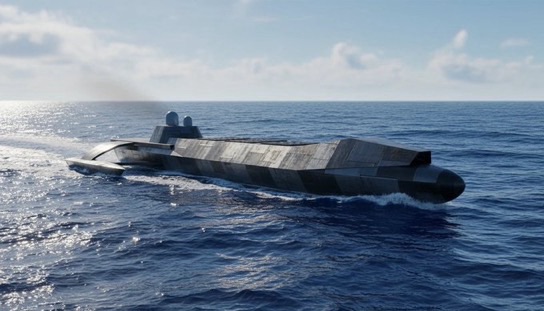
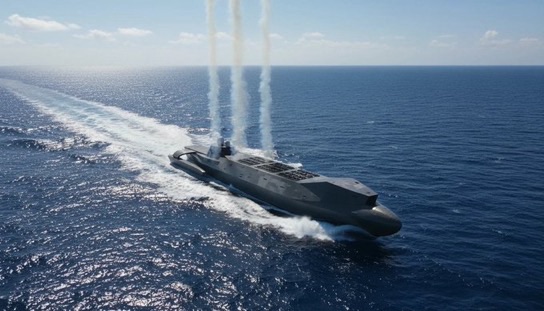
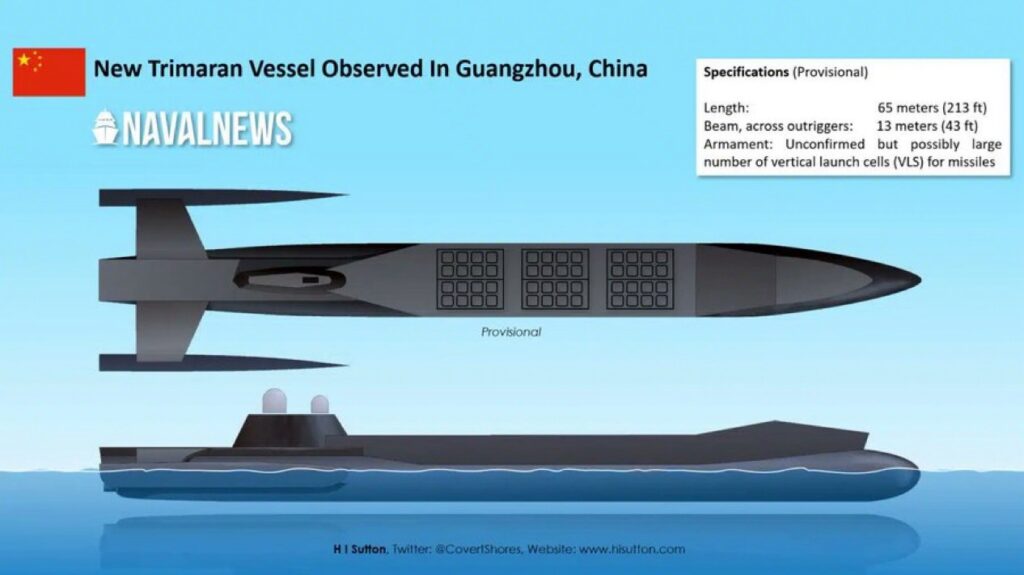
• Unmanned and Stealthy: The vessel features a very small, narrow superstructure. This indicates it is either completely uncrewed or has a minimal “skeleton crew,” allowing the vast majority of its internal volume to be dedicated to fuel and weapons. Its sleek, submarine-like contours and dark, radar-absorbent paint suggest a design heavily focused on stealth and low observability.
• Semi-Submersible Capability: The most radical feature is its semi-submersible hull. This would allow the vessel to “sink” its main body below the waterline, leaving only the small superstructure exposed. In this mode, its radar and thermal signature would be reduced to a fraction of a conventional warship’s, making it incredibly difficult to detect and target.
• Large VLS Arsenal: The long, box-like section on the forward deck is clearly a large bank of VLS cells. While the exact number is not yet confirmed, analysts speculate it could hold 48 or more missile cells. This effectively adds the firepower of an entire frigate or destroyer to the fleet without risking a single sailor.
The “Loyal Wingman” Doctrine
This vessel is the physical manifestation of the PLAN’s emerging “manned-unmanned teaming” doctrine, often called the “loyal wingman” concept. In this tactical setup, the unmanned arsenal ship does not operate independently. It is networked directly to a “parent” warship, such as a Type 055 destroyer.
The Type 055, with its world-class “Dragon Eye” phased-array radar and advanced combat management system, would act as the “eyes and brains” of the operation. It would detect and track threats, identify targets, and then “offboard” the engagement to its unmanned wingman. The arsenal ship, remaining in a stealthy, semi-submerged state, would then receive the launch command and fire its missiles.
This provides several revolutionary advantages:
1. Massively Increased Firepower: A Type 055 destroyer carries 112 VLS cells. By teaming up with one or two of these unmanned ships, a single destroyer captain could command a “distributed arsenal” of over 200 missiles, overwhelming an enemy’s defenses through sheer saturation.
2. Enhanced Survivability: The most valuable assets—the Type 055 and the aircraft carrier—can remain further back from the “high-threat” zone. The unmanned arsenal ship can be sent forward to fire the first salvos, acting as an expendable pawn. If an enemy fires back, they are wasting their most advanced munitions on a relatively low-cost, expendable drone ship, rather than on a billion-dollar destroyer with a crew of 300.
3. Tactical Deception: An enemy will be forced to target every single “blip” on their radar, unable to distinguish between the high-value manned destroyer and the low-cost unmanned arsenal ship. This complicates their targeting solution and drains their missile reserves.
A Deadly and Versatile Arsenal
The true threat of this platform lies in the weapons it will likely carry. Its VLS is almost certainly the same “universal” VLS found on the Type 055 and 052D, allowing it to be “mission-loaded” with a devastating mix of China’s most advanced missiles.
• Anti-Ship (AShM) Role: The arsenal ship would be loaded with YJ-18 supersonic anti-ship missiles and, most dangerously, the YJ-21 hypersonic “carrier killer” missile. A CSG could send these unmanned platforms ahead, creating a wide “missile screen” capable of launching multiple hypersonic attacks on an enemy fleet from over 1,500 kilometers away.
• Air Defense (SAM) Role: Alternatively, the ship could be configured as a dedicated anti-air “bodyguard” for the carrier. Loaded with dozens of the long-range HQ-9C Surface-to-Air Missile (SAM), it would dramatically expand the fleet’s defensive bubble, protecting the carrier from incoming aircraft and cruise missiles.
The emergence of this unmanned arsenal ship is a clear signal of China’s intent to dominate the seas through technological innovation. By blending stealth, unmanned systems, and overwhelming firepower, the PLAN is building a distributed, resilient, and highly lethal fleet. This “loyal wingman” is not just a new ship; it’s the forerunner of a new era in naval warfare, where manned flagships command swarms of expendable, robotic weapons platforms.