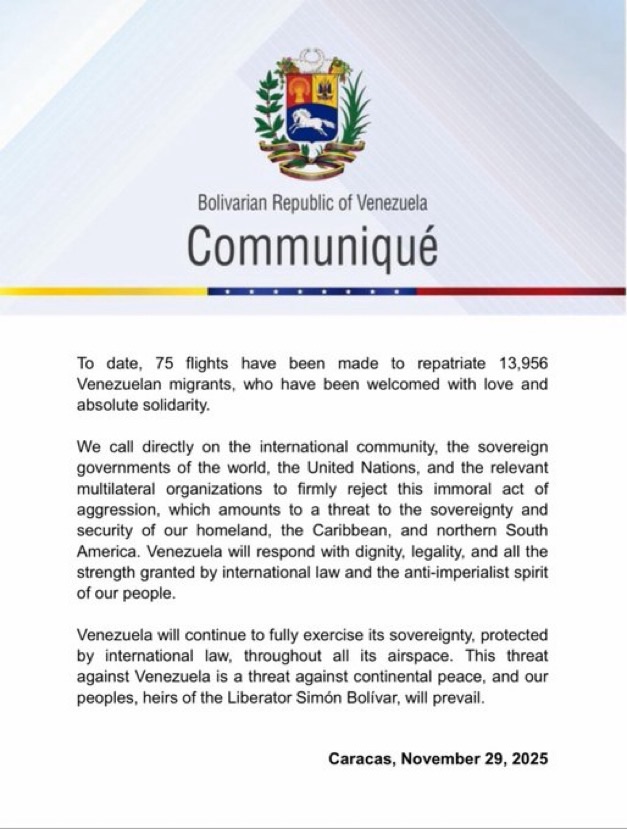

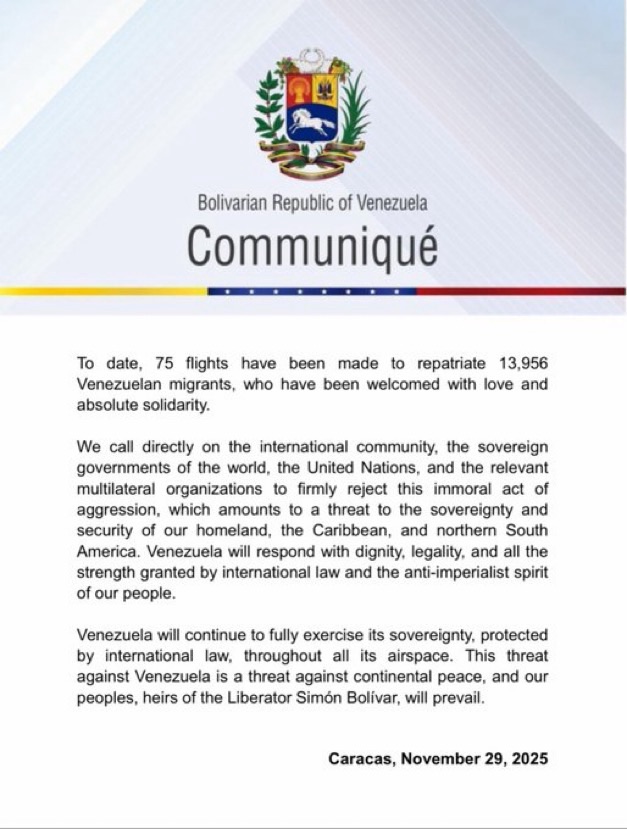
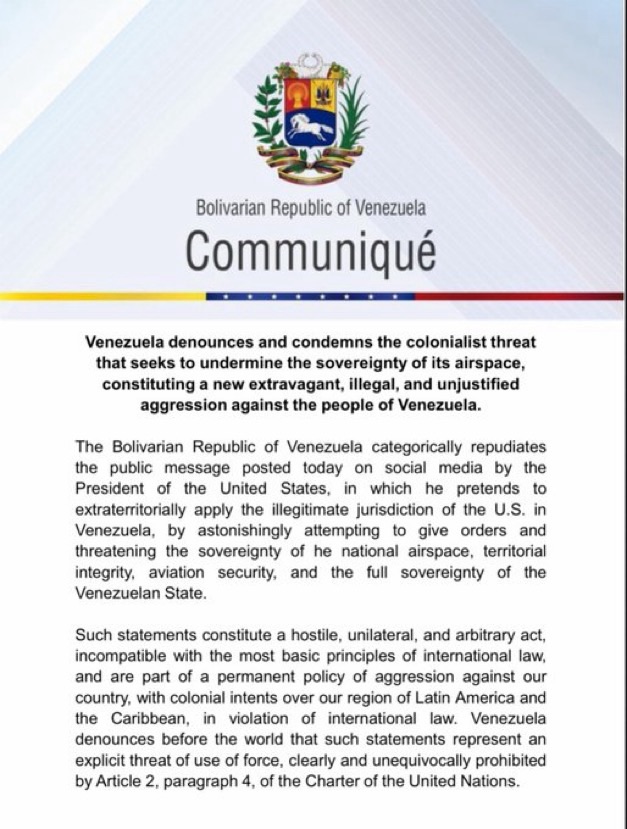
The Bolivarian Republic of Venezuela, through its Foreign Ministry, has issued a forceful and multi-layered Communiqué vehemently rejecting US President Donald J. Trump’s social media declaration that the airspace above and surrounding the nation should be considered “CLOSED IN ITS ENTIRETY.” Caracas labeled the unilateral command a “colonialist threat that seeks to undermine the sovereignty of its airspace, constituting a new extravagant, illegal, and unjustified aggression against the people of Venezuela.” The statement elevates the diplomatic crisis, framing the US action as a direct violation of international law and a hostile act against continental peace.
Asserting Sovereign Airspace Under ICAO Rules
The Venezuelan government grounded its rejection in international aviation and diplomatic law. It categorically repudiated the US attempt to apply “illegitimate jurisdiction” extraterritorially, stressing that the move explicitly threatens Venezuela’s territorial integrity, aviation security, and full sovereignty.
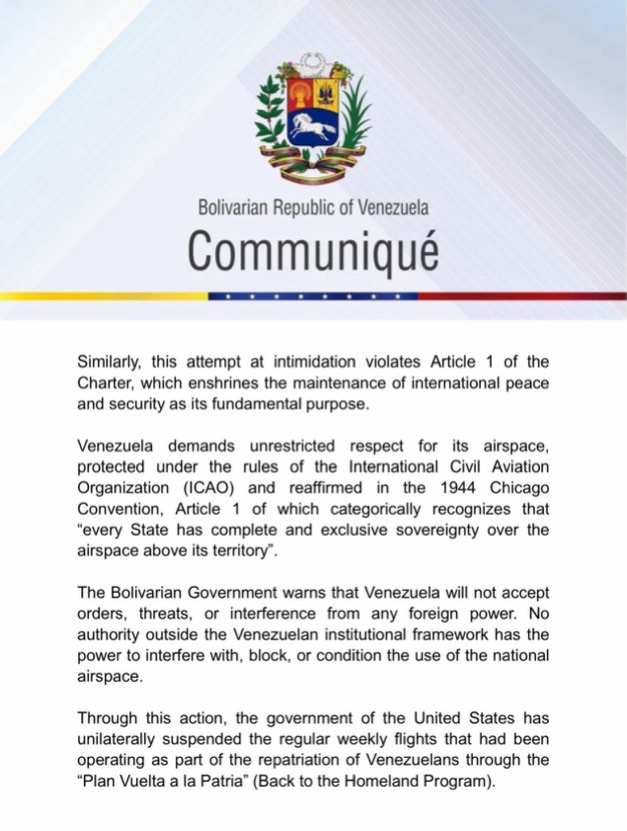
Critically, the Communiqué referenced Article 1 of the 1944 Chicago Convention, which is the foundational treaty of global civil aviation. Venezuela asserted its position that the Convention “categorically recognizes that ‘every State has complete and exclusive sovereignty over the airspace above its territory.'” By citing this international framework overseen by the International Civil Aviation Organization (ICAO), Caracas challenges the legal basis of the US President’s order, warning that it “will not accept orders, threats, or interference from any foreign power.” Venezuela pledged to “fully exercise its sovereignty… throughout all its airspace.”
Explicit Threat of Force and UN Charter Violation
Beyond the issue of airspace sovereignty, the Venezuelan Ministry of Foreign Affairs denounced the US statement as an “explicit threat of use of force,” which is unequivocally prohibited under international law. The Communiqué specifically cited Article 2, paragraph 4, of the Charter of the United Nations, which mandates that all member states refrain from the threat or use of force against the territorial integrity or political independence of any state. The government further called on the United Nations and the international community to “firmly reject this immoral act of aggression,” underscoring the serious nature of the US move.
Humanitarian Repatriation Flights Suspended
A immediate, concrete consequence of the US declaration has been the unilateral suspension of deportation and repatriation flights from the United States to Venezuela. The Communiqué highlighted that this US action has halted regular weekly flights operating under Venezuela’s humanitarian “Plan Vuelta a la Patria” (Back to the Homeland Program). To date, Venezuela stated that 75 such flights have successfully repatriated 13,956 Venezuelan migrants, making the suspension a direct blow to a vital humanitarian effort. The move suggests that the US airspace order extends beyond commercial and military advisories, directly affecting government-to-government cooperation, even in the humanitarian sphere. The escalating military and legal confrontation underscores the rapid deterioration of relations between Washington and Caracas.