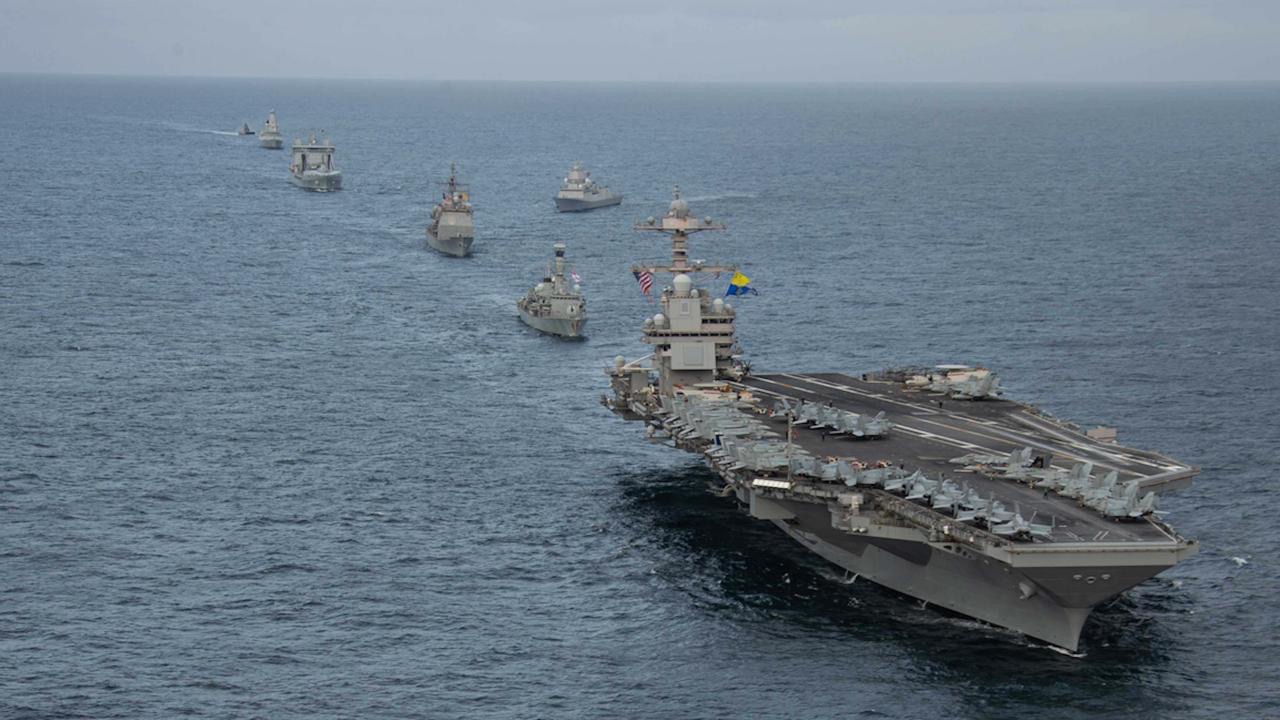

In a major escalation of U.S. military operations in the Western Hemisphere, the Pentagon has ordered the Gerald R. Ford Carrier Strike Group—the largest and most advanced warship in American history—into U.S. Southern Command’s (USSOUTHCOM) area of operations.
The deployment marks one of the most significant naval mobilizations toward Latin America in decades, signaling that Washington is taking its campaign against narco-terror networks to a new level.

The Mission
According to Pentagon officials, the Ford Strike Group’s mission is to detect, track, and dismantle cartel operations across maritime and aerial routes that span the Caribbean, the Gulf of Mexico, and the Pacific approaches to Central and South America. The carrier group’s deployment follows months of intelligence buildup and increased coordination between U.S. military and intelligence agencies, including the CIA and DEA, to combat the expanding influence of organized crime networks.
The Gerald R. Ford (CVN-78)—a nuclear-powered supercarrier equipped with F-35C Lightning II stealth fighters, E-2D Advanced Hawkeye radar aircraft, and a fleet of electronic warfare platforms—brings unmatched strike and surveillance capabilities to the theater. Operating alongside guided missile destroyers, cruisers, and submarines, the carrier’s task force will coordinate with U.S. Marines, Coast Guard, and allied regional navies.
This deployment, officials emphasize, is not symbolic. It is an operational campaign aimed at cutting off the logistics, finances, and political protection sustaining cartel networks that stretch from Venezuela and Colombia to Mexico and the U.S. border.
A Regional Escalation
The Ford Strike Group joins an already formidable force in the Caribbean and South Atlantic, including Marine Expeditionary Units in Puerto Rico, Navy P-8 Poseidon patrol aircraft, and special operations detachments conducting reconnaissance and interdiction missions against cartel-linked smuggling fleets.
Sources within USSOUTHCOM describe the move as a “globalization of the counter-cartel war.” What began as an intelligence operation has evolved into a multinational military campaign, one that also targets state actors accused of supporting or shielding narco-terror groups.
“The deployment of a carrier strike group to the south sends a clear message,” said one senior U.S. defense official. “This is no longer a regional police problem. It’s a hemispheric threat.”
Strategic Context
The decision comes as cartel-linked violence has surged across the hemisphere, with reports of transnational gangs collaborating with hostile states and militias. U.S. intelligence has pointed to increasing coordination between Venezuelan, Iranian, and Russian-linked networks, raising fears that criminal organizations could be exploited to destabilize democratic governments or traffic advanced weapons.
By assigning the Gerald R. Ford Strike Group to SOUTHCOM—traditionally a command focused on counter-narcotics and humanitarian missions—the U.S. is militarizing the anti-cartel effort in a way not seen since the 1989 invasion of Panama.
A Clear Message
With over 75 aircraft on board, advanced sensors capable of mapping entire coastlines, and strike capability extending thousands of miles, the Ford transforms the Caribbean theater into a zone of overwhelming American presence.
Its deployment is both a tactical operation and a strategic warning. To criminal networks and state sponsors alike, it signals that the United States is prepared to use full-spectrum military power to eliminate threats at their source.
As one Pentagon official put it, “The war on cartels has gone global—and this time, it’s backed by a carrier strike group.”