
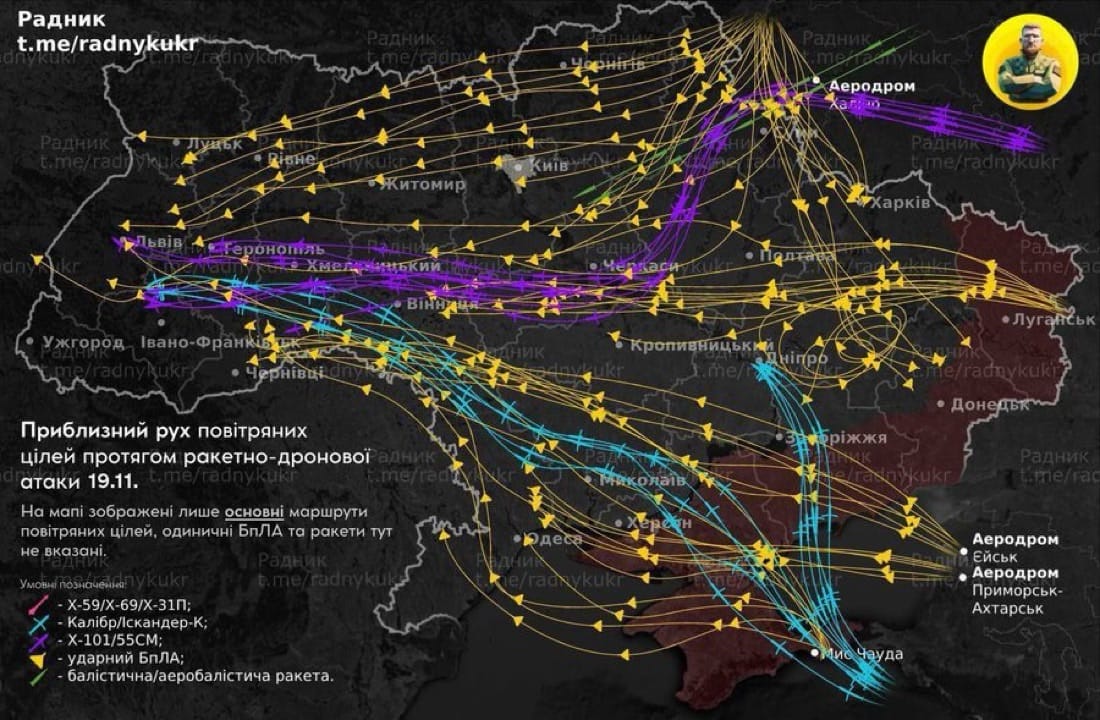

In one of the largest and most complex aerial assaults since the start of the war, Russian forces launched a massive combined missile and drone barrage overnight, heavily targeting cities in Western Ukraine. The attack, which utilized a mix of hypersonic ballistic missiles, cruise missiles, and loitering munitions, caused widespread destruction in Lviv, Ternopil, and Ivano-Frankivsk, while triggering a high-level security alert in neighboring Poland.

Ukrainian Air Force Command reported that the enemy deployed Tu-95MS strategic bombers to fire Kh-101 cruise missiles, alongside MiG-31K jets launching “Kinzhal” hypersonic aeroballistic missiles. These were synchronized with waves of Shahed-136/131 (Geran-2) attack drones designed to overwhelm air defense systems.
The consequences were immediate and severe. In Ternopil, local officials confirmed a strike on a residential high-rise building, causing significant casualties and structural collapse. In Lviv, critical energy infrastructure was hit, plunging districts into darkness and disrupting water supplies. “The scale of this attack is unprecedented for our region,” stated Lviv Regional Governor Maksym Kozytskyi, urging residents to remain in shelters as secondary waves of drones approached.
The attack’s proximity to the NATO border precipitated a dangerous international incident. The Polish Operational Command of the Armed Forces confirmed that “Polish and allied aircraft” were scrambled to protect national airspace. “Due to the massive attack by the Russian Federation using cruise missiles, ballistic missiles, and unmanned aerial vehicles… all necessary procedures to ensure the safety of Polish airspace have been activated,” the Command stated on X (formerly Twitter).
Reports indicate that the threat to Poland was not merely theoretical. Radar systems tracked several Russian drones moving dangerously close to the border, with unconfirmed reports suggesting that at least two UAVs may have briefly entered Polish airspace before turning back or being intercepted. This potential breach echoes the September 2025 incident where Russian drones entered Polish territory, further straining the already volatile relationship between Warsaw and Moscow.
This escalation comes just hours after Polish Prime Minister Donald Tusk accused Russian intelligence of orchestrating railway sabotage within Poland. The synchronization of sabotage on the ground and air strikes near the border is being viewed by analysts as a deliberate “hybrid war” signal from the Kremlin to NATO’s eastern flank.