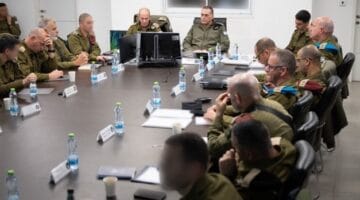

Following the breakthrough agreement reached between Israel and Hamas in Egypt, combat units of the Israeli Defense Forces (IDF) currently operating within the Gaza Strip have received orders to prepare for redeployment. This movement is the operational component of the Phase One deal, which calls for an Israeli military pullback to an agreed-upon line in exchange for the release of the remaining Israeli hostages held by Hamas.
This order to prepare for redeployment marks the most concrete and immediate military step toward implementing the initial stage of the U.S.-brokered peace plan, which was confirmed by President Donald Trump and Hamas late Wednesday.
IDF Shifts to Defensive Posture
The directive given to the combat units within Gaza is to “advance readiness” for the first part of the peace plan. This signals a transition in the military’s mission from offensive operations to a defensive, repositioning phase.
◦ Partial Withdrawal: The core military requirement of the Phase One deal is for Israel to conduct a partial withdrawal of its forces from the Gaza Strip, specifically pulling back to a predetermined “agreed upon line.” While the precise coordinates of this line have not been made public, an earlier map posted by President Trump suggested a withdrawal that would leave the IDF maintaining a presence in some border regions and a buffer zone, but clearing out of the deeply contested areas of Gaza City and other key northern and central sectors.
◦ Immediate Halt to Offensive Operations: Israeli army radio reports indicate that major offensive operations in Gaza are being reduced to the “minimum,” with troops instructed to focus only on defensive strikes. This is in direct response to the agreement and President Trump’s earlier calls for Israel to stop its heavy bombing to ensure the safe execution of the hostage release.
◦ Timeline for Action: The IDF’s redeployment is slated to be one of the very first physical steps in the implementation process. The Israeli government, led by Prime Minister Benjamin Netanyahu, is scheduled to convene on Thursday to formally approve the deal. Once approved, a senior U.S. official indicated that the IDF withdrawal to the agreed-upon line is expected to take less than 24 hours, after which the 72-hour window for Hamas to release the hostages will begin.
The Military Logic of the Withdrawal
For Israel, the initial partial withdrawal is a necessary concession to secure the immediate return of the remaining living hostages. The current Israeli presence in the Strip, estimated to cover roughly 75% of the territory, is seen as leverage in the negotiation, but its reduction is vital for allowing a viable ceasefire to take effect and for Hamas to safely move the hostages.
The withdrawal will likely be executed with extreme caution. The IDF will be focused on:
◦ Securing the New Line: Fortifying the new, agreed-upon line that will serve as the demarcation zone during the ceasefire. This line is likely designed to allow the IDF to maintain observation and security along the Israeli border.
◦ Maintaining a Buffer Zone: Reports suggest Israel will retain a military presence in key border areas, which are being converted into an expanded security buffer zone to mitigate the threat of future cross-border attacks.
Future Military Uncertainties
While the redeployment marks a significant pause in the fighting, the long-term military stance remains highly contentious.
◦ No Full Exit: The agreement is for a partial withdrawal. Israel’s Prime Minister Netanyahu has publicly maintained that Israel will retain the right to conduct targeted operations and may not agree to a full withdrawal until Hamas is completely disarmed—a point that is deferred to the next phase of negotiations.
◦ Unresolved Issues: The IDF redeployment does not resolve the complex issues of Hamas’s disarmament and the future governance of the Gaza Strip. Without an agreement on a security mechanism to prevent Hamas from rearming, the IDF is likely to maintain a posture of constant readiness along the new line.
The order for IDF units to prepare for redeployment is the strongest signal yet that the two-year war is entering its most critical transition phase, shifting focus from battlefield objectives to the painstaking political process of securing a lasting peace.
IDF Orders Gaza Redeployment in Line with Hostage and Ceasefire Agreement
Combat units of the Israeli army in the Gaza Strip have received orders to prepare for redeployment to an "agreed upon line" as part of the Phase One ceasefire deal. This initial, partial withdrawal is expected to take place within 24 hours of the Israeli government's formal approval of the agreement.