


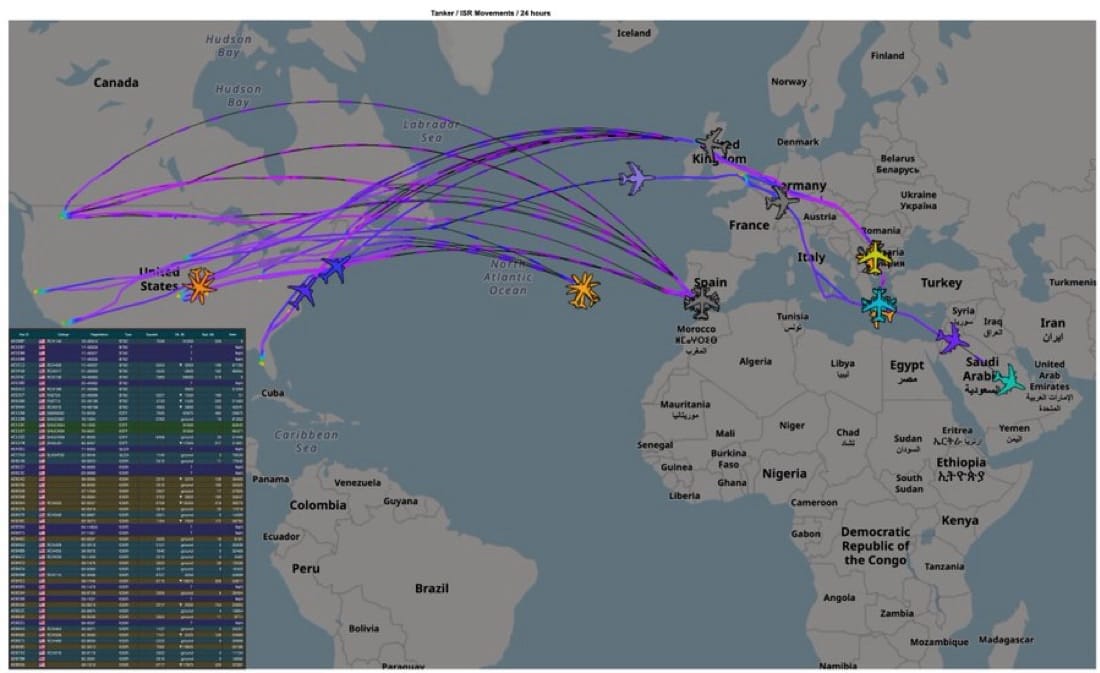
The U.S. military has executed a staggering 193 airlift flights into the Middle East, signaling a massive and rapid force buildup as the window for diplomacy with Iran appears to be slamming shut. The historic logistical surge, which involves a complex web of aerial refueling tankers, advanced fighters, and intelligence aircraft, underscores Washington’s transition from deterrence signaling to active war-footing.
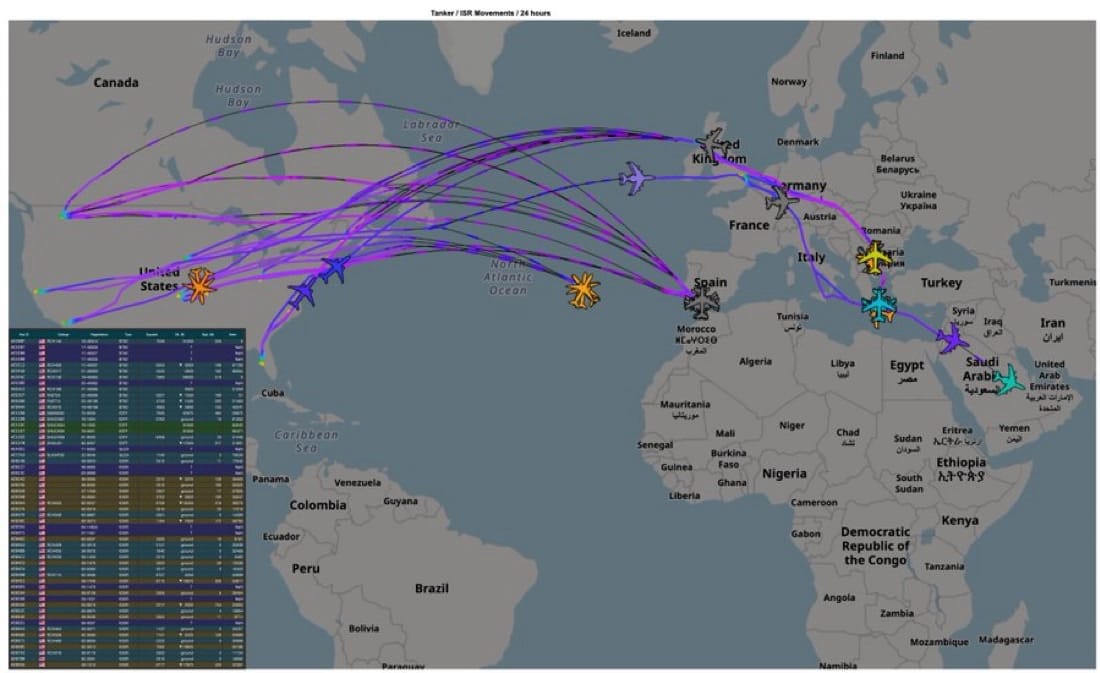
The Trans-Atlantic “Fuel Bridge”
To sustain this unprecedented movement of tactical airpower, the U.S. Air Force has repositioned 46 aerial refueling tankers to staging bases across Europe. This armada of KC-135 Stratotankers and KC-46 Pegasus aircraft is serving as a critical trans-Atlantic “fuel bridge,” dragging shorter-range fighter jets across the ocean toward the U.S. Central Command (CENTCOM) area of responsibility. As of Thursday morning, open-source trackers indicate that over 15 airlift and support flights remain actively airborne en route to the region.
Fighters Converge on Jordan and Saudi Arabia
The combat power currently being assembled represents a multi-layered strike package specifically tailored to dismantle sophisticated integrated air defense systems. Dozens of advanced fighters are actively arriving at key forward operating bases:
* Muwaffaq Salti Air Base (Jordan): Already hosting A-10s, this base is now receiving waves of F-15E Strike Eagles and F-35A Lightning II stealth fighters, positioning a formidable strike force within close range of the Iranian border.
* Prince Sultan Air Base (Saudi Arabia): Serving as a primary hub for incoming F-16 Fighting Falcons and the newly dispatched F-22 Raptors, which are tasked with spearheading any potential campaign by securing total air superiority.
The “Eyes and Ears” in the Sky
Alongside kinetic strike assets, the Pentagon is heavily reinforcing its Intelligence, Surveillance, and Reconnaissance (ISR) and Electronic Warfare (EW) capabilities. Multiple E-3 Sentry AWACS (Airborne Warning and Control System) aircraft have been deployed to the theater. These iconic radar planes will serve as airborne command posts, orchestrating complex multi-domain strike packages while simultaneously scanning Iranian airspace for retaliatory missile or drone launches.
The Missing Piece: Strategic Bombers
Despite the overwhelming influx of tactical fighters and logistical support, defense analysts are closely monitoring one glaring absence: heavy strategic bombers. As of today, there has been no confirmed deployment of B-2 Spirits or B-52 Stratofortresses to the region or forward bases like Diego Garcia. While the current fighter force—coupled with naval cruise missiles—is fully capable of initiating “Phase I” blinding and suppression operations, the eventual arrival of heavy bombers would likely serve as the final, unmistakable indicator that an attack on Iran’s deepest nuclear bunkers is imminent.