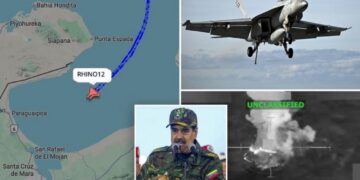


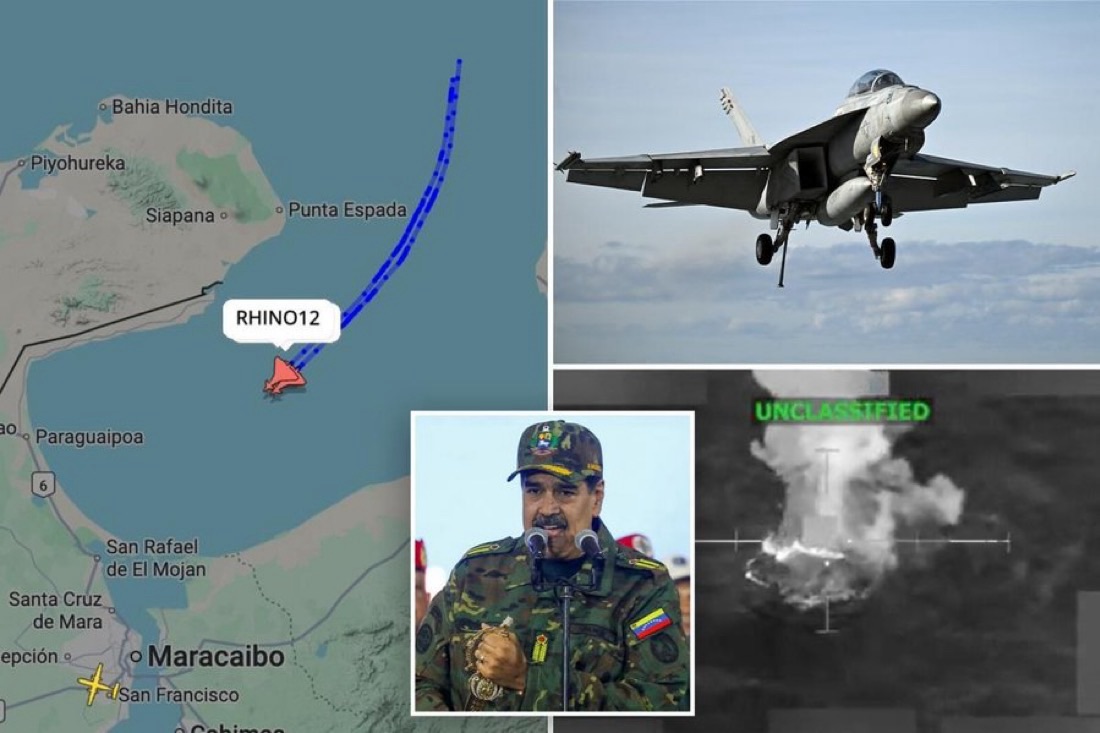
The military pressure campaign by the United States against Venezuelan President Nicolás Maduro reached a new and provocative level on Tuesday, December 9, 2025, as two U.S. Navy F/A-18 Super Hornet fighter jets conducted a prolonged mission over the Gulf of Venezuela. The flyover marks the closest known approach by US warplanes to Venezuelan territory since the start of the Trump administration’s intensified pressure campaign, sending an undeniable signal to Caracas and its foreign allies.

Probing the Limits of Sovereignty
The jets, reportedly flying with the call signs “RHINO11” and “RHINO12” and likely launched from the nearby USS Gerald R. Ford aircraft carrier, were tracked in real-time by thousands of people on public flight-monitoring websites like FlightRadar24. They flew a distinctive pattern over the narrow Gulf of Venezuela for approximately 40 minutes, circling near the oil-rich states of Zulia and Falcón, and within 100 miles of the Rafael Urdaneta Air Base in Maracaibo.
* Official Line vs. Reality: A US defense official confirmed the mission, stating the jets were conducting a “routine, lawful training flight” in international airspace. However, the Gulf of Venezuela is a body of water bounded by Venezuelan territory on three sides, and Caracas has historically claimed the entire gulf as internal waters—a claim the US has rejected for decades. The prolonged presence of the advanced fighter jets in this contested area is viewed by analysts as a deliberate, calculated act of intimidation designed to test Venezuelan military readiness and defenses.
* Previous Threats: The flyover follows a series of sharp escalations, including US President Donald Trump authorizing lethal strikes on alleged drug-smuggling vessels in the Caribbean (resulting in at least 87 fatalities since September), the issuance of FAA restrictions treating Venezuelan airspace as closed, and the explicit warning that “land attacks are coming soon” against narco-terrorist targets.
The Geopolitical Message
The deployment of the F/A-18s so close to Venezuela’s heartland delivers a powerful message to all actors in the region. The move underscores Washington’s concern that Venezuela has become a staging ground for rival powers to expand their influence in the Western Hemisphere, citing Maduro’s deepened ties with Russia, Chinese investment, and Iranian networks.
The demonstration of hard power is intended to:
* Project Reach: Remind the Maduro regime that the U.S. military has the reach and capability to penetrate the edge of Venezuelan territory at any moment.
* Test Defenses: The sorties likely served as an intelligence-gathering mission to test the response time and efficacy of Venezuela’s Russian-built air defense systems. US military analysts have repeatedly noted that while Venezuela’s military may appear threatening on paper, its forces are vulnerable and outdated and could be neutralized rapidly in a conflict.
The flyover dramatically raises the stakes, introducing a palpable risk of miscalculation. If Venezuela were to attempt to intercept or engage the US aircraft, the US could respond decisively, leading to a swift, unplanned military conflict. The mission is a clear signal that under renewed Trump leadership, the US is prepared to use military assets to defend its interests in Latin America, making the strategic rivalry feel increasingly reminiscent of the Cold War era.