

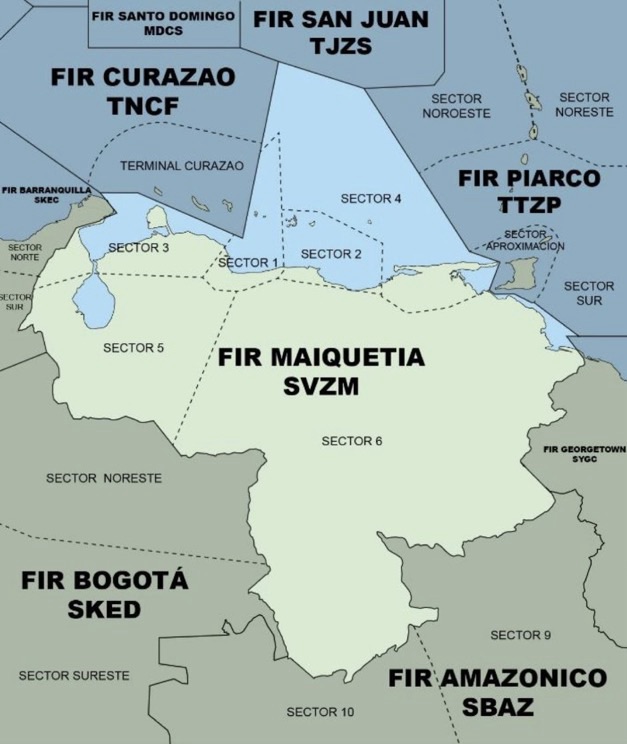
The United States Federal Aviation Administration (FAA) has issued a critical emergency warning for all civil aviation operating in or near Venezuela, signaling a potentially imminent escalation in the standoff between Washington and Caracas. In a newly released Notice to Air Missions (NOTAM A0012/25), the FAA explicitly advises operators to exercise extreme caution within the entire Maiquetía Flight Information Region (SVZM), which encompasses all of Venezuelan airspace and a significant portion of the southern Caribbean Sea.
The advisory, which went into effect on November 21, 2025, cites a “worsening security situation and heightened military activity in or around Venezuela” as the primary drivers for the alert. The language used in the notice is stark and alarming, warning that these threats “could pose a potential risk to aircraft at all altitudes, including during overflight, the arrival and departure phases of flight, and/or airports and aircraft on the ground.”

This directive effectively designates Venezuelan airspace as a high-risk conflict zone. Aviation analysts note that such comprehensive warnings—covering “all altitudes”—are typically reserved for active war zones or areas where high-performance air defense systems and military aircraft are operating without coordination with civil air traffic control. The warning is scheduled to remain active until at least February 19, 2026, suggesting that the U.S. anticipates a prolonged period of instability.

The FAA’s move comes just days after reports surfaced of a massive U.S. naval deployment to the region, including the USS Gerald R. Ford carrier strike group, ostensibly for counter-narcotics operations. Simultaneously, President Donald Trump has publicly stated he is “not ruling out” military options to address the crisis in Venezuela. The convergence of these factors—naval positioning, hostile rhetoric, and now the clearing of civilian airspace—bears a chilling resemblance to the prelude of major military interventions.
Adding to the regional tension, the FAA has also issued a parallel advisory (NOTAM A0011/25) for the neighboring San Juan Flight Information Region (TJZS), which covers Puerto Rico and surrounding waters. This secondary notice warns of “potentially hazardous situations” due to an “increase in state aircraft operations,” further confirming that the Caribbean skies are becoming crowded with military assets.


For international airlines, this notification will likely result in immediate and wide-ranging flight diversions. Carriers flying between North and South America will be forced to reroute around Venezuelan airspace, adding hours to flight times and increasing fuel costs. Politically, the move further isolates the Maduro regime, severing one of its few remaining physical links to the outside world as the threat of a kinetic conflict looms larger than ever.