
J-35 Stealth Fighter: China’s Carrier-Based 5th-Gen Jet Set for Operational Debut in 2026
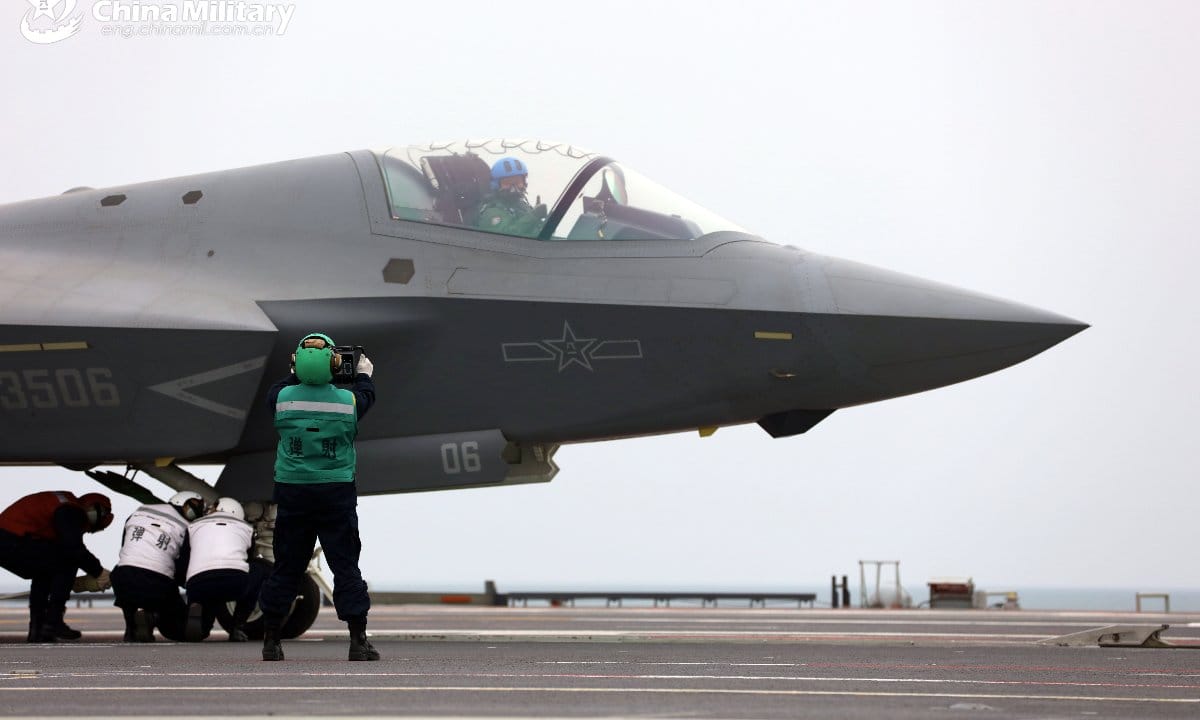
The Shenyang J-35—China’s first operational carrier-capable fifth-generation stealth fighter—is nearing full combat readiness in late 2025, with formal induction into the People’s Liberation Army Navy (PLAN) expected by mid-2026 aboard the new Fujian (Type 003) aircraft carrier. Developed in parallel with the land-based FC-31 Gyrfalcon export variant, the J-35 closes a critical capability gap for China: stealth-enabled, beyond-visual-range (BVR) air dominance over the maritime domain—directly countering U.S. F-35C deployments in the Indo-Pacific.
Origins and Evolution
Initially revealed as the FC-31 prototype (2012), the program underwent major redesigns after early flight tests exposed shortcomings in stealth shaping, engine performance, and avionics integration. The J-35 prototype (2021) marked a clean-sheet evolution:
- Wider wing area and foldable wings for carrier storage
- Reinforced landing gear and tailhook for arrested recovery
- Redesigned intakes and diverterless supersonic inlets (DSI) for lower radar cross-section (RCS)
- Twin WS-21 engines (interim) — a non-afterburning variant of the WS-13, delivering ~9,500 kgf thrust each
By 2024, the J-35A (land-based PLAAF variant) and J-35N (naval PLAN variant) were formally distinguished, with the latter undergoing intensive catapult compatibility testing at the Wuhan land-based EMALS facility.
Stealth and Signature Reduction
The J-35’s radar cross-section is estimated at 0.01–0.1 m² (frontal), placing it between the F-35 (~0.001 m²) and Su-57 (~0.5–1 m²). Key low-observable features:
- Sawtooth panel edges on weapons bay doors and access panels
- S-duct engine inlets hiding fan blades
- Radar-absorbent material (RAM) coatings on leading edges and canopy
- Internal weapons carriage only (no external pylons in stealth mode)
However, analysts note compromises: larger vertical stabilizers (for low-speed carrier control) and less refined edge alignment than the F-22 or F-35—suggesting a focus on tactical rather than strategic stealth.
Avionics and Sensors
The J-35 integrates China’s most advanced sensor fusion suite:
- Type 17 AESA radar (KLJ-7A derivative) with electronic attack (EA) modes
- Distributed Aperture System (DAS): 6 IR/EO cameras for 360° spherical awareness
- IRST (Infra-Red Search & Track) embedded in the nose cone
- Beidou-3 + SATCOM datalinks for networked operations with KJ-600 AEW&C and Type 055 destroyers
Cockpit features a large-area touchscreen display, helmet-mounted display (HMD), and AI-assisted target prioritization—similar in concept to the F-35’s HMDS.
Weapons and Payload
Internal weapons bay accommodates:
- 4 × PL-15E long-range AAMs (range: 150–200 km)
- 2 × PL-10E high-off-boresight IR missiles
- Precision-guided munitions: LS-6 glide bombs, TL-50 anti-radiation missiles
Future integration planned for:
- PL-21 ultra-long-range AAM (300+ km, ramjet-powered)
- YJ-21 anti-ship ballistic missile (air-launched variant under study)
Carrier Integration and Timeline
- 2024–2025: Over 50 carrier suitability tests at Wuhan EMALS site
- Q3 2025: First at-sea arrested landings aboard Shandong (ski-jump only—proof of concept)
- Late 2025: EMALS catapult launches from Fujian during third sea trial
- 2026: First operational squadron (believed to be PLANAF 3rd Carrier Air Wing) to form at Zhanjiang Naval Base
Export Variant: FC-31 Gyrfalcon 3.0
The export-oriented FC-31 3.0, unveiled at Zhuhai 2024, offers a stripped-down configuration:
- Single WS-19 engine (12,500 kgf, with afterburner)
- Reduced stealth (no RAM, simplified shaping)
- Open architecture for foreign weapons (e.g., MBDA Meteor)
Pakistan has signed an MoU for ~50 units; Egypt and Algeria show interest.
Strategic Implications
The J-35 transforms China’s carrier strike groups from defensive A2/AD platforms into offensive power projection forces. Paired with the Fujian and KJ-600 AWACS, it enables:
- Contested airspace penetration in the South China Sea and Western Pacific
- Suppression of Enemy Air Defenses (SEAD) against U.S. and allied bases
- Deterrence against F-35C deployments from Japan, Guam, or Australia
While it lags behind the F-35 in sensor fusion maturity and combat experience, the J-35 is a credible regional peer—and China’s fastest path to carrier-based stealth airpower. With serial production underway at Shenyang Aircraft Corporation, over 20 airframes are believed to exist as of November 2025.
J-35 Stealth Fighter: Key Specifications (2025 Estimate)
| Parameter | Specification |
|---|---|
| Role | Carrier-based air superiority / multirole |
| First Flight | October 31, 2021 (J-35 prototype) |
| Status | Advanced flight testing; IOC expected Q3 2026 |
| Length | 17.3 m |
| Wingspan | 11.5 m (13.2 m w/ folded wings) |
| Height | 4.8 m |
| Max Takeoff Weight | ~28,000 kg |
| Engines | 2 × WS-21 (interim); 2 × WS-21E (upgraded, 2027) |
| Thrust | 2 × 9,500 kgf (non-afterburning) |
| Max Speed | Mach 1.8 (estimated) |
| Combat Radius | ~1,200 km (clean, internal fuel) |
| Service Ceiling | 16,000 m |
| Stealth RCS | ~0.01–0.1 m² (frontal, estimated) |
| Avionics | Type 17 AESA, DAS, IRST, Beidou-3 datalink |
| Internal Payload | 6 missiles (4 PL-15E + 2 PL-10E) or 2,000 kg bombs |
| Unit Cost (est.) | $80–90M (domestic); $65M (FC-31 export) |