

Directed-Energy Weapons – The “Infinite Magazine” Revolution
For centuries, warfare has been defined by kinetics—the science of projectiles. From a simple arrow to a hypersonic missile, the principle has remained the same: launching a physical object to destroy a target. This entire paradigm is now being fundamentally challenged by a technology that has moved from science fiction to battlefield reality. Directed-Energy Weapons (DEWs) are no longer a futuristic concept; they are a disruptive and rapidly maturing class of military hardware poised to redefine defense and deterrence in the 21st century.

Unlike conventional munitions, DEWs do not fire projectiles. They are a broad category of systems that project concentrated electromagnetic energy at a target, damaging or destroying it at the speed of light. This technology encompasses multiple forms, primarily High-Energy Lasers (HELs) and High-Power Microwaves (HPMs). As of 2025, global powers, including the United States, China, and Russia, are in a sprint to deploy these systems. The allure is undeniable: a weapon with a “bottomless magazine,” an exceptionally low cost-per-shot, and the precision of a scalpel. This revolution is already creating a new strategic reality, one where the dominant threat—the swarm of low-cost drones—may have finally met its perfect counter.
Understanding the Core Technologies: Lasers vs. Microwaves
Directed-energy weapons are not a single technology but a spectrum of capabilities. The two primary types being operationalized today have distinct methods and applications, making them complementary tools on the modern battlefield.
1. High-Energy Lasers (HEL)
High-Energy Lasers are the “scalpel” of the DEW world. They work by focusing a single, highly concentrated beam of coherent light—often in the infrared spectrum and invisible to the naked eye—onto a target. This isn’t the explosive impact of a missile; it is a rapid, intense transfer of thermal energy.
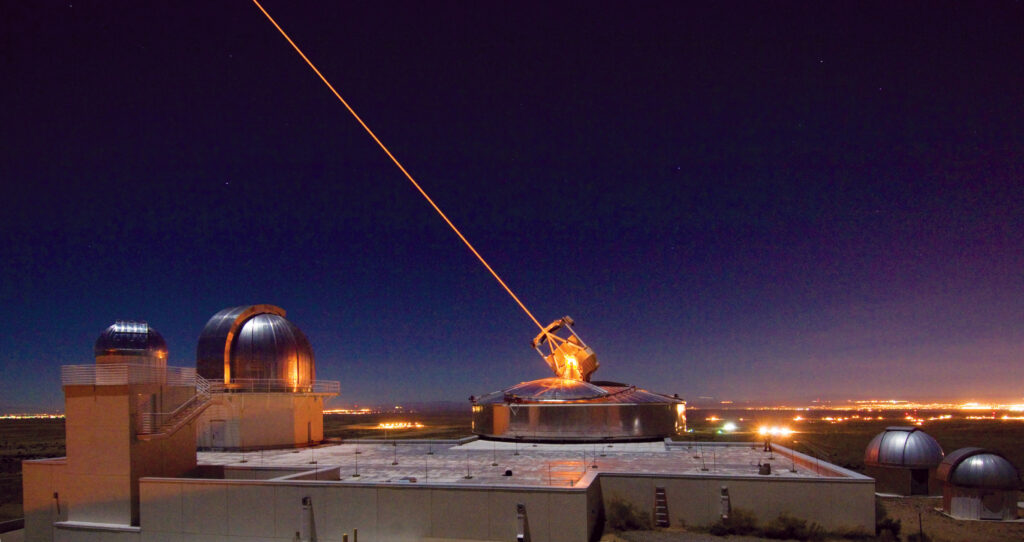
The laser beam remains on a specific spot for several seconds, causing the target’s surface to superheat, melt, and fail. An HEL doesn’t need to obliterate a drone; it simply needs to burn through a control surface, melt a sensor, or ignite its fuel tank to cause a catastrophic “hard kill.”
- Primary Role: Precision hard-kill of individual targets.
- Key Targets: Unmanned Aerial Systems (UAS), small boats, and, in increasingly powerful systems, rockets, artillery, and mortar (C-RAM) projectiles.
- Key Systems:
- U.S. Navy HELIOS: The High Energy Laser with Integrated Optical-dazzler and Surveillance system, being integrated into destroyers. It provides scalable power to dazzle (blind) enemy sensors or increase energy to destroy targets.
- U.S. Army DE M-SHORAD: The “Directed Energy Maneuver Short-Range Air Defense” is a 50-kilowatt laser mounted on a Stryker combat vehicle, designed to protect maneuvering ground forces from drones, rockets, and mortars.
2. High-Power Microwaves (HPM)
If the laser is a scalpel, the High-Power Microwave weapon is a hammer. HPMs do not burn targets; they attack their electronics. These systems blast a wide cone of intense radiofrequency energy, similar to a focused, weaponized electromagnetic pulse (EMP).
This energy couples with the internal wiring and electronic circuits of a target, inducing an overwhelming electrical voltage. This can instantly “fry” computer processors, guidance systems, and communication links, resulting in a “soft kill” where the target is rendered inert and falls from the sky.
- Primary Role: Area-effect “soft kill” against electronics.
- Key Targets: Swarms of drones (its greatest advantage), communications hubs, and guided missile electronics.
- Key Systems:
- U.S. Air Force THOR: The “Tactical High-power Operational Responder” is a system designed specifically to counter drone swarms. It can instantly disable multiple drones within its wide beam, a capability kinetic missiles cannot replicate.
- China’s HPM Systems: In 2025, China has showcased several large, truck-mounted HPM systems, signaling a strong focus on this “drone-killer” technology for area defense.
The Unprecedented Advantages Driving DEW Adoption
The global rush to field DEWs is driven by a set of revolutionary advantages that solve some of the most pressing problems in modern warfare.
- Deep Magazine and Low Cost-Per-Shot: This is the most significant tactical advantage. A conventional missile interceptor, like those used to shoot down drones, can cost hundreds of thousands or even millions of dollars per round. A laser or microwave shot, in contrast, costs only a few dollars—the price of the diesel or electricity required to generate the beam. As long as the system has power, it has a virtually unlimited magazine. This “deep magazine” is the only economically viable solution to the emerging threat of cheap, mass-produced drone swarms.
- Speed-of-Light Engagement: The energy beam travels at approximately 300,000 kilometers per second. This means there is no flight time, no “time-to-target,” and no need to lead a maneuvering target in the traditional sense. The engagement is instantaneous, making DEWs exceptionally effective against fast-moving, agile threats like drones and incoming mortars.
- Scalable Effects: Unlike a missile, which is a binary “all-or-nothing” explosive, a DEW’s power can be dialed up or down. A low-power laser can dazzle a sensor on an enemy ship or drone, temporarily blinding it without destroying it—a critical de-escalation option. If the threat persists, the operator can increase the power to full-lethal effect.
- Surgical Precision: High-energy lasers are incredibly precise, minimizing collateral damage. A laser can disable the engine on a small attack boat or neutralize a drone over a friendly area without the risk of shrapnel or a large explosion hitting unintended targets.
The Global DEW Arms Race: A 2025 Snapshot
The strategic imperative of DEWs has kicked off a quiet but intense arms race.
- United States: The U.S. is aggressively fielding prototypes across all service branches. The Army’s DE M-SHORAD and the Navy’s HELIOS are moving from experimentation to integration. The Air Force’s THOR and other HPM systems are focused on base defense. The clear U.S. priority is creating a layered, mobile defense to protect its forces and high-value assets (like ships and bases) from the drone and missile threat.
- China: China has made enormous strides and, in 2025, is showcasing a mature and diverse range of DEW systems. It has publicly revealed naval-based laser systems like the Liaoyuan-1, which it claims is more powerful than its U.S. counterparts, as well as multiple truck-mounted HPM “microwave guns.” China’s focus appears to be on both drone defense and developing offensive anti-satellite (ASAT) capabilities.
- Russia: Russia has been more secretive but claims to have operational DEWs. Its most famous system is the Peresvet, a mobile laser system that is reportedly tasked with protecting its road-mobile ICBM launchers. While its exact capabilities are unconfirmed, Russia has claimed it has anti-satellite “blinding” functions. Russia has also claimed to use a new-generation laser called “Zadira” in Ukraine to burn drones.
- Other Players: The technology is proliferating. India announced a major breakthrough in 2025 with a successful test of a 30-kilowatt laser, with plans to scale it to 100-kilowatt systems. Israel’s “Iron Beam” laser system is being developed to complement its Iron Dome missile defense, offering a cost-effective way to intercept rockets. The United Kingdom and other NATO allies are also accelerating their own DEW programs.
The Hurdles: Why DEWs Haven’t Replaced All Weapons
Despite their immense potential, DEWs face significant real-world limitations that are the focus of current research and development.
- Atmospheric Conditions: This is the greatest weakness for High-Energy Lasers. The beam is just light, and it is scattered, absorbed, and distorted by particles in the air. Rain, fog, dust, and smoke can severely degrade a laser’s power and effective range, a phenomenon known as “atmospheric bloom.” HPMs are less affected by weather but have a shorter effective range.
- Power and Cooling: Generating a high-energy beam requires an immense amount of electricity, and the process is inefficient, creating massive amounts of waste heat. Fielding these systems requires a large, dedicated power source (like a vehicle’s engine or a ship’s power plant) and a complex, heavy cooling system. This makes “man-portable” laser rifles a distant fantasy.
- Line-of-Sight: DEWs are “line-of-sight” weapons. If you cannot see the target, you cannot hit it. They cannot shoot over hills, around buildings, or engage targets beyond the horizon.
- Target Dwell Time: Unlike an explosive, a laser must remain perfectly focused on a single spot on the target for several seconds to achieve a kill. This requires an incredibly precise tracking and beam-control system, especially against a fast-moving, jinking target.
Conclusion: The Battlefield of Tomorrow is Here
Directed-Energy Weapons have breached the gap between science fiction and military doctrine. They are not a “silver bullet” that will make all other weapons obsolete. However, they represent a true military-technical revolution, offering a vital and cost-effective counter to the defining threat of 21st-century warfare: the rise of cheap, autonomous, and swarming systems. As the technology matures, power levels increase, and systems become more compact, the “zap” of a laser and the “snap” of a microwave will become as common on the battlefield as the roar of a jet engine or the crack of a rifle.