
Hypersonic Weapons – The Dawn of an “Unstoppable” Era
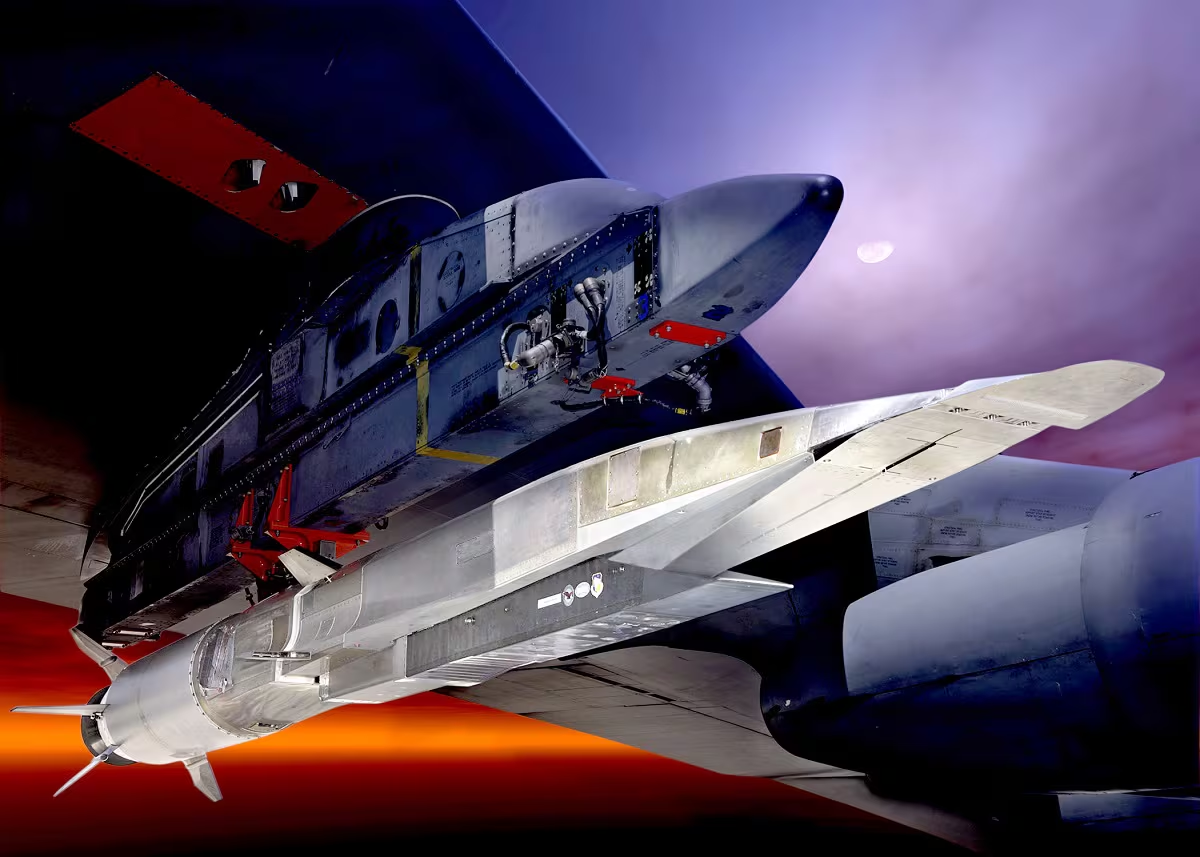
A new class of weaponry has fundamentally altered the landscape of global military strategy, sparking a high-stakes arms race among world powers. These are hypersonic weapons, a designation for systems that travel at speeds of Mach 5—five times the speed of sound—or faster. But speed alone is not what makes them a revolutionary threat. Unlike the predictable, high-arcing trajectory of an intercontinental ballistic missile (ICBM), hypersonic weapons combine this incredible velocity with sustained, unpredictable maneuverability deep within the Earth’s atmosphere.
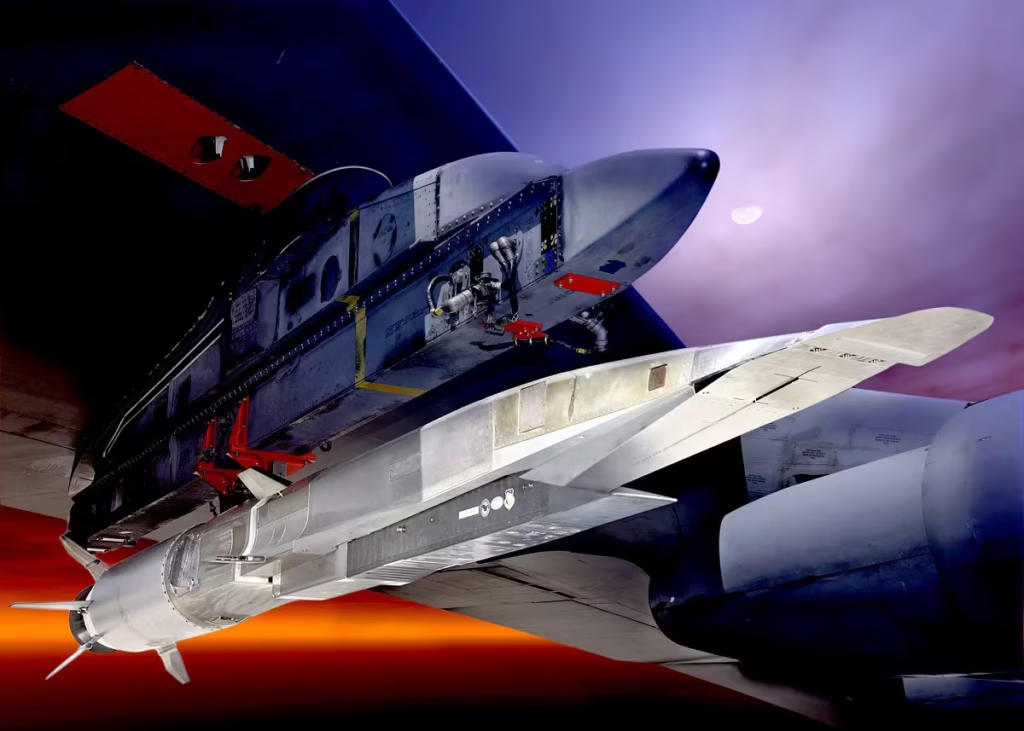
This combination is a lethal paradigm shift. It is engineered to render decades of investment in sophisticated, multi-billion-dollar missile defense systems obsolete. By flying low and fast, and by jinking and weaving mid-flight, these weapons are designed to be virtually undetectable and unstoppable, compressing a nation’s response time from 30 minutes to potentially less than five. As of 2025, this technology is no longer theoretical. It is being actively deployed by nations like Russia and China, forcing the United States and its allies into a desperate game of catch-up, and pushing the world into a new, unstable era of strategic competition.
What Makes Hypersonic Weapons a Game-Changing Threat?
To understand the hypersonic threat, one must look beyond the simple metric of speed. After all, ballistic missiles have been “hypersonic” for over 60 years, with ICBM reentry vehicles reaching speeds of Mach 20 or more. The difference lies in how and where they fly.
A traditional ballistic missile is like a cannonball shot into the sky. It launches on a high, parabolic arc that takes it into the vacuum of space. While its flight is fast, its trajectory is largely fixed and predictable by the laws of physics. This predictability is what allows early-warning satellite systems and ground-based radars to detect the launch, track its path, and calculate an intercept point.
Hypersonic weapons shatter this defensive model in three critical ways:
- Sustained Maneuverability: This is the core of the threat. A hypersonic weapon does not follow a fixed path. It can perform significant evasive maneuvers during its flight, making it impossible for defenders to predict its final target or calculate a stable intercept solution.
- Atmospheric Flight: Instead of arcing into space, these weapons fly at lower altitudes (between 20 and 80 kilometers) within the upper atmosphere. This “depressed trajectory” keeps them below the detection threshold of most traditional, space-based early-warning satellites and beneath the scanning horizon of many ground-based radars until the last moments of their flight.
- Compressed Response Time: This combination of low-altitude flight, speed, and maneuverability drastically cuts down the warning time. For a target nation, the window to detect, identify, track, and intercept an incoming strike shrinks from half an hour to a matter of minutes.
This creates a terrifying “strategic ambiguity.” Is the incoming, untrackable missile carrying a conventional warhead to strike a high-value military target, or is it a nuclear-tipped first strike? The inability to know for certain, combined with the vanishingly small window to react, could force a leader to assume the worst and escalate a conflict, potentially to a nuclear exchange, based on terrifyingly incomplete information.
The Two Pillars of Hypersonic Technology
The hypersonic threat is not monolithic. It is comprised of two distinct and technologically complex categories of weapons, each with different capabilities and missions.
1. Hypersonic Glide Vehicles (HGVs)
A Hypersonic Glide Vehicle (HGV) is an unpowered warhead that is “boosted” to extreme altitude and speed by a conventional ballistic missile rocket. Once it reaches its apogee, the HGV detaches from its booster and begins its “glide” phase, skipping along the upper atmosphere at speeds between Mach 5 and Mach 20+.
During this glide, the HGV uses its aerodynamic shape to generate lift, allowing it to “pull up” and maneuver, trade altitude for speed, and change its trajectory significantly. It can fly at a much flatter angle than a traditional reentry vehicle, extending its range and keeping it hidden from radar.
- Key Examples:
- Russia’s Avangard: Reportedly deployed and operational, Russia claims the Avangard is a strategic, nuclear-capable HGV that can “zigzag” on its way to a target, making defense impossible.
- China’s DF-ZF (DF-17): This is a medium-range HGV system deployed by China, designed specifically to strike regional targets like US military bases in the Pacific and aircraft carrier strike groups.
2. Hypersonic Cruise Missiles (HCMs)
If an HGV is a high-speed glider, a Hypersonic Cruise Missile (HCM) is a high-speed jet. This is a powered missile that flies at lower altitudes (20-40 km) for its entire flight, using a revolutionary propulsion system to sustain speeds above Mach 5.
The technological heart of the HCM is the scramjet (Supersonic Combustion Ramjet). A normal jet engine compresses incoming air before mixing it with fuel. A scramjet is an “air-breathing” engine that is so simple it has almost no moving parts. It uses the missile’s own hypersonic forward speed to forcibly compress air into its combustion chamber, where fuel is injected and ignited in a supersonic airflow. Mastering this process is incredibly complex—it has been compared to “lighting a match in a hurricane and keeping it lit.”
- Key Examples:
- Russia’s 3M22 Zircon: A ship-launched HCM that Russia claims is operational. It is designed as a “carrier-killer,” capable of striking naval targets with such speed that traditional close-in-weapon-systems (CIWS) cannot react in time.
The 2025 Global Arms Race: Who Has What
The pursuit of hypersonic dominance has become a central focus of military R&D, creating clear tiers of capability among global powers.
- Tier 1: Deployed (Russia & China)
- Russia: Russia has publicly claimed to be the global leader, not only deploying systems like the Avangard and Zircon but also being the first to use a hypersonic-designated weapon in combat (the air-launched Kinzhal missile) during its war in Ukraine. This has provided an invaluable, if grim, real-world testbed for its technology.
- China: China has conducted hundreds of hypersonic tests and has deployed systems like the DF-17. Its focus is widely seen as tactical, perfecting Anti-Access/Area Denial (A2/AD) capabilities to create a “bubble” in the Western Pacific, holding US naval and air assets at extreme risk.
- Tier 2: Developing (United States)
- The United States, despite pioneering much of the early hypersonic research, is now admittedly “playing catch-up” in terms of deployed systems. Test failures and developmental delays have pushed its first operational timelines to 2027 or later. The US focus is different: it is exclusively pursuing highly accurate, conventionally-armed hypersonic weapons, which presents a greater technical challenge.
- Key US Programs:
- Army: Long-Range Hypersonic Weapon (LRHW)
- Navy: Conventional Prompt Strike (CPS)
- Air Force: Hypersonic Attack Cruise Missile (HACM)
- Tier 3: Aspiring (The Next Wave)
- The race has expanded. India is aggressively developing its own scramjet-powered HCM under “Project Vishnu,” aiming for Mach 8.
- The AUKUS pact (Australia, UK, US) has made joint hypersonic development a key priority.
- France, Japan, North Korea, and Iran all have active research programs, fearing they will be left behind in this new military revolution.
The Race to Defend: Countering the “Unstoppable”
A weapon designed to be unstoppable has naturally triggered a frantic race to find a way to stop it. Countering hypersonic missiles is now one of the highest priorities for defense agencies, particularly in the United States.
The emerging strategy is not a single “silver bullet” but a multi-layered “kill chain” designed to track and engage the threat from “birth to death.”
- Advanced Detection (The “Sensor Layer”): Since ground-based radar is ineffective, the solution is to go to space. The US Space Development Agency (SDA) is rapidly deploying a new “Tracking and Transport Layer”—a large constellation of Low Earth Orbit (LEO) satellites. This network will provide persistent, global, “eyes-on” tracking to detect the heat signature of a hypersonic launch and follow the weapon throughout its glide path, something existing satellites cannot do.
- New Interceptors (The “Shield”): Once a threat is tracked, something must intercept it. The US Missile Defense Agency (MDA) is developing a “Glide Phase Interceptor” (GPI), a new missile designed to be launched and guided using the SDA’s satellite data to hit the HGV during its most vulnerable mid-course “glide” phase.
- Comprehensive Architecture (The “Golden Dome”): The US is also conceptualizing a new, all-encompassing defense plan known as “Golden Dome.” This initiative aims to unify all offensive and defensive capabilities—satellites, ground-based interceptors, and AI-driven command and control—into a single, integrated network capable of defeating hypersonic and ballistic threats.
Conclusion: A New Era of Strategic Instability
Hypersonic weapons are far more than just a technological marvel; they are a profoundly destabilizing force. They have shattered the long-held doctrines of missile defense and nuclear deterrence that have kept a precarious peace for half a century. The new arms race is not just about building faster missiles, but about who can see, decide, and react in a battlespace where time itself has been compressed to the breaking point. This high-speed, high-stakes competition is forcing a complete rethink of global security, arms control, and the very nature of modern warfare.