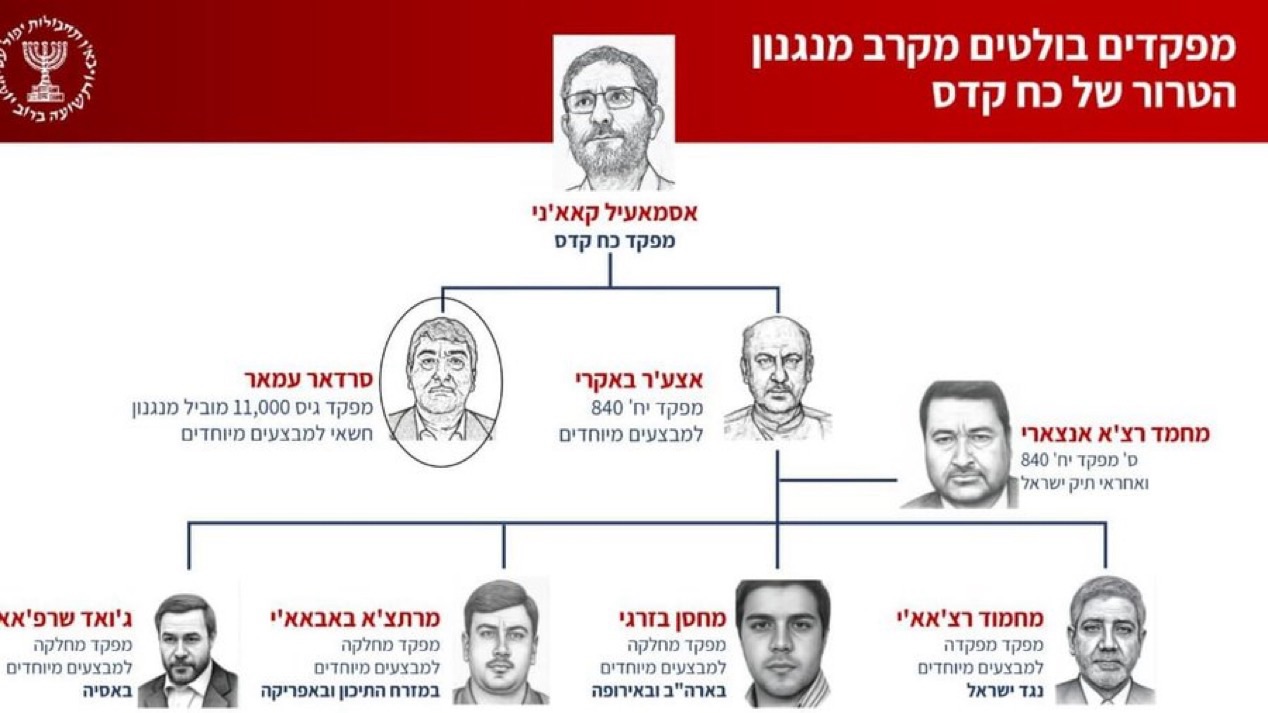

Israel’s intelligence agency, Mossad, has accused Iran’s Islamic Revolutionary Guard Corps (IRGC) of orchestrating a global terror campaign aimed at Jewish and Israeli targets in multiple countries, including Germany, Greece, and Australia. According to senior Israeli officials, the operation was directed by Sardar Ammar, a top IRGC commander operating under General Esmail Qaani, head of the elite Quds Force.

Mossad claims that Ammar’s network relied on criminal intermediaries and foreign recruits to carry out arson and bombing attacks, allowing Iran to maintain a veil of “plausible deniability.” The plots were allegedly designed to mimic spontaneous anti-Israel violence, hiding the role of Tehran’s intelligence apparatus.
However, Israeli and Western security services reportedly intercepted and neutralized dozens of planned attacks, preventing what Mossad described as a “coordinated campaign of global terror.” The thwarted operations included attempted firebombings of synagogues, Jewish community centers, and Israeli-linked businesses in Berlin, Athens, and Sydney.
The intelligence breakthrough came through joint counterterrorism cooperation between Mossad and several allied agencies, including those in Australia, Germany, and the United States. According to sources familiar with the operation, data-sharing and surveillance coordination played a crucial role in identifying the operatives and dismantling the IRGC’s covert network before it could act.
In response, Australia expelled Iran’s ambassador and announced its intention to formally designate the IRGC as a terrorist organization, a step long pushed by Israel and U.S. lawmakers. The German government summoned Tehran’s envoy after a suspect was detained for conducting reconnaissance on Jewish institutions in Berlin, a move that Berlin described as “deeply concerning and unacceptable.”
A senior Mossad official told Israeli media that the agency’s investigation has irrefutable proof of IRGC involvement, including encrypted communications, financial transfers through proxy companies, and coordination with Iranian diplomatic missions. “Iran’s game of deniability is over,” the official said. “They can no longer hide behind foreign agents and criminal cutouts.”
Mossad’s statement carried an unambiguous warning: any attack on Jewish or Israeli citizens abroad will trigger a direct response. Israeli intelligence reportedly delivered classified warnings to several Western capitals, urging heightened security around Jewish institutions and Israeli diplomatic sites.
This revelation follows a surge in Iranian-linked activity in Europe and Asia, with intelligence reports suggesting the IRGC has intensified its global shadow warfare campaign following Israel’s recent operations against Iranian assets in Syria and Iraq. Analysts believe Tehran’s leadership has increasingly turned to asymmetric and deniable operations to retaliate against Israeli and Western pressure without triggering open military confrontation.
The renewed exposure of Iran’s global reach underscores a wider pattern of state-sponsored terrorism extending beyond the Middle East, further straining Tehran’s relations with Western nations already at odds over its nuclear and missile programs.
With growing diplomatic fallout and rising calls for coordinated sanctions, Mossad’s declaration marks a new escalation in the shadow war between Israel and Iran, now spilling into the streets of Europe and beyond.