

The U.S. Navy’s Strategic Systems Programs has confirmed the successful completion of four test flights of the Trident II D5 Life Extension Program (D5LE) Submarine-Launched Ballistic Missile (SLBM). The launches were carried out from an Ohio-Class Ballistic Missile Submarine off the eastern coast of Florida between September 17 and 21. These tests are part of a planned, recurring series of events designed to evaluate and ensure the continued readiness and reliability of the nation’s sea-based nuclear deterrent.

The Trident II D5 missile system, a cornerstone of the U.S. nuclear triad, has a long history of successful launches, and these latest tests further cement its record. According to the Navy, the four successful flights bring the total number of successful test launches of the Trident II D5 Strategic Weapon System to an impressive 197 since its initial development in the 1980s. The program underwent a significant life-extension refresh in 2017 to modernize the missiles and extend their service life to the 2040s, a crucial step in maintaining a credible deterrent capability for decades to come.
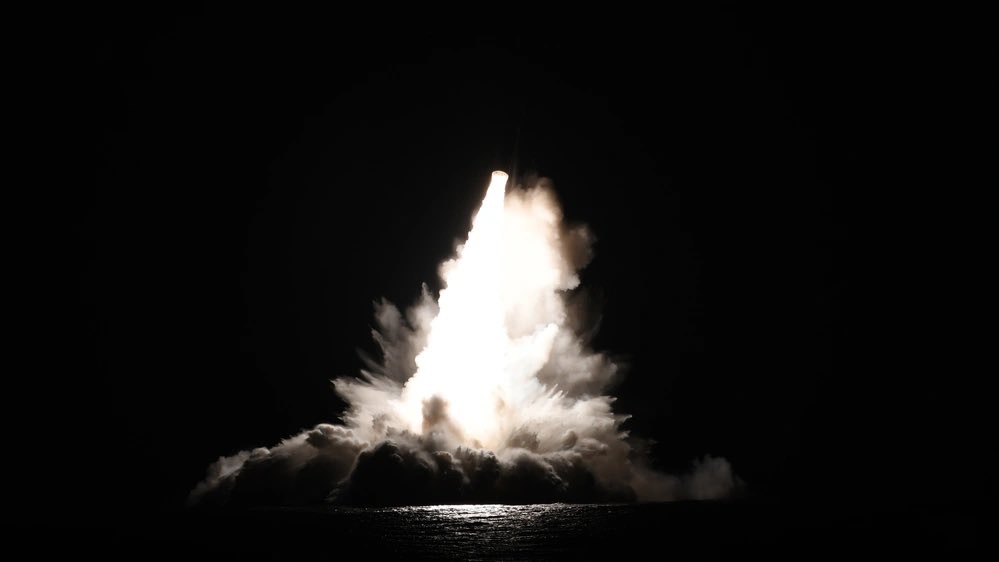
One of the test launches, which occurred on Sunday evening, was particularly notable, as the missile’s trail was visible across a vast area, including from as far away as Puerto Rico. This visibility highlights the immense power and range of the Trident II D5, which is capable of traveling a nominal range of 4,000 nautical miles. The tests are an essential part of the life-cycle support for the system, ensuring that the technology, equipment, and personnel responsible for its operation remain at the highest level of readiness. They provide critical data on the system’s performance, validating its accuracy and reliability.
The Ohio-Class submarine, from which the missiles were launched, is the backbone of the U.S. Navy’s ballistic missile submarine fleet. Each submarine is designed to carry a complement of Trident II D5 missiles, providing the most survivable leg of the nation’s nuclear deterrent triad, which also includes intercontinental ballistic missiles and nuclear-capable bombers. The ability of a submarine to remain undetected while carrying this immense destructive power ensures a second-strike capability that deters potential adversaries from a first-strike attack.
These tests, while routine in nature, serve a dual purpose: they are a technical validation of the system and a powerful public message. They demonstrate to both allies and potential adversaries that the United States is committed to maintaining a modern, reliable, and effective nuclear deterrent. The successful completion of these test flights underscores the readiness and effectiveness of the U.S. Navy’s submarine force and the ongoing commitment to the nation’s strategic defense posture.