


A new report from The Wall Street Journal reveals that last Tuesday’s Israeli airstrike against Hamas leadership in Doha, Qatar, was launched from over the Northern Red Sea, not the Persian Gulf as initially speculated. The audacious and unprecedented operation involved twelve Israeli fighter jets, including eight F-15s and four F-35s, which fired several air-launched ballistic missiles into space over Saudi Arabia before they re-entered the atmosphere to strike their target in Qatar.
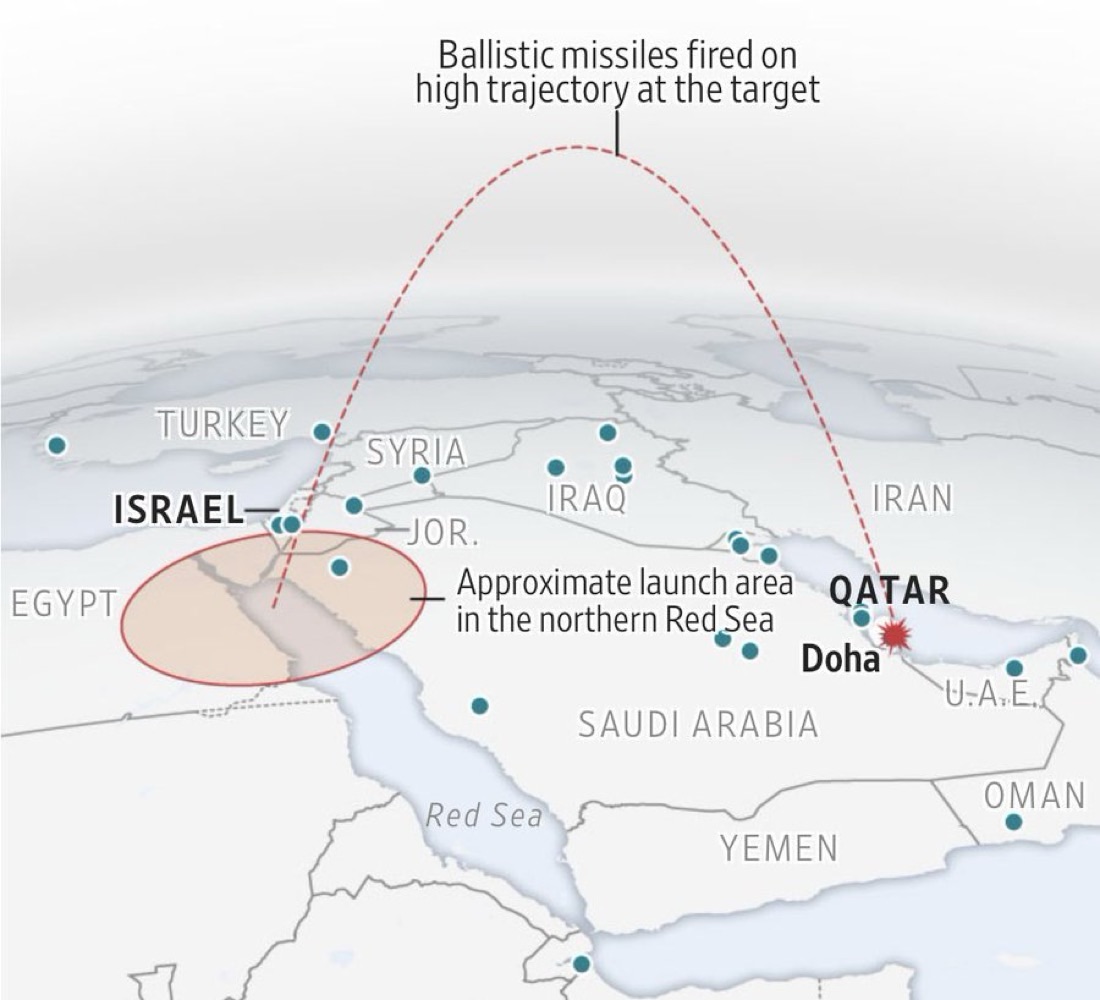
According to multiple senior U.S. officials, the operation, which was carried out with a high degree of secrecy, was only communicated to the U.S. military minutes before the missiles struck. The Israelis reportedly did not provide precise information on the target, but space-based sensors operated by the U.S. Space Force detected the infrared heat signatures and trajectory of the missiles, confirming the target as Doha. This intelligence was immediately relayed to U.S. Central Command (CENTCOM), which alerted Gen. Dan Caine, the Chairman of the Joint Chiefs of Staff.
The information was then sent to the White House, where President Trump directed Special Envoy Steve Witkoff to notify the Qataris. However, the warning came too late. According to Qatari officials, the notification arrived approximately ten minutes after the missiles had already hit the meeting site in Doha. This delay has sparked outrage in both Qatar and the United States, with both countries feeling blindsided by the Israeli action.
The strike has created a major diplomatic rift, with President Trump reportedly having a heated phone call with Israeli Prime Minister Benjamin Netanyahu. The U.S. has expressed frustration at not being consulted beforehand, warning that the action could jeopardize key diplomatic relationships and ongoing peace efforts in the region. The revelations about the strike’s launch point and its secretive nature have only added to the tension. The use of air-launched ballistic missiles that travel into space to strike a target is a highly complex and sophisticated maneuver that showcases the advanced capabilities of the Israeli military.
The incident highlights the growing chasm between the Israeli government and its U.S. allies. While the U.S. supports Israel’s war against Hamas, it has grown increasingly concerned about what it sees as unilateral actions that risk destabilizing the region. Qatar, a crucial U.S. ally and host of the largest American military base in the Middle East, has condemned the attack as a violation of its sovereignty and a threat to regional stability.