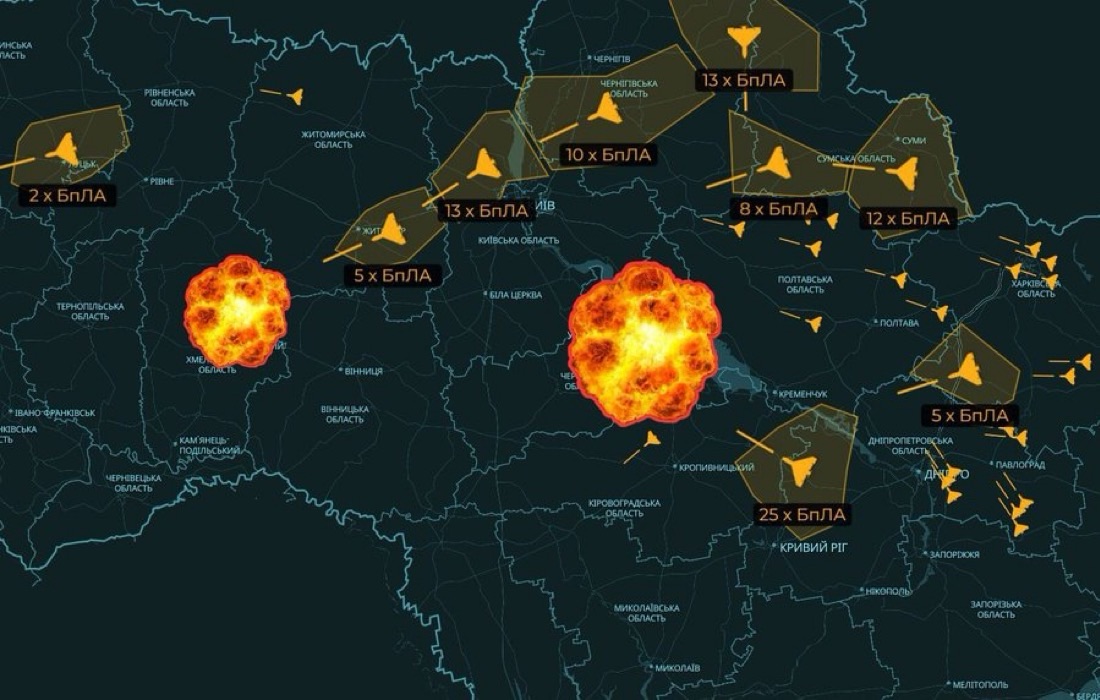

In a record-breaking aerial assault, Russia launched over 800 drones and missiles at Ukraine in the largest single-night attack of the war. The Ukrainian Air Force reported that out of 810 Shahed drones and 13 missiles launched, it shot down an impressive 747 drones and four missiles. The scale of the attack surpassed a previous record set in July when Russia launched 741 munitions in one night. Despite the high interception rate, nine missiles and 54 drones evaded Ukrainian air defenses, with impacts reported in at least 37 locations across the country.

The barrage targeted cities including Kyiv, Zaporizhzhia, Sumy, Chernihiv, Dnipro, and Odesa, causing widespread damage to residential buildings and critical infrastructure. In Kyiv, a woman and her infant were among at least two people confirmed to have been killed, with dozens more injured across the country. For the first time, a government building was confirmed to have been hit, with a fire breaking out at the Cabinet of Ministers building in central Kyiv. Ukrainian President Volodymyr Zelenskyy referred to the attack as the “largest” of the war and confirmed that it struck the Cabinet building.
The unprecedented number of drones used in the attack highlights a key strategic objective for Russia: to overwhelm and exhaust Ukraine’s layered air defense systems. The sheer volume of incoming threats, often launched in combination with cruise and ballistic missiles, is designed to saturate air defenses and allow a number of them to get through. Ukraine’s air defense strategy, which includes a mix of advanced missile systems like the Patriot, as well as cost-effective mobile fire teams with machine guns, is being continuously tested by these mass attacks.
The ongoing “drone wars” have also led to a technological arms race, with Russia reportedly modifying its Shahed drones to include jet engines for increased speed, onboard cameras for live reconnaissance, and remote piloting capabilities. The Ukrainian military has been adapting its defenses in response, but the latest attack underscores the ongoing challenges of countering a high-volume, low-cost threat. The massive assault has reignited calls from Ukraine’s leaders for more air defense assistance from Western partners, as the country braces for the possibility of even larger attacks in the future.